Xu Qiaohua, Zhou Maigeng, Yin Peng, Jin Donghui
Department of Chronic Disease Control and Prevention, Hunan Provincial Center for Disease Control and Prevention, Changsha, China.
National Center for Chronic and Non-communicable Disease Control and Prevention, Chinese Center for Disease Control and Prevention, Beijing, China.
Heliyon. 2023 Feb 2;9(2):e13432. doi: 10.1016/j.heliyon.2023.e13432. eCollection 2023 Feb.
In China, there are few studies that have reported future estimations for cancer mortality. Therefore, this study aimed to assess cancer mortality in China and identify priorities for future cancer control strategies.
Based on the Global Burden of Disease 2019 study, we extracted data on cancer-related deaths from 1990 to 2019 in Hunan Province, China. Under the current trends evaluated using a joinpoint regression model, we fitted a linear regression model for cancer mortality projections by 2025.
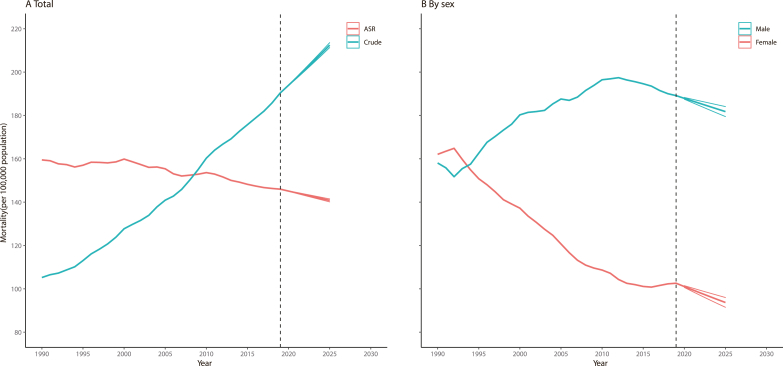
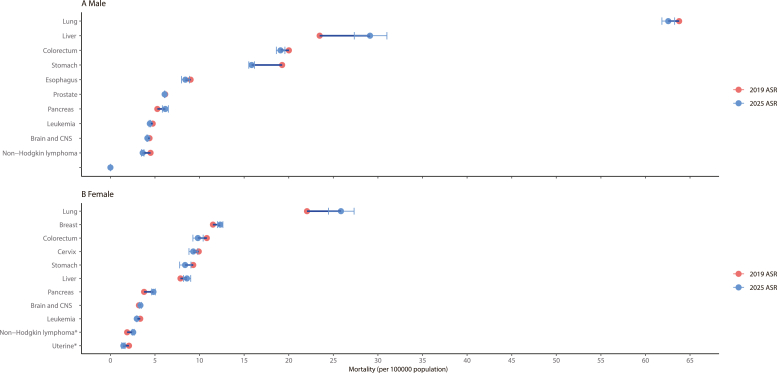
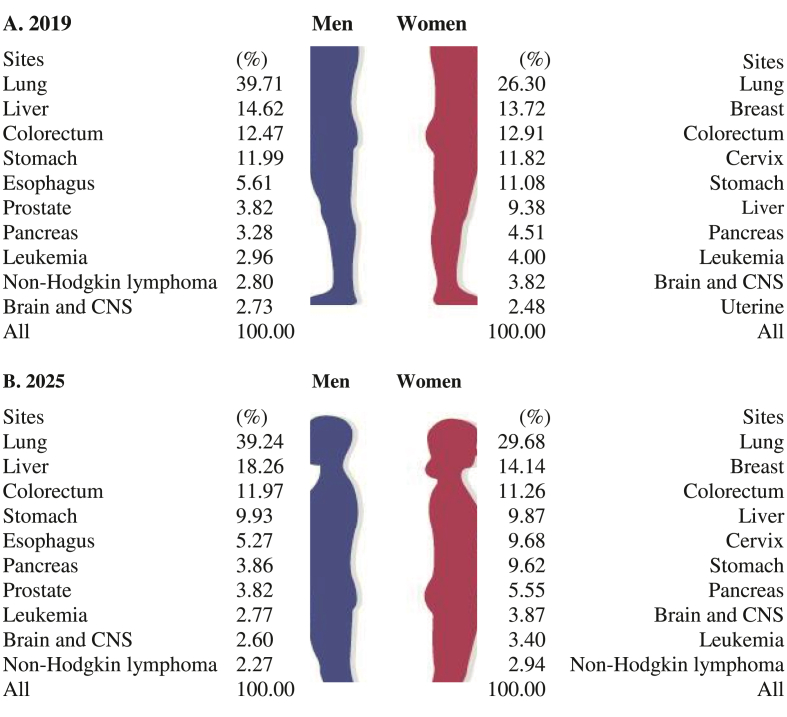
The age-standardized mortality rate of total cancer in Hunan, China, declined slowly and is projected to be 140.80 (95% confidence interval [CI]: 140.12-141.48) by 2025, with the mortality rate in men approximately twice that in women. In 2025, the top five causes of cancer-related deaths in males are projected to be lung, liver, colorectal, stomach, and esophageal cancers, with the corresponding causes in females being lung, breast, colorectal, liver, and cervical cancers. Between 2019 and 2025, male mortality rates due to liver and pancreatic cancer are expected to increase, while those due to the six leading female cancers will increase. Excess male deaths were associated with liver and esophageal cancers, while all main cancers in females will have excess mortality, except for colorectal cancer.
A comprehensive cancer spectrum characteristic of both developing and developed countries will remain in Hunan, China. Lung cancer remains the most common cause of cancer-related deaths, and tobacco control efforts are urgently required. Additional efforts should be made to promote universal screening, improve access to cancer healthcare services, optimize medical payment models, and enhance access to valuable anticancer drugs.
在中国,很少有研究报告癌症死亡率的未来估计。因此,本研究旨在评估中国的癌症死亡率,并确定未来癌症控制策略的重点。
基于《2019年全球疾病负担》研究,我们提取了中国湖南省1990年至2019年与癌症相关死亡的数据。在使用连接点回归模型评估的当前趋势下,我们拟合了一个线性回归模型以预测到2025年的癌症死亡率。
中国湖南省所有癌症的年龄标准化死亡率缓慢下降,预计到2025年将达到140.80(95%置信区间[CI]:140.12 - 141.48),男性死亡率约为女性的两倍。预计2025年男性癌症相关死亡的前五位原因是肺癌、肝癌、结直肠癌、胃癌和食管癌,女性相应的原因是肺癌、乳腺癌、结直肠癌、肝癌和宫颈癌。在2019年至2025年期间,预计男性因肝癌和胰腺癌导致的死亡率将上升,而女性六种主要癌症导致的死亡率将上升。男性超额死亡与肝癌和食管癌相关,而女性除结直肠癌外的所有主要癌症都将出现超额死亡率。
中国湖南省将保留发展中国家和发达国家共有的综合癌症谱特征。肺癌仍然是癌症相关死亡的最常见原因,迫切需要开展控烟工作。应进一步努力推广普遍筛查、改善癌症医疗服务的可及性、优化医疗支付模式以及增加获得有价值抗癌药物的机会。