Instituto Tecnológico de Aeronáutica (ITA), Laboratório de Plasma e Processos (LPP), São José dos Campos, Brasil.
Universidade de São Paulo, Faculdade de Odontologia de Bauru, Departamento de Prótese e Periodontia, Bauru, SP, Brasil.
J Appl Oral Sci. 2023 Feb 20;31:e20220421. doi: 10.1590/1678-7757-2022-0421. eCollection 2023.
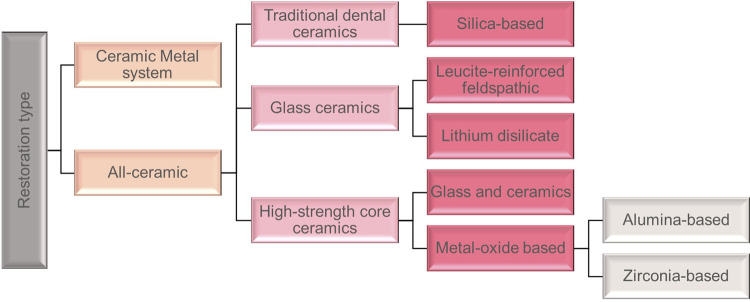
The demands for dental materials continue to grow, driven by the desire to reach a better performance than currently achieved by the available materials. In the dental restorative ceramic field, the structures evolved from the metal-ceramic systems to highly translucent multilayered zirconia, aiming not only for tailored mechanical properties but also for the aesthetics to mimic natural teeth. Ceramics are widely used in prosthetic dentistry due to their attractive clinical properties, including high strength, biocompatibility, chemical stability, and a good combination of optical properties. Metal-ceramics type has always been the golden standard of dental reconstruction. However, this system lacks aesthetic aspects. For this reason, efforts are made to develop materials that met both the mechanical features necessary for the safe performance of the restoration as well as the aesthetic aspects, aiming for a beautiful smile. In this field, glass and high-strength core ceramics have been highly investigated for applications in dental restoration due to their excellent combination of mechanical properties and translucency. However, since these are recent materials when compared with the metal-ceramic system, many studies are still required to guarantee the quality and longevity of these systems. Therefore, a background on available dental materials properties is a starting point to provoke a discussion on the development of potential alternatives to rehabilitate lost hard and soft tissue structures with ceramic-based tooth and implant-supported reconstructions. This review aims to bring the most recent materials research of the two major categories of ceramic restorations: ceramic-metal system and all-ceramic restorations. The practical aspects are herein presented regarding the evolution and development of materials, technologies applications, strength, color, and aesthetics. A trend was observed to use high-strength core ceramics type due to their ability to be manufactured by CAD/CAM technology. In addition, the impacts of COVID-19 on the market of dental restorative ceramics are presented.
牙科材料的需求不断增长,这是因为人们希望获得比现有材料更好的性能。在牙科修复陶瓷领域,结构从金属陶瓷系统发展为高度半透明的多层氧化锆,不仅旨在获得定制的机械性能,还旨在模仿天然牙齿的美学效果。陶瓷由于其吸引人的临床特性,如高强度、生物相容性、化学稳定性和良好的光学性能,在修复体中得到广泛应用。金属陶瓷一直是牙科重建的金标准。然而,这种系统缺乏美学方面。出于这个原因,人们努力开发既能满足修复体安全性能所需的机械特性,又能满足美学要求的材料,旨在实现美丽的笑容。在这一领域,由于其机械性能和半透明度的优异结合,玻璃和高强度核陶瓷已被高度研究用于牙科修复。然而,与金属陶瓷系统相比,由于这些材料是最近才出现的,因此仍然需要进行许多研究来保证这些系统的质量和耐久性。因此,了解现有牙科材料的性能是讨论开发潜在替代材料以修复陶瓷基牙和种植体支持的重建中丢失的硬组织和软组织结构的起点。本综述旨在介绍两种主要陶瓷修复体的最新材料研究:陶瓷-金属系统和全陶瓷修复体。本文介绍了材料、技术应用、强度、颜色和美学方面的发展和演变的实际方面。观察到一种趋势是使用高强度核陶瓷类型,因为它们能够通过 CAD/CAM 技术制造。此外,还介绍了 COVID-19 对牙科修复陶瓷市场的影响。