Namlı Zeynep, Tamam Lut, Demirkol Mehmet Emin, Karaytuğ Mahmut Onur, Yeşiloğlu Caner, Uğur Kerim
Medical School, Department of Psychiatry, Çukurova University, 01330 Adana, Turkey.
Department of Psychiatry, Ahi Evran University, 40100 Kırşehir, Turkey.
Behav Sci (Basel). 2023 Jan 22;13(2):91. doi: 10.3390/bs13020091.
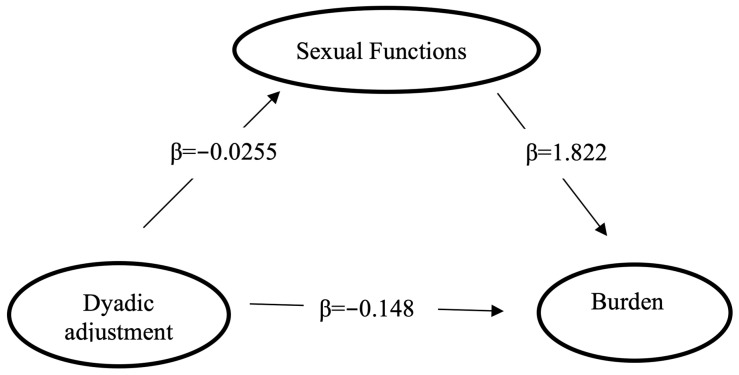
(1) Background: Spouses of individuals with bipolar disorder (BD) experience significant burdens, and the perception of the burden may affect dyadic adjustment. We aimed to investigate the sexual functions, alexithymic traits, marital satisfaction, and burden in patients with BD and their spouses. We also aimed to assess the mediating role of sexual functions and alexithymia in the relationship between burden and dyadic adjustment. (2) Methods: We included 81 patients with BD type 1 (40.69 ± 8.55 years, 65.4% female, and 34.6% male) and their healthy spouses (40.95 ± 7.30 years, 34.6% female, and 65.4% male) and 78 healthy controls (38.90 ± 5.88, 48.7% female, and 51.3% male). The participants were evaluated using the Golombok-Rust Inventory of Sexual Satisfaction (GRISS), Dyadic Adjustment Scale (DAS), Hamilton Depression Rating Scale (HDRS), Toronto Alexithymia Scale-20 (TAS-20), and Burden Assessment Scale (BAS). (3) Results: The GRISS scores of the control group were significantly lower than the spouses and BD groups. The DAS total score of the control group was significantly higher than that of the spouses and BD groups. Regression analyses revealed that TAS, GRISS, and HDRS scores were associated with DAS scores in the BD group. In the spouse group, TAS and BAS scores were associated with DAS scores. The GRISS scores partially mediated the relationship between dyadic adjustment and burden in the spouses of patients with BD. (4) Conclusions: Mental health professionals should regularly scan caregivers' perceptions of burden. Appropriate psychosocial interventions could help spouses of patients with BD to cope better with the burden and improve dyadic adjustment.
(1) 背景:双相情感障碍(BD)患者的配偶承受着巨大负担,而对负担的认知可能会影响二元关系的调适。我们旨在调查BD患者及其配偶的性功能、述情障碍特质、婚姻满意度和负担情况。我们还旨在评估性功能和述情障碍在负担与二元关系调适之间关系中的中介作用。(2) 方法:我们纳入了81例1型BD患者(年龄40.69±8.55岁,女性占65.4%,男性占34.6%)及其健康配偶(年龄40.95±7.30岁,女性占34.6%,男性占65.4%)以及78名健康对照者(年龄38.90±5.88岁,女性占48.7%,男性占51.3%)。使用戈洛姆贝克 - 拉斯特性满意度量表(GRISS)、二元关系调适量表(DAS)、汉密尔顿抑郁评定量表(HDRS)、多伦多述情障碍量表 - 20(TAS - 20)和负担评估量表(BAS)对参与者进行评估。(3) 结果:对照组的GRISS得分显著低于配偶组和BD患者组。对照组的DAS总分显著高于配偶组和BD患者组。回归分析显示,BD患者组中TAS、GRISS和HDRS得分与DAS得分相关。在配偶组中,TAS和BAS得分与DAS得分相关。GRISS得分部分中介了BD患者配偶二元关系调适与负担之间的关系。(4) 结论:心理健康专业人员应定期审视照顾者对负担的认知。适当的心理社会干预可以帮助BD患者的配偶更好地应对负担并改善二元关系调适。