Marcucci Gemma, Domazetovic Vladana, Nediani Chiara, Ruzzolini Jessica, Favre Claudio, Brandi Maria Luisa
Department of Experimental and Clinical Biomedical Sciences, University of Florence, 50134 Florence, Italy.
Department of Paediatric Haematology-Oncology, Meyer Children's Hospital IRCCS, 50139 Florence, Italy.
Antioxidants (Basel). 2023 Feb 3;12(2):373. doi: 10.3390/antiox12020373.
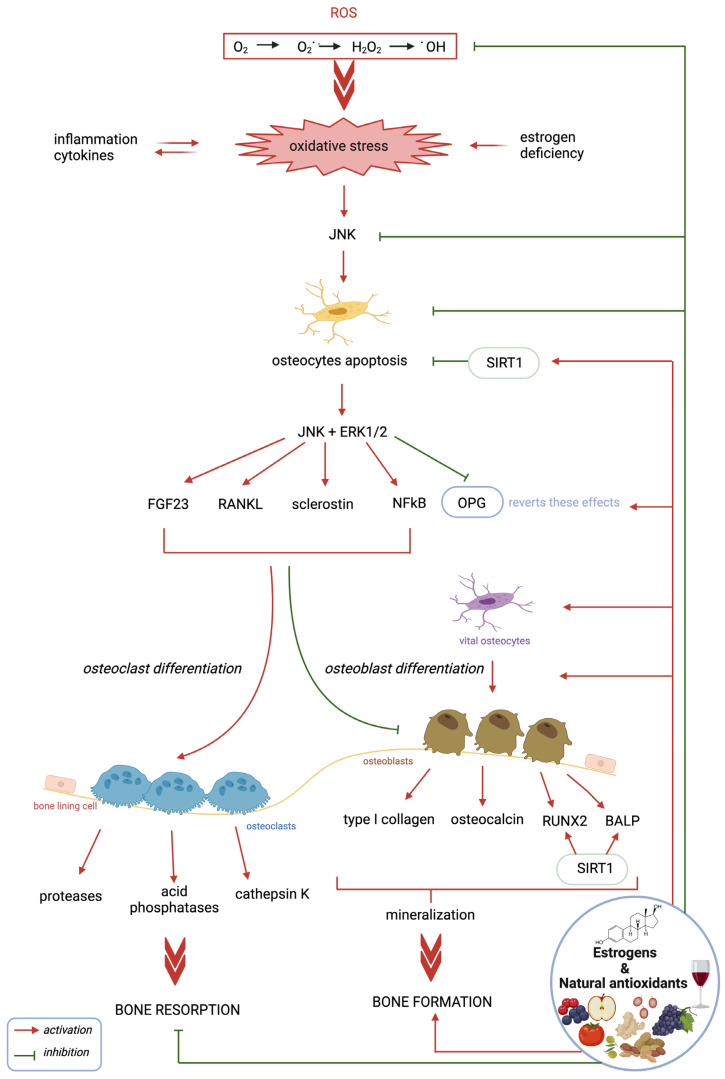
This review reports in detail the cellular and molecular mechanisms which regulate the bone remodeling process in relation to oxidative stress (OS), inflammatory factors, and estrogen deficiency. OS is considered an important pathogenic factor of osteoporosis, inducing osteocyte apoptosis and varying levels of specific factors, such as receptor activator κB ligand (RANKL), sclerostin, and, according to recent evidence, fibroblast growth factor 23, with consequent impairment of bone remodeling and high bone resorption. Bone loss increases the risk of fragility fractures, and the most commonly used treatments are antiresorptive drugs, followed by anabolic drugs or those with a double effect. In addition, recent data show that natural antioxidants contained in the diet are efficient in preventing and reducing the negative effects of OS on bone remodeling and osteocytes through the involvement of sirtuin type 1 enzyme. Indeed, osteocytes and some of their molecular factors are considered potential biological targets on which antioxidants can act to prevent and reduce bone loss, as well as to promote bone anabolic and regenerative processes by restoring physiological bone remodeling. Several data suggest including antioxidants in novel therapeutic approaches to develop better management strategies for the prevention and treatment of osteoporosis and OS-related bone diseases. In particular, anthocyanins, as well as resveratrol, lycopene, oleuropein, some vitamins, and thiol antioxidants, could have protective and therapeutic anti-osteoporotic effects.
本综述详细报告了与氧化应激(OS)、炎症因子和雌激素缺乏相关的调节骨重塑过程的细胞和分子机制。OS被认为是骨质疏松症的一个重要致病因素,可诱导骨细胞凋亡,并改变特定因子的水平,如核因子κB受体活化因子配体(RANKL)、硬化蛋白,以及根据最近的证据,成纤维细胞生长因子23,从而导致骨重塑受损和高骨吸收。骨质流失会增加脆性骨折的风险,最常用的治疗方法是抗吸收药物,其次是合成代谢药物或具有双重作用的药物。此外,最近的数据表明,饮食中含有的天然抗氧化剂通过沉默调节蛋白1型酶的参与,能有效预防和减少OS对骨重塑和骨细胞的负面影响。事实上,骨细胞及其一些分子因子被认为是潜在的生物学靶点,抗氧化剂可作用于这些靶点以预防和减少骨质流失,并通过恢复生理性骨重塑来促进骨合成代谢和再生过程。一些数据表明,在新的治疗方法中加入抗氧化剂,以制定更好的骨质疏松症和OS相关骨疾病的预防和治疗管理策略。特别是,花青素以及白藜芦醇、番茄红素、橄榄苦苷、一些维生素和硫醇抗氧化剂可能具有保护性和治疗性的抗骨质疏松作用。