Virhia Jennika, Gilmour Molly, Russell Cairistiona, Mutua Edna, Nasuwa Fortunata, Mmbaga Blandina T, Mshana Stephen E, Dunlea Torre, Shirima Gabriel, Seni Jeremiah, Lembo Tiziana, Davis Alicia
School of Social & Political Sciences/School of Health and Wellbeing, University of Glasgow, Glasgow G12 8QQ, UK.
KEMRI-Wellcome Trust Research Program, Kilifi P.O. Box 230, Kenya.
Antibiotics (Basel). 2023 Jan 25;12(2):243. doi: 10.3390/antibiotics12020243.
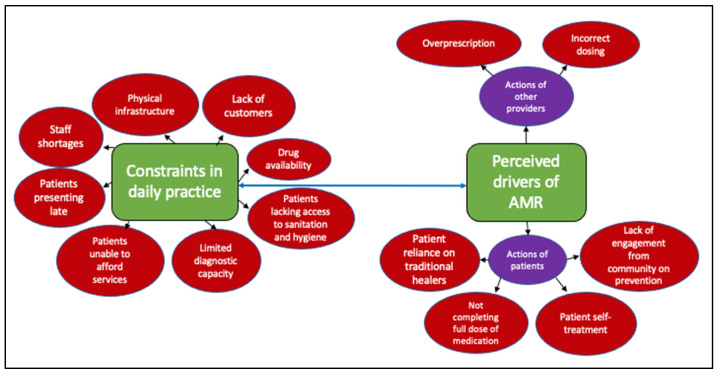
Antimicrobial resistance (AMR) is a global health issue disproportionately affecting low- and middle-income countries. In Tanzania, multi-drug-resistant bacteria (MDR) are highly prevalent in clinical and community settings, inhibiting effective treatment and recovery from infection. The burden of AMR can be alleviated if antimicrobial stewardship (AMS) programs are coordinated and incorporate local knowledge and systemic factors. AMS includes the education of health providers to optimise antimicrobial use to improve patient outcomes while minimising AMR risks. For programmes to succeed, it is essential to understand not just the awareness of and receptiveness to AMR education, but also the opportunities and challenges facing health professionals. We conducted in-depth interviews ( = 44) with animal and human health providers in rural northern Tanzania in order to understand their experiences around AMR. In doing so, we aimed to assess the contextual factors surrounding their practices that might enable or impede the translation of knowledge into action. Specifically, we explored their motivations, training, understanding of infections and AMR, and constraints in daily practice. While providers were motivated in supporting their communities, clear issues emerged regarding training and understanding of AMR. Community health workers and retail drug dispensers exhibited the most variation in training. Inconsistencies in understandings of AMR and its drivers were apparent. Providers cited the actions of patients and other providers as contributing to AMR, perpetuating narratives of blame. Challenges related to AMR included infrastructural constraints, such as a lack of diagnostic testing. While health and AMR-specific training would be beneficial to address awareness, equally important, if not more critical, is tackling the challenges providers face in turning knowledge into action.
抗菌药物耐药性(AMR)是一个全球性的健康问题,对低收入和中等收入国家的影响尤为严重。在坦桑尼亚,多重耐药菌(MDR)在临床和社区环境中高度流行,阻碍了感染的有效治疗和康复。如果抗菌药物管理(AMS)计划得到协调,并纳入当地知识和系统因素,AMR的负担就可以减轻。AMS包括对医疗服务提供者进行教育,以优化抗菌药物的使用,改善患者预后,同时将AMR风险降至最低。为使这些计划取得成功,不仅要了解对AMR教育的认识和接受程度,还要了解卫生专业人员面临的机遇和挑战。我们对坦桑尼亚北部农村的动物和人类健康服务提供者进行了深入访谈(n = 44),以了解他们在AMR方面的经历。在此过程中,我们旨在评估围绕其做法的背景因素,这些因素可能促进或阻碍知识转化为行动。具体而言,我们探讨了他们的动机、培训、对感染和AMR的理解以及日常实践中的限制因素。虽然提供者有动力支持他们的社区,但在培训和对AMR的理解方面出现了明显的问题。社区卫生工作者和零售药店药剂师的培训差异最大。对AMR及其驱动因素的理解存在明显不一致。提供者认为患者和其他提供者的行为导致了AMR,延续了指责的说法。与AMR相关的挑战包括基础设施限制,如缺乏诊断检测。虽然针对健康和AMR的特定培训有助于提高认识,但同样重要甚至更关键的是应对提供者在将知识转化为行动时面临的挑战。