Queiroga Maria Cristina, Laranjo Marta, Andrade Nara, Marques Mariana, Costa Ana Rodrigues, Antunes Célia Maria
MED-Mediterranean Institute for Agriculture, Environment and Development & CHANGE-Global Change and Sustainability Institute, Institute for Advanced Studies and Research, Universidade de Évora, Pólo da Mitra, Ap. 94, 7006-554 Évora, Portugal.
Departamento de Medicina Veterinária, Escola de Ciências e Tecnologia, Universidade de Évora, Pólo da Mitra, Ap. 94, 7006-554 Évora, Portugal.
Antibiotics (Basel). 2023 Feb 8;12(2):347. doi: 10.3390/antibiotics12020347.
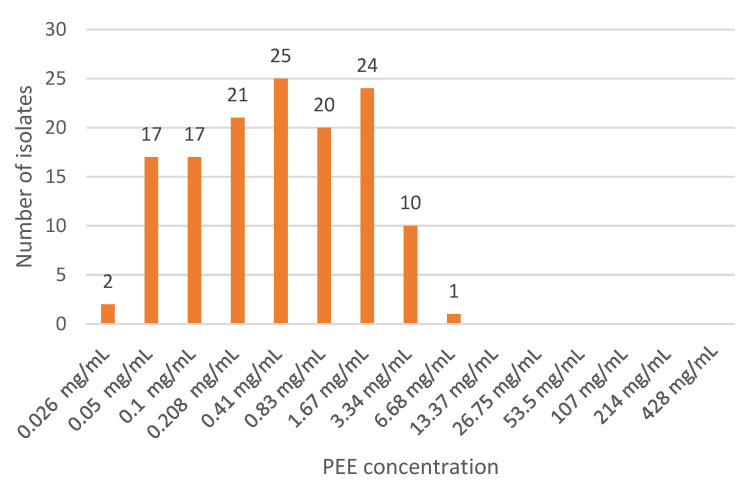
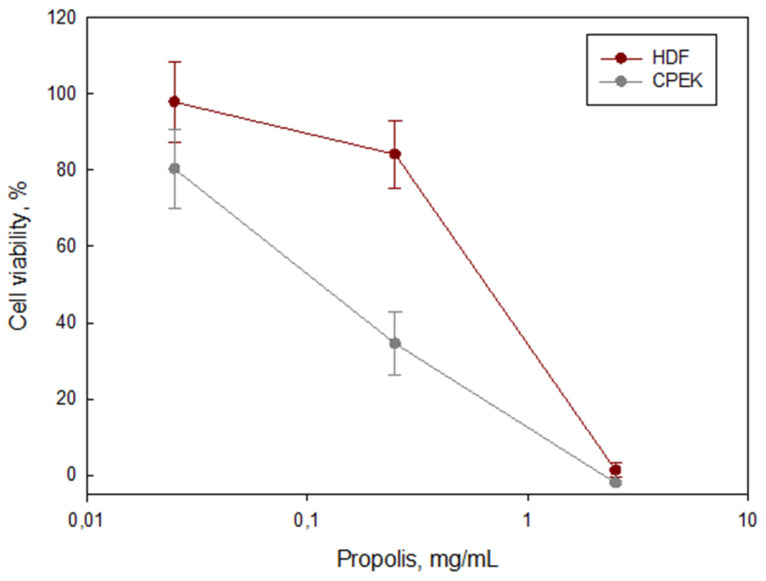
Antimicrobial resistance is a serious problem for the control of infections and infectious diseases. Propolis is a substance produced by honeybees with antimicrobial and antibiofilm properties. To consider propolis as an alternative to the use of antimicrobials for infection control, we assessed its antimicrobial and antibiofilm activities. To assess propolis for topical medical use, toxicological studies were also performed. A Portuguese 70% propolis ethanolic extract was chemically evaluated and studied for antimicrobial activity on staphylococcal field isolates (n = 137) and antibiofilm action (n = 45). Cell toxicological assessment was performed using keratinocytes and fibroblasts. Pinobanksin, chrysin, acacetin, apigenin, pinocembrin, and kaempferol-dimethyl-ether were detected. All 137 isolates were susceptible to 6.68 mg/mL or lower propolis concentration (80% isolates were susceptible to <1 mg/mL). The mean percentage of biofilm inhibition was 71%, and biofilm disruption was 88.5%. Propolis (<1 mg/mL) was well-tolerated by fibroblasts and moderately tolerated by keratinocytes. The combined antimicrobial and antibiofilm effect of propolis, together with its low toxicity to connective tissue and epithelial cells, suggests a good applicability for topical antibacterial treatment. Therefore, propolis seems to be a good alternative to antimicrobials for the treatment of infections with spp. that deserves to be evaluated in vivo.
抗菌药物耐药性是控制感染和传染病的一个严重问题。蜂胶是蜜蜂产生的一种具有抗菌和抗生物膜特性的物质。为了将蜂胶视为控制感染时使用抗菌药物的替代品,我们评估了其抗菌和抗生物膜活性。为了评估蜂胶在局部医学应用中的效果,还进行了毒理学研究。对一种葡萄牙70%蜂胶乙醇提取物进行了化学评估,并研究了其对葡萄球菌现场分离株(n = 137)的抗菌活性和抗生物膜作用(n = 45)。使用角质形成细胞和成纤维细胞进行细胞毒理学评估。检测到了白杨素、白杨黄素、刺槐素、芹菜素、松属素和山柰酚二甲醚。所有137株分离株对6.68 mg/mL或更低浓度的蜂胶敏感(80%的分离株对<1 mg/mL敏感)。生物膜抑制的平均百分比为71%,生物膜破坏为88.5%。蜂胶(<1 mg/mL)对成纤维细胞耐受性良好,对角质形成细胞耐受性中等。蜂胶的抗菌和抗生物膜联合作用,以及其对结缔组织和上皮细胞的低毒性,表明其在局部抗菌治疗中具有良好的适用性。因此,对于 spp. 感染的治疗,蜂胶似乎是抗菌药物的一个很好的替代品,值得进行体内评估。