Becciolini Andrea, Parisi Simone, Del Medico Patrizia, Farina Antonella, Visalli Elisa, Molica Colella Aldo Biagio, Lumetti Federica, Caccavale Rosalba, Scolieri Palma, Andracco Romina, Girelli Francesco, Bravi Elena, Colina Matteo, Volpe Alessandro, Ianniello Aurora, Ditto Maria Chiara, Nucera Valeria, Franchina Veronica, Platè Ilaria, Donato Eleonora Di, Amato Giorgio, Salvarani Carlo, Bernardi Simone, Lucchini Gianluca, De Lucia Francesco, Molica Colella Francesco, Santilli Daniele, Mansueto Natalia, Ferrero Giulio, Marchetta Antonio, Arrigoni Eugenio, Foti Rosario, Sandri Gilda, Bruzzese Vincenzo, Paroli Marino, Fusaro Enrico, Ariani Alarico
Internal Medicine and Rheumatology Unit, Department of Medicine, University Hospital of Parma, 43121 Parma, Italy.
Rheumatology Unit, Department of General and Specialistic Medicine, Azienda Ospedaliera Universitaria, Città della Salute e della Scienza di Torino, 10121 Turin, Italy.
Biomedicines. 2023 Feb 2;11(2):433. doi: 10.3390/biomedicines11020433.
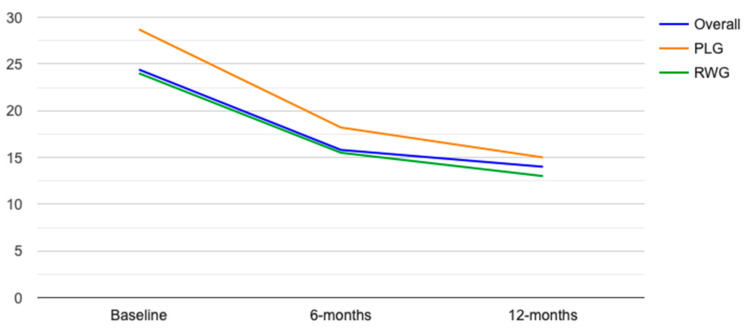
To date, only a few real-world-setting studies evaluated apremilast effectiveness in psoriatic arthritis (PsA). The aims of this retrospective observational study are to report long-term Disease Activity Index for Psoriatic Arthritis (DAPSA) response of apremilast in PsA patients and to analyze the predictors of clinical response.
All PsA consecutive patients treated with apremilast in fifteen Italian rheumatological referral centers were enrolled. Anamnestic data, treatment history, and PsA disease activity (DAPSA) at baseline, 6 months, and 12 months were recorded. The Mann-Whitney test and chi-squared tests assessed the differences between independent groups, whereas the Wilcoxon matched pairs signed-rank test assessed the differences between dependent samples. Logistic regressions verified if there were factors associated with achievement of DAPSA low disease activity or remission at 6 and 12 months.
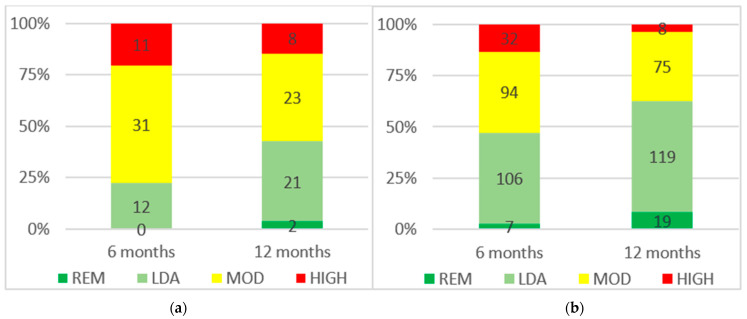
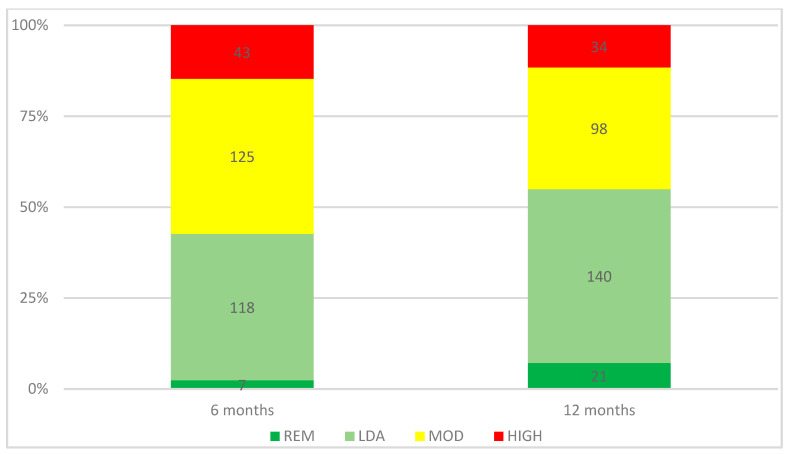
DAPSA low disease activity or remission rates at 6 and 12 months were observed, respectively, in 42.7% ( = 125) and 54.9% ( = 161) patients. Baseline DAPSA was inversely associated with the odds of achieving low disease activity or remission at 6 months (odds ratio (OR) 0.841, 95% confidence interval (CI) 0.804-0.879; < 0.01) and at 12 months (OR 0.911, 95% CI 0.883-0.939; < 0.01).
Almost half of the PsA patients receiving apremilast achieved DAPSA low disease activity or remission at 6 and 12 months. The only factor associated with achievement of low disease activity or remission at both 6 and 12 months was baseline DAPSA.
迄今为止,仅有少数在真实世界环境中开展的研究评估了阿普斯特在银屑病关节炎(PsA)中的疗效。这项回顾性观察性研究的目的是报告阿普斯特在PsA患者中的长期银屑病关节炎疾病活动指数(DAPSA)反应,并分析临床反应的预测因素。
纳入在意大利15个风湿病转诊中心接受阿普斯特治疗的所有连续性PsA患者。记录患者的既往病史、治疗史以及基线、6个月和12个月时的PsA疾病活动度(DAPSA)。采用曼-惠特尼检验和卡方检验评估独立组之间的差异,而威尔科克森配对符号秩检验评估相关样本之间的差异。逻辑回归分析验证是否存在与6个月和12个月时达到DAPSA低疾病活动度或缓解相关的因素。
分别有42.7%(n = 125)和54.9%(n = 161)的患者在6个月和12个月时达到DAPSA低疾病活动度或缓解。基线DAPSA与6个月时达到低疾病活动度或缓解的几率呈负相关(优势比(OR)0.841,95%置信区间(CI)0.804 - 0.879;P < 0.01),与12个月时达到低疾病活动度或缓解的几率也呈负相关(OR 0.911,95% CI 0.883 - 0.939;P < 0.01)。
接受阿普斯特治疗的PsA患者中,近一半在6个月和12个月时达到DAPSA低疾病活动度或缓解。与6个月和12个月时达到低疾病活动度或缓解均相关的唯一因素是基线DAPSA。