Mulet-Margalef Núria, Linares Jenniffer, Badia-Ramentol Jordi, Jimeno Mireya, Sanz Monte Carolina, Manzano Mozo José Luis, Calon Alexandre
Institut Català d'Oncologia, 08916 Badalona, Spain.
Hospital del Mar Medical Research Institute (IMIM), 08003 Barcelona, Spain.
Cancers (Basel). 2023 Feb 6;15(4):1022. doi: 10.3390/cancers15041022.
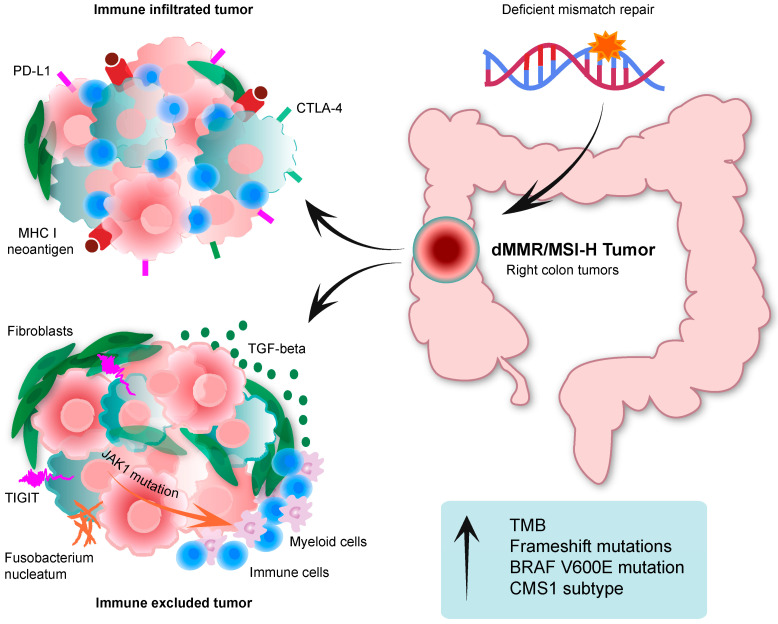
About 5 to 15% of all colorectal cancers harbor mismatch repair deficient/microsatellite instability-high status (dMMR/MSI-H) that associates with high tumor mutation burden and increased immunogenicity. As a result, and in contrast to other colorectal cancer phenotypes, a significant subset of dMMR/MSI-H cancer patients strongly benefit from immunotherapy. Yet, a large proportion of these tumors remain unresponsive to any immuno-modulating treatment. For this reason, current efforts are focused on the characterization of resistance mechanisms and the identification of predictive biomarkers to guide therapeutic decision-making. Here, we provide an overview on the new advances related to the diagnosis and definition of dMMR/MSI-H status and focus on the distinct clinical, functional, and molecular cues that associate with dMMR/MSI-H colorectal cancer. We review the development of novel predictive factors of response or resistance to immunotherapy and their potential application in the clinical setting. Finally, we discuss current and emerging strategies applied to the treatment of localized and metastatic dMMR/MSI-H colorectal tumors in the neoadjuvant and adjuvant setting.
所有结直肠癌中约5%至15%存在错配修复缺陷/微卫星高度不稳定状态(dMMR/MSI-H),这与高肿瘤突变负荷和免疫原性增加相关。因此,与其他结直肠癌表型不同,相当一部分dMMR/MSI-H癌症患者从免疫治疗中显著获益。然而,这些肿瘤中有很大一部分对任何免疫调节治疗仍无反应。因此,目前的努力集中在耐药机制的表征和预测生物标志物的识别上,以指导治疗决策。在此,我们概述了与dMMR/MSI-H状态的诊断和定义相关的新进展,并关注与dMMR/MSI-H结直肠癌相关的独特临床、功能和分子线索。我们回顾了免疫治疗反应或耐药的新型预测因素的发展及其在临床环境中的潜在应用。最后,我们讨论了在新辅助和辅助治疗中应用于局部和转移性dMMR/MSI-H结直肠肿瘤治疗的当前和新兴策略。