Chen Han, Yao Yao, Zhang Chao, Ping Jianfeng
Laboratory of Agricultural Information Intelligent Sensing, School of Biosystems Engineering and Food Science, Zhejiang University, Hangzhou 310058, China.
Foods. 2023 Feb 7;12(4):730. doi: 10.3390/foods12040730.
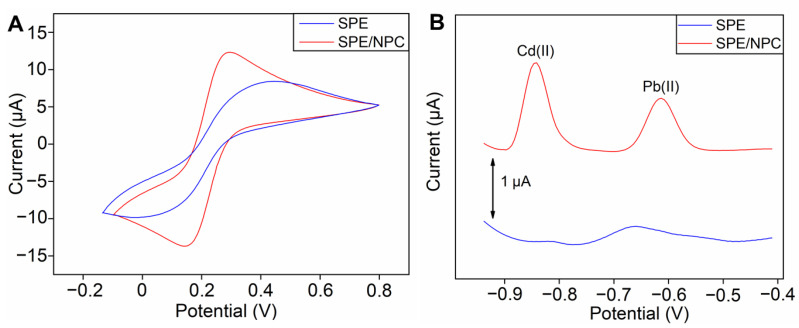
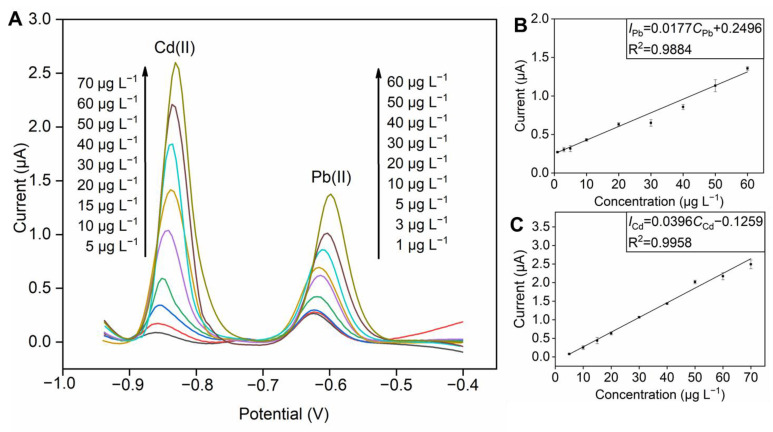
Due to the risk of heavy metal pollution in infant milk powder, it is significant to establish effective detection methods. Here, a screen-printed electrode (SPE) was modified with nanoporous carbon (NPC) to detect Pb(II) and Cd(II) in infant milk powder using an electrochemical method. Using NPC as a functional nanolayer facilitated the electrochemical detection of Pb(II) and Cd(II) due to its efficient mass transport and large adsorption capacity. Linear responses were obtained for Pb (II) and Cd(II) in the range from 1 to 60 µg L and 5 to 70 µg L, respectively. The limit of detection was 0.1 µg L for Pb(II) and 1.67 µg L for Cd(II). The reproducibility, stability, and anti-interference performance of the prepared sensor were tested as well. The heavy metal ion detection performance in the extracted infant milk powder shows that the developed SPE/NPC possesses the ability to detect Pb(II) and Cd(II) in milk powder.
由于婴儿奶粉存在重金属污染风险,建立有效的检测方法具有重要意义。在此,采用纳米多孔碳(NPC)修饰丝网印刷电极(SPE),用电化学方法检测婴儿奶粉中的Pb(II)和Cd(II)。使用NPC作为功能纳米层,由于其高效的传质和大吸附容量,促进了Pb(II)和Cd(II)的电化学检测。Pb(II)和Cd(II)分别在1至60 μg L和5至70 μg L范围内获得线性响应。Pb(II)的检测限为0.1 μg L,Cd(II)的检测限为1.67 μg L。还测试了制备传感器的重现性、稳定性和抗干扰性能。在提取的婴儿奶粉中的重金属离子检测性能表明,所开发的SPE/NPC具有检测奶粉中Pb(II)和Cd(II)的能力。