Alves Virgínia Farias, Tadielo Leonardo Ereno, Pires Ana Carolina Moreira da Silva, Pereira Marita Gimenez, Bersot Luciano Dos Santos, De Martinis Elaine Cristina Pereira
Faculdade de Farmácia, Universidade Federal de Goiás, Goiânia 74605-170, Brazil.
Department of Animal Production and Food, State University of Santa Catarina, Lages 88040-900, Brazil.
Foods. 2024 Dec 11;13(24):3994. doi: 10.3390/foods13243994.
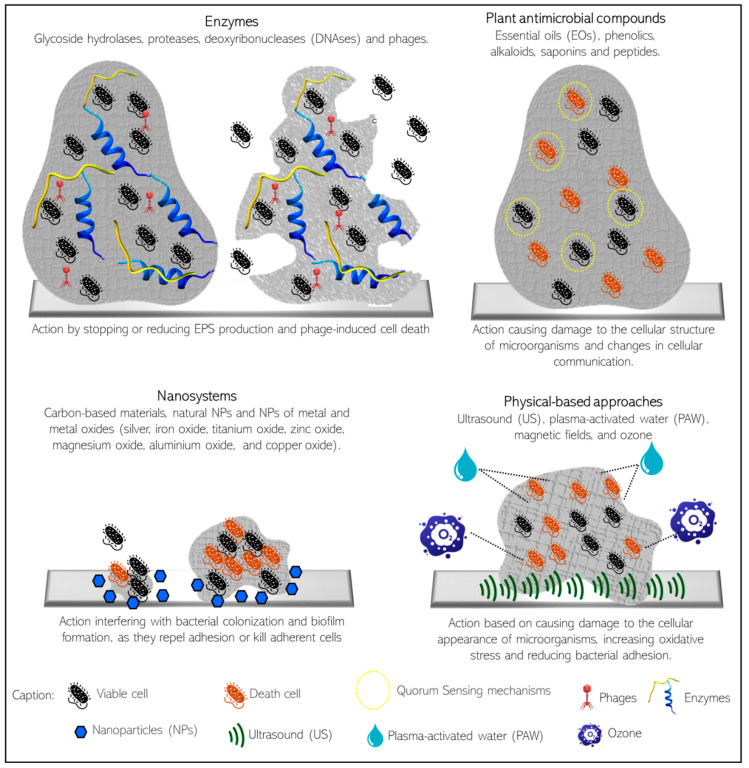
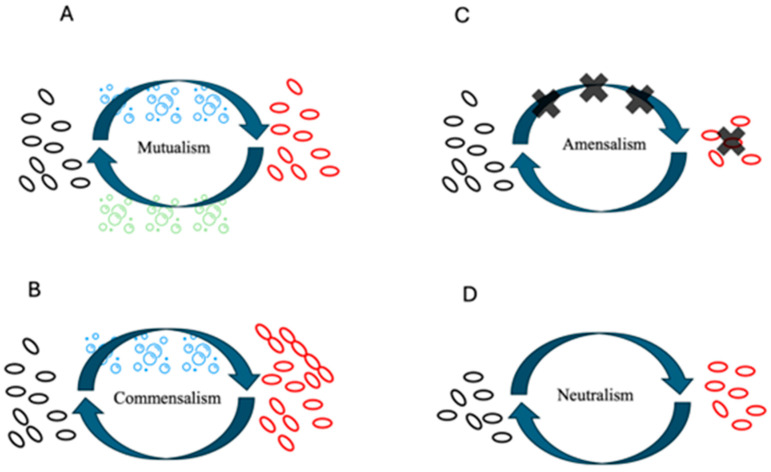
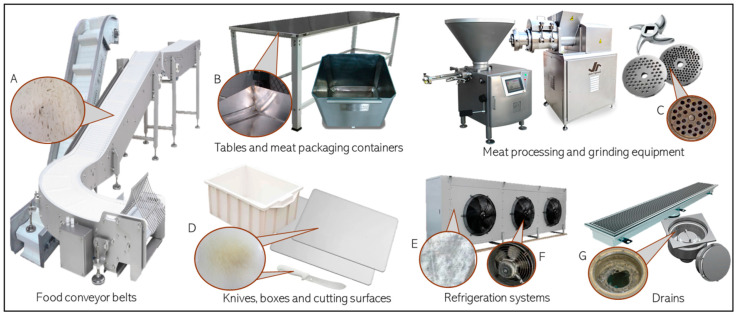
Biofilms are of great concern for the meat industry because, despite the implementation of control plans, they remain important hotspots of contamination by foodborne pathogens, highlighting the need to better understand the ecology of these microecosystems. The objective of this paper was to critically survey the recent scientific literature on microbial biofilms of importance for meat safety and quality, also pointing out the most promising methods to combat them. For this, the databases PubMed, Scopus, Science Direct, Web of Science, and Google Scholar were surveyed in a 10-year time frame (but preferably papers less than 5 years old) using selected keywords relevant for the microbiology of meats, especially considering bacteria that are tolerant to cleaning and sanitization processes. The literature findings showed that massive DNA sequencing has deeply impacted the knowledge on the species that co-habit biofilms with important foodborne pathogens (, , pathogenic , and ). It is likely that recalcitrant commensal and/or spoilage microbiota somehow protect the more fastidious organisms from harsh conditions, in addition to harboring antimicrobial resistance genes. Among the members of background microbiota, , , and have been commonly found on food contact and non-food contact surfaces in meat processing plants, in addition to less common genera, such as , , , and , among others. It has been hypothesized that these rare taxa may represent a primary layer in microbial biofilms, offering better conditions for the adhesion of otherwise poor biofilm formers, especially considering their tolerance to cold conditions and sanitizers. Taking into consideration these findings, it is not only important to target the foodborne pathogens per se in cleaning and disinfection plans but the use of multiple hurdles is also recommended to dismantle the recalcitrant structures of biofilms. In this sense, the last part of this manuscript presents an updated overview of the antibiofilm methods available, with an emphasis on eco-friendly approaches.
生物膜是肉类行业极为关注的问题,因为尽管实施了控制计划,但它们仍是食源性病原体污染的重要热点,这凸显了更好地了解这些微生态系统生态学的必要性。本文的目的是批判性地综述近期关于对肉类安全和质量具有重要意义的微生物生物膜的科学文献,同时指出对抗它们最有前景的方法。为此,在10年时间范围内(但最好是5年以内的论文)对PubMed、Scopus、Science Direct、Web of Science和谷歌学术数据库进行了检索,使用了与肉类微生物学相关的选定关键词,尤其考虑了对清洁和消毒过程具有耐受性的细菌。文献研究结果表明,大规模DNA测序对与重要食源性病原体(如金黄色葡萄球菌、单核细胞增生李斯特菌、致病性大肠杆菌和沙门氏菌)共同栖息在生物膜中的物种的认识产生了深远影响。除了携带抗微生物抗性基因外,顽固的共生菌和/或腐败微生物群可能以某种方式保护更挑剔的生物体免受恶劣条件的影响。在背景微生物群的成员中,不动杆菌属、芽孢杆菌属和假单胞菌属除了较少见的属(如嗜冷杆菌属、嗜冷栖热菌属、嗜冷栖芽孢杆菌属和嗜冷栖球菌属等)外,在肉类加工厂的食品接触和非食品接触表面普遍存在。据推测,这些罕见的分类群可能代表微生物生物膜中的初级层,为原本形成生物膜能力较差的细菌提供更好的附着条件,尤其是考虑到它们对寒冷条件和消毒剂的耐受性。考虑到这些发现,在清洁和消毒计划中不仅针对食源性病原体本身很重要,还建议使用多种障碍来破坏生物膜顽固的结构。从这个意义上说,本文的最后一部分提供了现有抗生物膜方法的最新概述,重点是环保方法。