Blandon Sabrina E, Vargas David A, Casas Diego E, Sarasty Oscar, Woerner Dale R, Echeverry Alejandro, Miller Markus F, Carpio Carlos E, Sanchez-Plata Marcos X, Legako Jerrad F
International Center for Food Industry Excellence, Department of Animal and Food Science, Texas Tech University, Lubbock, TX 79409, USA.
Department of Agricultural and Applied Economics, Texas Tech University, Lubbock, TX 79409, USA.
Foods. 2023 Feb 18;12(4):883. doi: 10.3390/foods12040883.
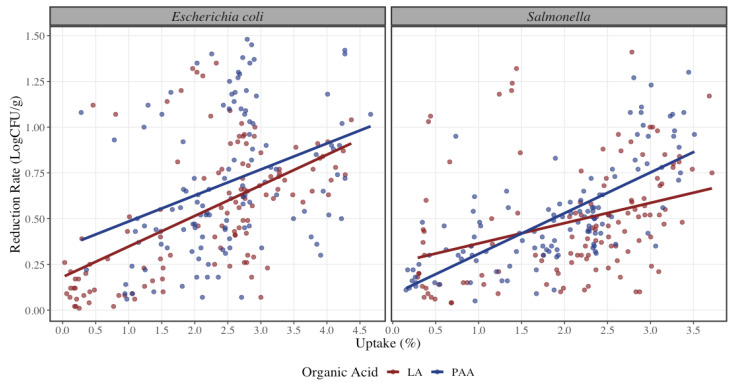
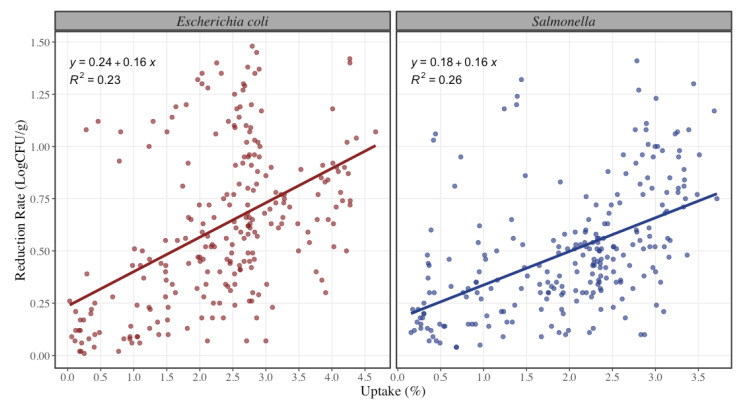
The objective of this study was to evaluate the food safety efficacy of common antimicrobial interventions at and above required uptake levels for processing aids on the reduction of Shiga-toxin producing (STEC) and spp. through spray and dip applications. Beef trim was inoculated with specific isolates of STEC or strains. Trim was intervened with peracetic or lactic acid through spray or dip application. Meat rinses were serially diluted and plated following the drop dilution method; an enumerable range of 2-30 colonies was used to report results before log transformation. The combination of all treatments exhibits an average reduction rate of 0.16 LogCFU/g for STEC and spp., suggesting that for every 1% increase in uptake there is an increase of 0.16 LogCFU/g of reduction rate. There is a statistical significance in the reduction rate of Shiga-toxin producing in relation to the uptake percentage ( < 0.01). The addition of explanatory variables increases the R of the regression for STEC, where all the additional explanatory variables are statistically significant for reduction ( < 0.01). The addition of explanatory variables increases the R of the regression for spp., but only trim type is statistically significant for reduction rate ( < 0.01). An increase in uptake percentages showed a significant increase in reduction rate of pathogens on beef trimmings.
本研究的目的是评估常见抗菌干预措施在达到及高于加工助剂所需摄取水平时,通过喷雾和浸渍应用对减少产志贺毒素大肠杆菌(STEC)和其他菌株的食品安全功效。牛肉碎末接种了特定的STEC或其他菌株分离物。通过喷雾或浸渍应用,用过氧乙酸或乳酸对碎末进行干预处理。按照滴液稀释法对肉冲洗液进行系列稀释并平板接种;在对数转换前,使用2 - 30个可计数菌落的范围来报告结果。所有处理的组合对STEC和其他菌株的平均减少率为0.16 LogCFU/g,这表明摄取量每增加1%,减少率就增加0.16 LogCFU/g。产志贺毒素菌的减少率与摄取百分比之间存在统计学显著性(P < 0.01)。添加解释变量会增加STEC回归的R值,其中所有额外的解释变量对减少率都具有统计学显著性(P < 0.01)。添加解释变量会增加其他菌株回归的R值,但只有碎末类型对减少率具有统计学显著性(P < 0.01)。摄取百分比的增加表明牛肉碎末上病原体的减少率显著增加。