Department of Epidemiology and Biostatistics, School of Public Health, Peking University, Beijing 100191, China.
Institute for Global Health and Development, Peking University, Beijing 100871, China.
Int J Environ Res Public Health. 2023 Feb 14;20(4):3335. doi: 10.3390/ijerph20043335.
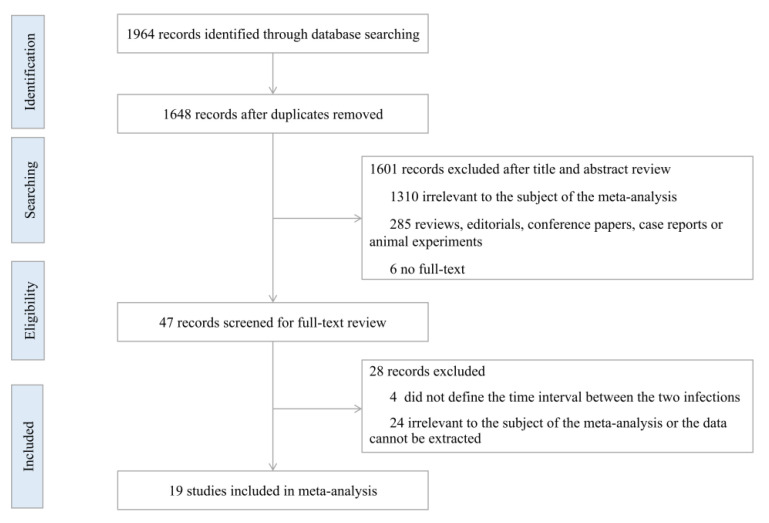
Severe acute respiratory syndrome coronavirus 2 (SARS-CoV-2) reinfection has brought new challenges to the global prevention and control of coronavirus disease 2019 (COVID-19) pandemic; however, current studies suggest that there is still great uncertainty about the risk of severe COVID-19 and poor outcomes after SARS-CoV-2 reinfection. Random-effects inverse-variance models were used to evaluate the pooled prevalence (PP) and its 95% confidence interval (CI) of severity, outcomes and symptoms of reinfection. Random-effects were used to estimate the pooled odds ratios (OR) and its 95%CI of severity and outcomes between reinfections and primary infections. Nineteen studies involving a total of 34,375 cases of SARS-CoV-2 reinfection and 5,264,720 cases of SARS-CoV-2 primary infection were included in this meta-analysis. Among those SARS-CoV-2 reinfection cases, 41.77% (95%CI, 19.23-64.31%) were asymptomatic, and 51.83% (95%CI, 23.90-79.76%) were symptomatic, only 0.58% (95%CI, 0.031-1.14%) manifested as severe illness, and 0.04% (95%CI, 0.009-0.078%) manifested as critical illness. The PPs for SARS-CoV-2 reinfection-related hospitalization, admission to ICU, and death were, respectively, 15.48% (95%CI, 11.98-18.97%), 3.58% (95%CI, 0.39-6.77%), 2.96% (95%CI, 1.25-4.67%). Compared with SARS-CoV-2 primary infection cases, reinfection cases were more likely to present with mild illness (OR = 7.01, 95%CI, 5.83-8.44), and the risk of severe illness was reduced by 86% (OR = 0.14, 95%CI, 0.11-0.16). Primary infection provided some protection against reinfection and reduces the risk of symptomatic infection and severe illness. Reinfection did not contribute to extra risk of hospitalization, ICU, or death. It is suggested to scientifically understand the risk of reinfection of SARS-CoV-2, strengthen public health education, maintain healthy habits, and reduce the risk of reinfection.
严重急性呼吸综合征冠状病毒 2(SARS-CoV-2)再次感染给全球 2019 年冠状病毒病(COVID-19)大流行的防控带来了新的挑战;然而,目前的研究表明,SARS-CoV-2 再次感染后发生严重 COVID-19 和不良结局的风险仍然存在很大的不确定性。采用随机效应逆方差模型评估再感染严重程度、结局和症状的汇总患病率(PP)及其 95%置信区间(CI)。采用随机效应估计再感染和初次感染之间严重程度和结局的汇总优势比(OR)及其 95%CI。本荟萃分析纳入了 19 项研究,共涉及 34375 例 SARS-CoV-2 再感染病例和 5264720 例 SARS-CoV-2 初次感染病例。在这些 SARS-CoV-2 再感染病例中,无症状病例占 41.77%(95%CI,19.23-64.31%),有症状病例占 51.83%(95%CI,23.90-79.76%),仅有 0.58%(95%CI,0.031-1.14%)表现为严重疾病,0.04%(95%CI,0.009-0.078%)表现为危重症。SARS-CoV-2 再感染相关住院、入住 ICU 和死亡的 PP 分别为 15.48%(95%CI,11.98-18.97%)、3.58%(95%CI,0.39-6.77%)、2.96%(95%CI,1.25-4.67%)。与 SARS-CoV-2 初次感染病例相比,再感染病例更有可能表现为轻症(OR=7.01,95%CI,5.83-8.44),严重疾病的风险降低了 86%(OR=0.14,95%CI,0.11-0.16)。初次感染为再感染提供了一定的保护,降低了有症状感染和严重疾病的风险。再感染不会增加住院、入住 ICU 或死亡的风险。建议科学认识 SARS-CoV-2 再感染的风险,加强公共卫生教育,保持健康习惯,降低再感染风险。