Skolkovo Institute of Science and Technology, Bolshoy Boulevard 30, bld. 1, 121205 Moscow, Russia.
Institute of Spectroscopy of the Russian Academy of Sciences, Fizicheskaya, 5, 108840 Moscow, Russia.
Int J Mol Sci. 2023 Feb 6;24(4):3183. doi: 10.3390/ijms24043183.
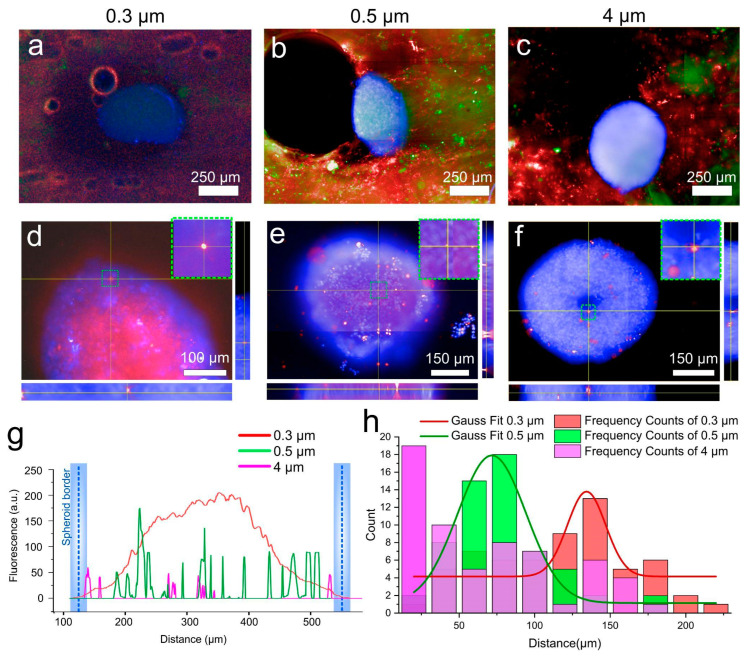
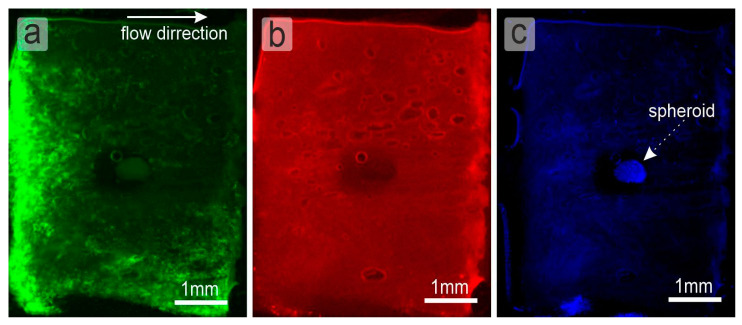
Towards the improvement of the efficient study of drugs and contrast agents, the 3D microfluidic platforms are currently being actively developed for testing these substances and particles in vitro. Here, we have elaborated a microfluidic lymph node-on-chip (LNOC) as a tissue engineered model of a secondary tumor in lymph node (LN) formed due to the metastasis process. The developed chip has a collagen sponge with a 3D spheroid of 4T1 cells located inside, simulating secondary tumor in the lymphoid tissue. This collagen sponge has a morphology and porosity comparable to that of a native human LN. To demonstrate the suitability of the obtained chip for pharmacological applications, we used it to evaluate the effect of contrast agent/drug carrier size, on the penetration and accumulation of particles in 3D spheroids modeling secondary tumor. For this, the 0.3, 0.5 and 4 μm bovine serum albumin (BSA)/tannic acid (TA) capsules were mixed with lymphocytes and pumped through the developed chip. The capsule penetration was examined by scanning with fluorescence microscopy followed by quantitative image analysis. The results show that capsules with a size of 0.3 μm passed more easily to the tumor spheroid and penetrated inside. We hope that the device will represent a reliable alternative to in vivo early secondary tumor models and decrease the amount of in vivo experiments in the frame of preclinical study.
为了提高药物和对比剂的研究效率,目前正在积极开发 3D 微流控平台,以在体外测试这些物质和颗粒。在这里,我们详细介绍了一种淋巴结芯片(LNOC)作为由于转移过程而在淋巴结(LN)中形成的继发性肿瘤的组织工程模型。所开发的芯片具有内部有 4T1 细胞的 3D 球体的胶原海绵,模拟淋巴组织中的继发性肿瘤。这种胶原海绵的形态和孔隙率与天然人类 LN 相当。为了证明所获得的芯片适用于药理学应用,我们使用它来评估对比剂/药物载体大小对模拟继发性肿瘤的 3D 球体中颗粒渗透和积累的影响。为此,将 0.3、0.5 和 4μm 的牛血清白蛋白(BSA)/单宁酸(TA)胶囊与淋巴细胞混合,并通过开发的芯片泵送。通过荧光显微镜扫描检查胶囊渗透情况,然后进行定量图像分析。结果表明,粒径为 0.3μm 的胶囊更容易进入肿瘤球体并渗透到内部。我们希望该设备将成为体内早期继发性肿瘤模型的可靠替代品,并减少临床前研究框架内的体内实验数量。