State Key Laboratory of NBC Protection for Civilian, Beijing 102205, China.
School of Chemistry and Chemical Engineering, Nanjing University of Science and Technology, Nanjing 210094, China.
Int J Mol Sci. 2023 Feb 6;24(4):3209. doi: 10.3390/ijms24043209.
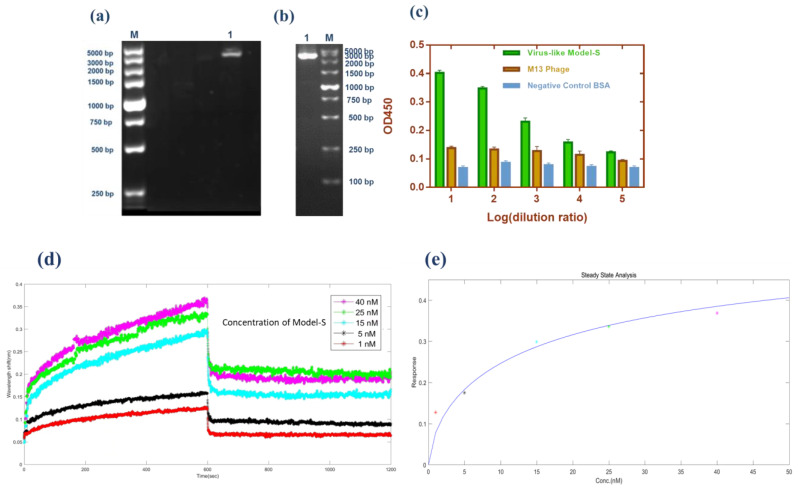
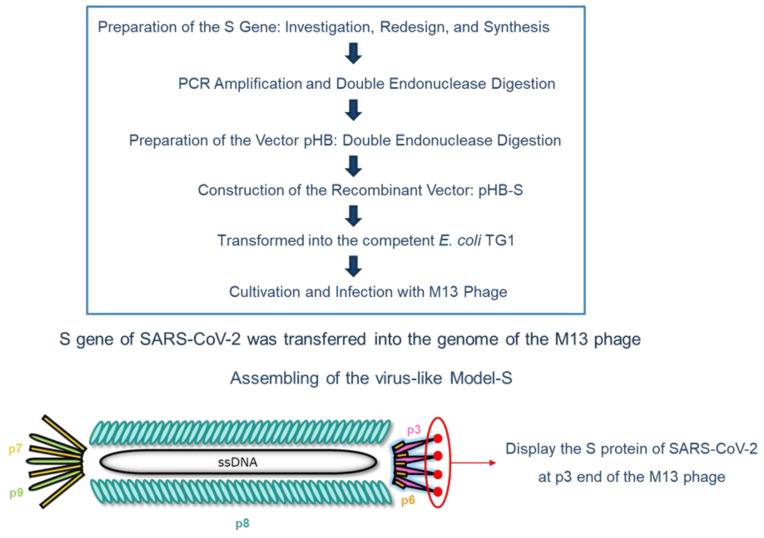
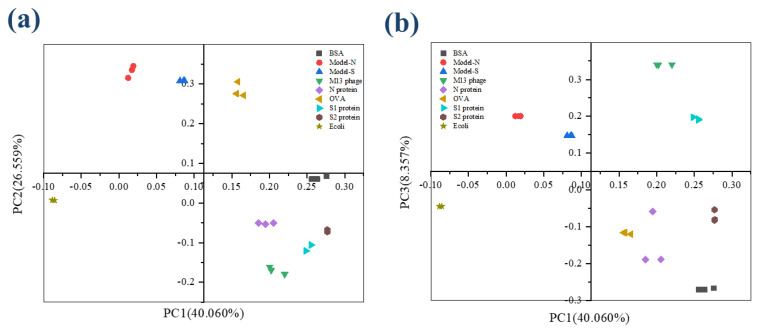
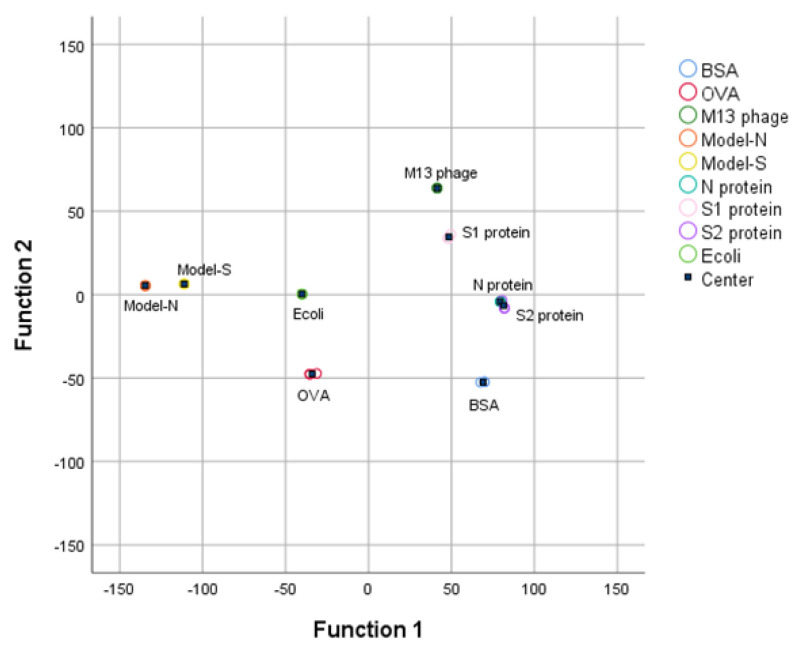
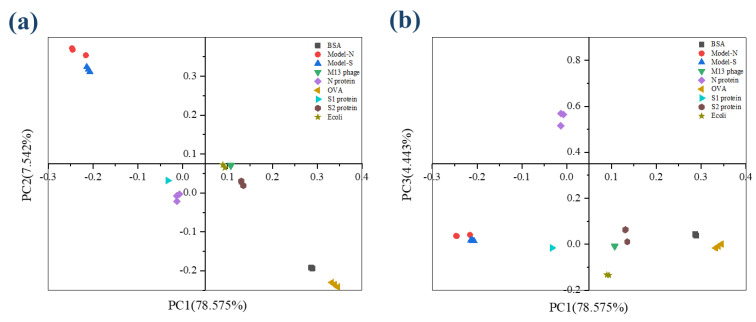
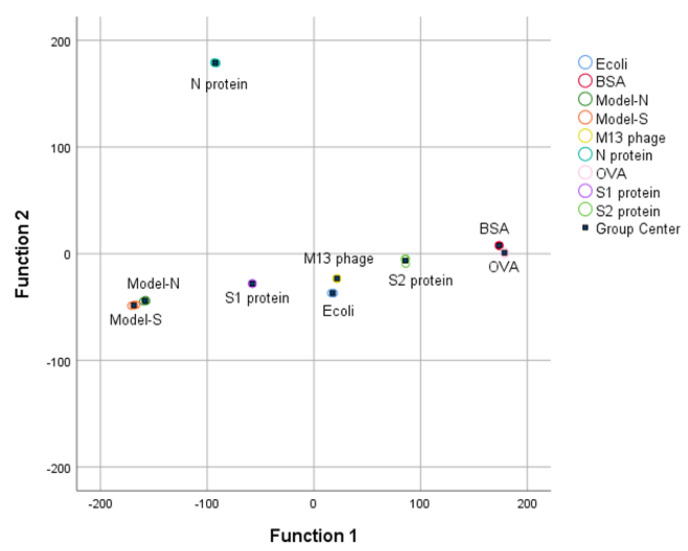
The rapid identification and recognition of COVID-19 have been challenging since its outbreak. Multiple methods were developed to realize fast monitoring early to prevent and control the pandemic. In addition, it is difficult and unrealistic to apply the actual virus to study and research because of the highly infectious and pathogenic SARS-CoV-2. In this study, the virus-like models were designed and produced to replace the original virus as bio-threats. Three-dimensional excitation-emission matrix fluorescence and Raman spectroscopy were employed for differentiation and recognition among the produced bio-threats and other viruses, proteins, and bacteria. Combined with PCA and LDA analysis, the identification of the models for SARS-CoV-2 was achieved, reaching a correction of 88.9% and 96.3% after cross-validation, respectively. This idea might provide a possible pattern for detecting and controlling SARS-CoV-2 from the perspective of combining optics and algorithms, which could be applied in the early-warning system against COVID-19 or other bio-threats in the future.
自 COVID-19 爆发以来,其快速识别和鉴定一直具有挑战性。已经开发出多种方法来实现快速监测,以预防和控制大流行。此外,由于高度传染性和致病性的 SARS-CoV-2,实际病毒很难且不切实际地用于研究和研究。在这项研究中,设计并生产了类似病毒的模型来代替原始病毒作为生物威胁。三维激发-发射矩阵荧光和拉曼光谱用于区分和识别产生的生物威胁与其他病毒、蛋白质和细菌。结合 PCA 和 LDA 分析,实现了对 SARS-CoV-2 模型的识别,交叉验证后的校正率分别达到 88.9%和 96.3%。从光学和算法相结合的角度来看,这种想法可能为检测和控制 SARS-CoV-2 提供一种可能的模式,未来可应用于 COVID-19 或其他生物威胁的预警系统。