College of International Education, Beijing University of Chemical Technology, Beijing 100029, China.
College of Horticulture, China Agricultural University, Beijing 100193, China.
Int J Mol Sci. 2023 Feb 17;24(4):4054. doi: 10.3390/ijms24044054.
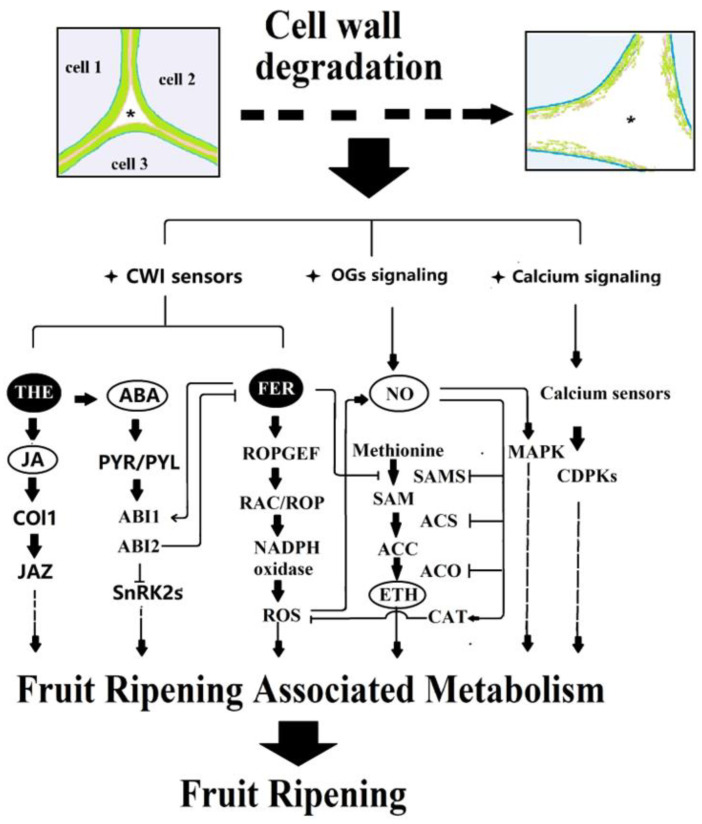
Plant cell walls are essential structures for plant growth and development as well as plant adaptation to environmental stresses. Thus, plants have evolved signaling mechanisms to monitor the changes in the cell wall structure, triggering compensatory changes to sustain cell wall integrity (CWI). CWI signaling can be initiated in response to environmental and developmental signals. However, while environmental stress-associated CWI signaling has been extensively studied and reviewed, less attention has been paid to CWI signaling in relation to plant growth and development under normal conditions. Fleshy fruit development and ripening is a unique process in which dramatic alternations occur in cell wall architecture. Emerging evidence suggests that CWI signaling plays a pivotal role in fruit ripening. In this review, we summarize and discuss the CWI signaling in relation to fruit ripening, which will include cell wall fragment signaling, calcium signaling, and NO signaling, as well as Receptor-Like Protein Kinase (RLKs) signaling with an emphasis on the signaling of FERONIA and THESEUS, two members of RLKs that may act as potential CWI sensors in the modulation of hormonal signal origination and transduction in fruit development and ripening.
植物细胞壁是植物生长发育以及植物适应环境胁迫的重要结构。因此,植物进化出了信号机制来监测细胞壁结构的变化,触发补偿性变化以维持细胞壁完整性(CWI)。CWI 信号可以响应环境和发育信号而被触发。然而,尽管环境胁迫相关的 CWI 信号已被广泛研究和综述,但在正常条件下与植物生长和发育相关的 CWI 信号受到的关注较少。肉质果实的发育和成熟是一个独特的过程,其中细胞壁结构会发生剧烈的变化。新出现的证据表明,CWI 信号在果实成熟中起着关键作用。在这篇综述中,我们总结和讨论了与果实成熟相关的 CWI 信号,其中包括细胞壁片段信号、钙信号和 NO 信号,以及受体样蛋白激酶(RLK)信号,重点介绍了 FERONIA 和 THESEUS 这两个 RLK 成员的信号,它们可能作为潜在的 CWI 传感器,在调节果实发育和成熟过程中激素信号的起始和转导中发挥作用。