Department of Biochemistry, Center for Molecular Biomedicine (CMB), Friedrich Schiller University Jena, Jena, 07745, Germany.
Josep Carreras Leukaemia Research Institute (IJC), Campus ICO-Germans Trias i Pujol, Badalona, 08916, Spain.
Oncogene. 2022 Sep;41(40):4560-4572. doi: 10.1038/s41388-022-02450-3. Epub 2022 Sep 6.
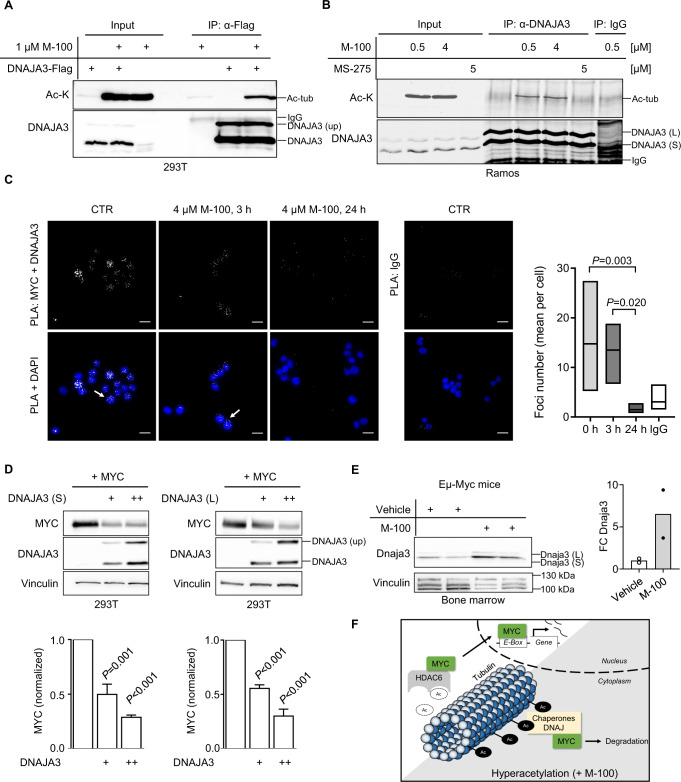
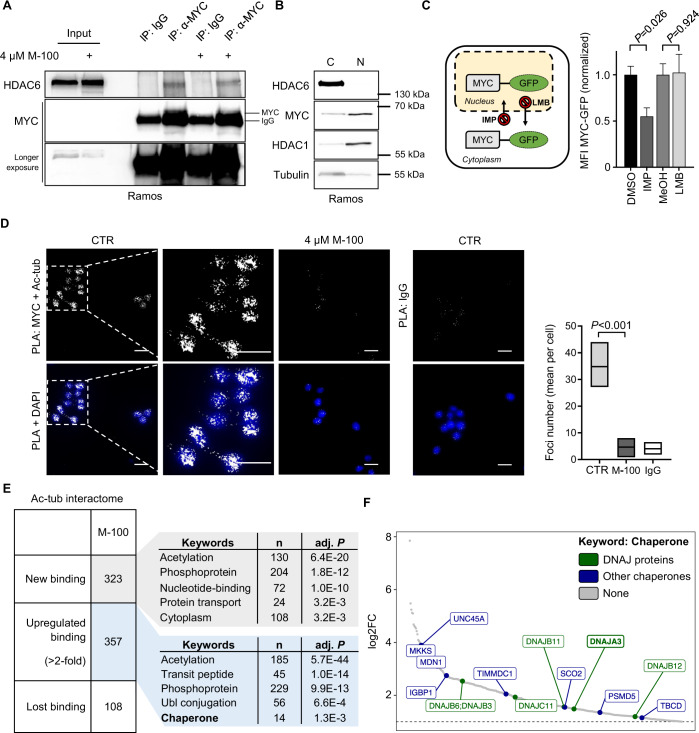
Overexpression of MYC is a genuine cancer driver in lymphomas and related to poor prognosis. However, therapeutic targeting of the transcription factor MYC remains challenging. Here, we show that inhibition of the histone deacetylase 6 (HDAC6) using the HDAC6 inhibitor Marbostat-100 (M-100) reduces oncogenic MYC levels and prevents lymphomagenesis in a mouse model of MYC-induced aggressive B-cell lymphoma. M-100 specifically alters protein-protein interactions by switching the acetylation state of HDAC6 substrates, such as tubulin. Tubulin facilitates nuclear import of MYC, and MYC-dependent B-cell lymphoma cells rely on continuous import of MYC due to its high turn-over. Acetylation of tubulin impairs this mechanism and enables proteasomal degradation of MYC. M-100 targets almost exclusively B-cell lymphoma cells with high levels of MYC whereas non-tumor cells are not affected. M-100 induces massive apoptosis in human and murine MYC-overexpressing B-cell lymphoma cells. We identified the heat-shock protein DNAJA3 as an interactor of tubulin in an acetylation-dependent manner and overexpression of DNAJA3 resulted in a pronounced degradation of MYC. We propose a mechanism by which DNAJA3 associates with hyperacetylated tubulin in the cytoplasm to control MYC turnover. Taken together, our data demonstrate a beneficial role of HDAC6 inhibition in MYC-dependent B-cell lymphoma.
MYC 的过表达是淋巴瘤和相关疾病预后不良的真正驱动因素。然而,靶向转录因子 MYC 的治疗仍然具有挑战性。在这里,我们表明使用组蛋白去乙酰化酶 6(HDAC6)抑制剂 Marbostat-100(M-100)抑制 HDAC6 可降低致癌性 MYC 水平,并防止 MYC 诱导的侵袭性 B 细胞淋巴瘤小鼠模型中的淋巴瘤发生。M-100 通过改变 HDAC6 底物(如微管蛋白)的乙酰化状态来特异性地改变蛋白质-蛋白质相互作用。微管蛋白促进 MYC 的核输入,并且由于其高周转率,依赖 MYC 的 B 细胞淋巴瘤细胞依赖于 MYC 的持续输入。微管蛋白的乙酰化会破坏这种机制,并使 MYC 发生蛋白酶体降解。M-100 几乎专门针对 MYC 水平高的 B 细胞淋巴瘤细胞,而非肿瘤细胞不受影响。M-100 在人源和鼠源 MYC 过表达的 B 细胞淋巴瘤细胞中诱导大量细胞凋亡。我们发现热休克蛋白 DNAJA3 以依赖于乙酰化的方式与微管蛋白相互作用,并且 DNAJA3 的过表达导致 MYC 的明显降解。我们提出了一种机制,即 DNAJA3 与细胞质中高度乙酰化的微管蛋白结合以控制 MYC 周转。总之,我们的数据表明 HDAC6 抑制在 MYC 依赖性 B 细胞淋巴瘤中具有有益作用。