Zhang Nan, Zhao Xin, Li Jie, Huang Liqun, Li Haotian, Feng Haiyu, Garcia Marcos A, Cao Yunshan, Sun Zhonghua, Chai Senchun
Department of Radiology, Beijing Anzhen Hospital, Capital Medical University, 2nd Anzhen Road, Chaoyang District, Beijing 100029, China.
School of Automation, Beijing Institute of Technology, No. 5 Zhongguancun South Street, Haidian District, Beijing 100081, China.
J Clin Med. 2023 Feb 6;12(4):1297. doi: 10.3390/jcm12041297.
Right heart catheterization is the gold standard for evaluating hemodynamic parameters of pulmonary circulation, especially pulmonary artery pressure (PAP) for diagnosis of pulmonary hypertension (PH). However, the invasive and costly nature of RHC limits its widespread application in daily practice.
To develop a fully automatic framework for PAP assessment via machine learning based on computed tomography pulmonary angiography (CTPA).
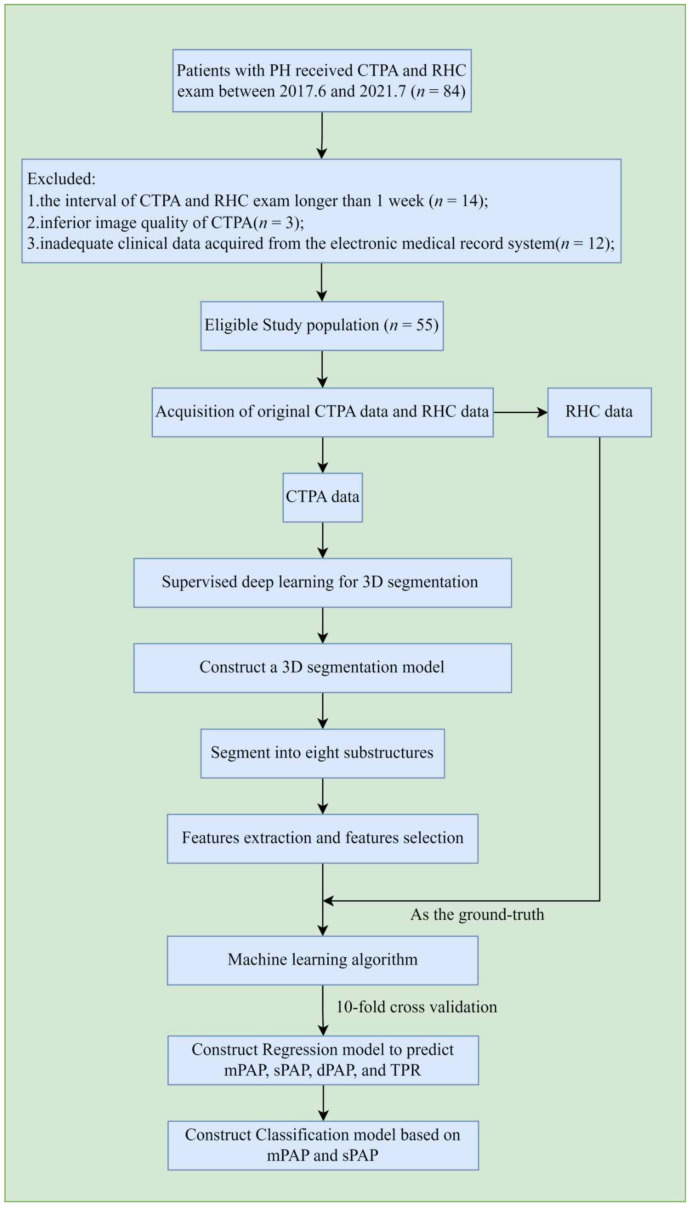
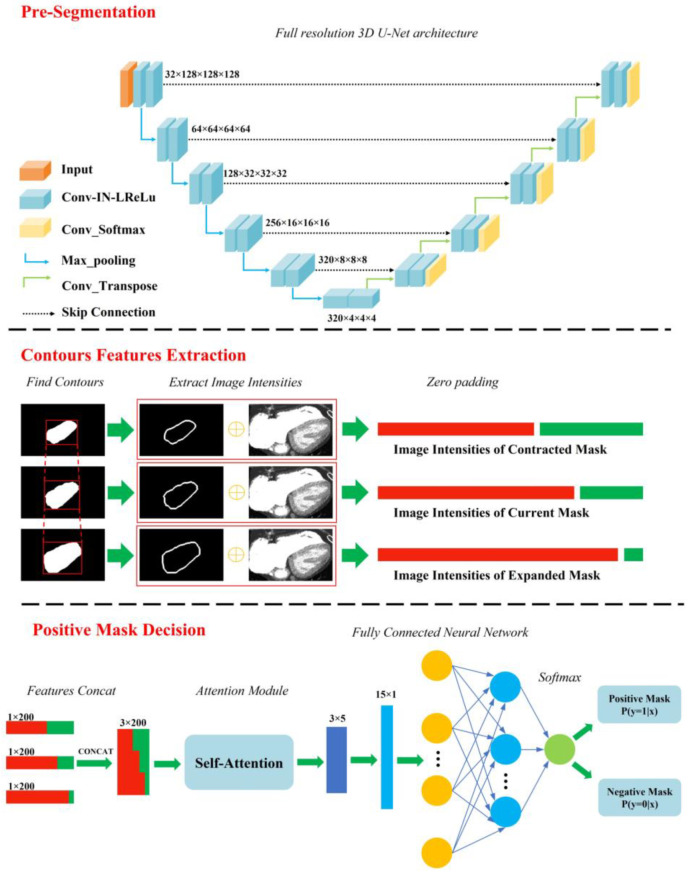
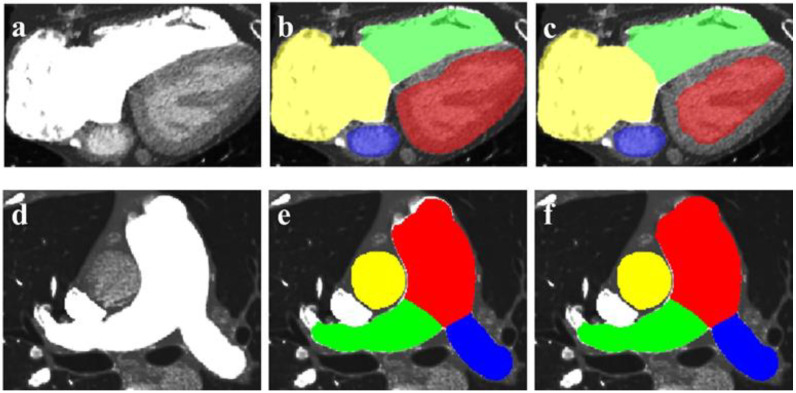
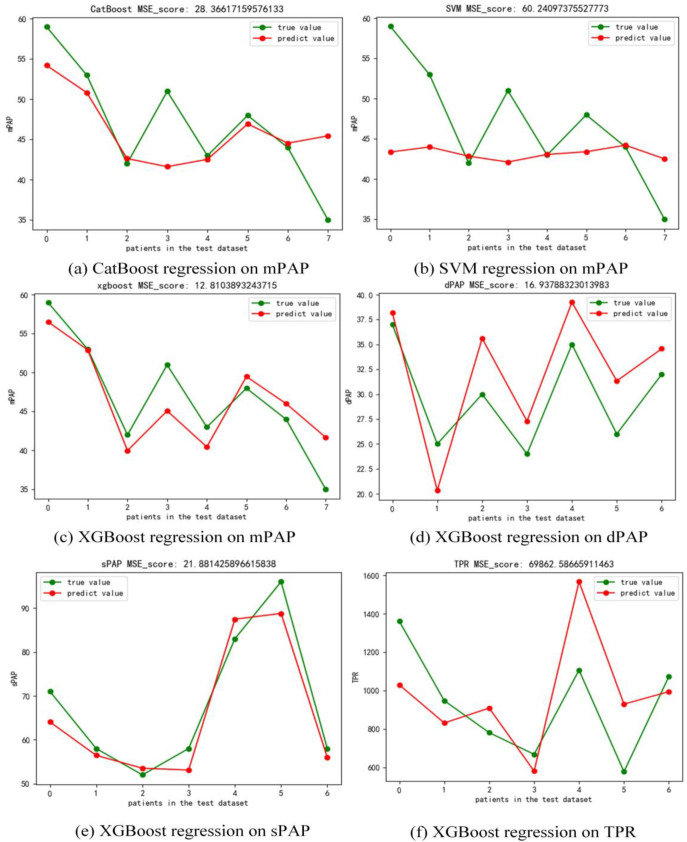
A machine learning model was developed to automatically extract morphological features of pulmonary artery and the heart on CTPA cases collected between June 2017 and July 2021 based on a single center experience. Patients with PH received CTPA and RHC examinations within 1 week. The eight substructures of pulmonary artery and heart were automatically segmented through our proposed segmentation framework. Eighty percent of patients were used for the training data set and twenty percent for the independent testing data set. PAP parameters, including mPAP, sPAP, dPAP, and TPR, were defined as ground-truth. A regression model was built to predict PAP parameters and a classification model to separate patients through mPAP and sPAP with cut-off values of 40 mm Hg and 55 mm Hg in PH patients, respectively. The performances of the regression model and the classification model were evaluated by analyzing the intraclass correlation coefficient (ICC) and the area under the receiver operating characteristic curve (AUC).
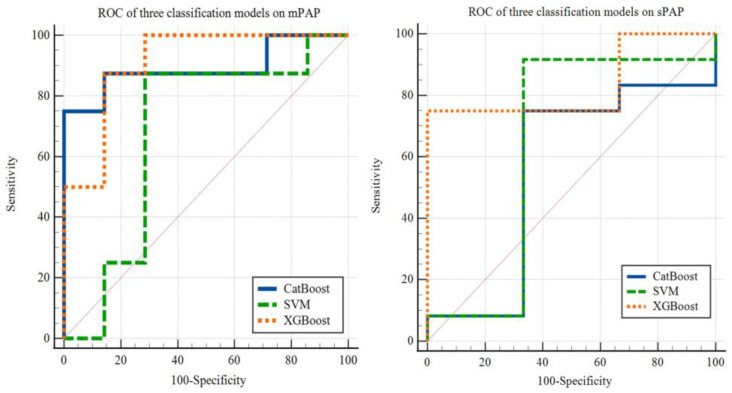
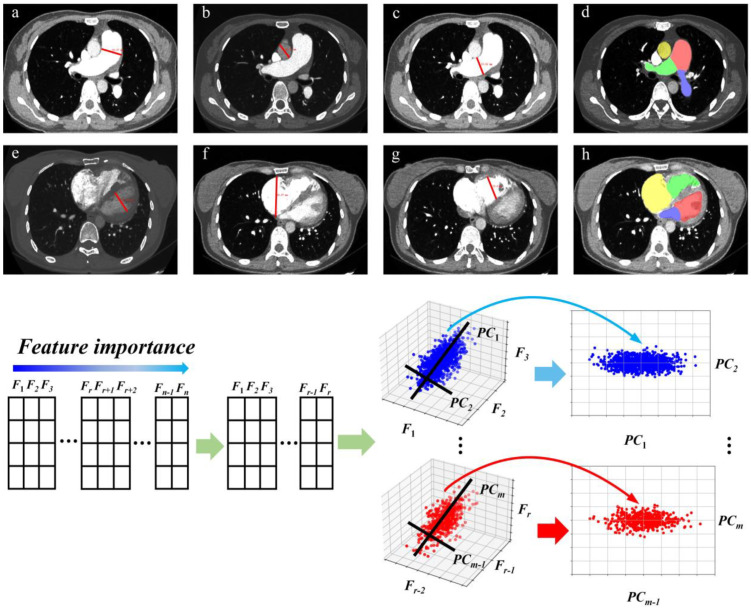
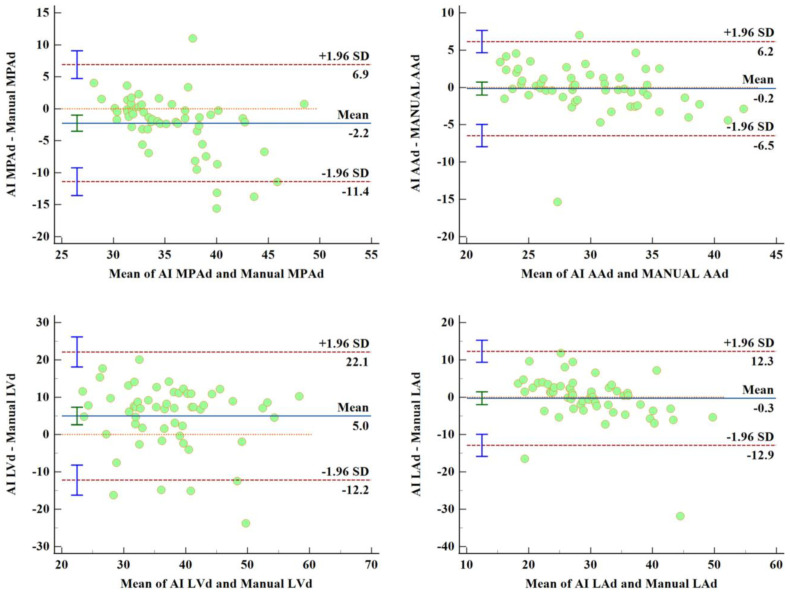
Study participants included 55 patients with PH (men 13; age 47.75 ± 14.87 years). The average dice score for segmentation increased from 87.3% ± 2.9 to 88.2% ± 2.9 through proposed segmentation framework. After features extraction, some of the AI automatic extractions (AAd, RVd, LAd, and RPAd) achieved good consistency with the manual measurements. The differences between them were not statistically significant (t = 1.222, = 0.227; t = -0.347, = 0.730; t = 0.484, = 0.630; t = -0.320, = 0.750, respectively). The Spearman test was used to find key features which are highly correlated with PAP parameters. Correlations between pulmonary artery pressure and CTPA features show a high correlation between mPAP and LAd, LVd, LAa (r = 0.333, = 0.012; r = -0.400, = 0.002; r = -0.208, = 0.123; r = -0.470, = 0.000; respectively). The ICC between the output of the regression model and the ground-truth from RHC of mPAP, sPAP, and dPAP were 0.934, 0.903, and 0.981, respectively. The AUC of the receiver operating characteristic curve of the classification model of mPAP and sPAP were 0.911 and 0.833.
The proposed machine learning framework on CTPA enables accurate segmentation of pulmonary artery and heart and automatic assessment of the PAP parameters and has the ability to accurately distinguish different PH patients with mPAP and sPAP. Results of this study may provide additional risk stratification indicators in the future with non-invasive CTPA data.
右心导管检查是评估肺循环血流动力学参数的金标准,尤其是用于诊断肺动脉高压(PH)的肺动脉压(PAP)。然而,右心导管检查具有侵入性且成本高昂,这限制了其在日常实践中的广泛应用。
开发一种基于计算机断层扫描肺动脉造影(CTPA)的机器学习全自动框架,用于评估PAP。
基于单中心经验,开发了一种机器学习模型,以自动提取2017年6月至2021年7月收集的CTPA病例中肺动脉和心脏的形态特征。患有PH的患者在1周内接受了CTPA和右心导管检查。通过我们提出的分割框架自动分割肺动脉和心脏的八个子结构。80%的患者用于训练数据集,20%用于独立测试数据集。将PAP参数,包括平均肺动脉压(mPAP)、收缩期肺动脉压(sPAP)、舒张期肺动脉压(dPAP)和肺血管阻力(TPR)定义为真实值。建立回归模型以预测PAP参数,并建立分类模型以通过PH患者中mPAP和sPAP的截断值分别为40 mmHg和55 mmHg来区分患者。通过分析组内相关系数(ICC)和受试者工作特征曲线下面积(AUC)来评估回归模型和分类模型的性能。
研究参与者包括55例PH患者(男性13例;年龄47.75±14.87岁)。通过提出的分割框架,分割的平均骰子分数从87.3%±2.9提高到88.2%±2.9。特征提取后,一些人工智能自动提取值(AAd、RVd、LAd和RPAd)与手动测量值具有良好的一致性。它们之间的差异无统计学意义(t分别为1.222,P = 0.227;t为-0.347,P = 0.730;t为0.484,P = 0.630;t为-0.320,P = 0.750)。使用Spearman检验来找出与PAP参数高度相关的关键特征。肺动脉压与CTPA特征之间的相关性显示mPAP与LAd、LVd、LAa之间具有高度相关性(r分别为0.333,P = 0.012;r为-0.400,P = 0.002;r为-0.208,P = 0.123;r为-0.470,P = 0.000)。回归模型输出与右心导管检查mPAP、sPAP和dPAP真实值之间的ICC分别为0.934、0.903和0.981。mPAP和sPAP分类模型的受试者工作特征曲线的AUC分别为0.911和0.833。
所提出的基于CTPA的机器学习框架能够准确分割肺动脉和心脏,并自动评估PAP参数,并且有能力通过mPAP和sPAP准确区分不同的PH患者。本研究结果可能在未来利用无创CTPA数据提供额外的风险分层指标。