Patiño Luz Helena, Muñoz Marina, Ramírez Angie Lorena, Vélez Nórida, Escandón Patricia, Parra-Giraldo Claudia-Marcela, Ramírez Juan David
Centro de Investigaciones en Microbiología y Biotecnología-UR (CIMBIUR), Facultad de Ciencias Naturales, Universidad del Rosario, Bogotá 111321, Colombia.
Unidad de Proteómica y Micosis Humanas, Grupo de Investigación en Enfermedades Infecciosas, Departamento de Microbiología, Pontificia Universidad Javeriana, Bogotá 111321, Colombia.
J Fungi (Basel). 2023 Jan 18;9(2):135. doi: 10.3390/jof9020135.
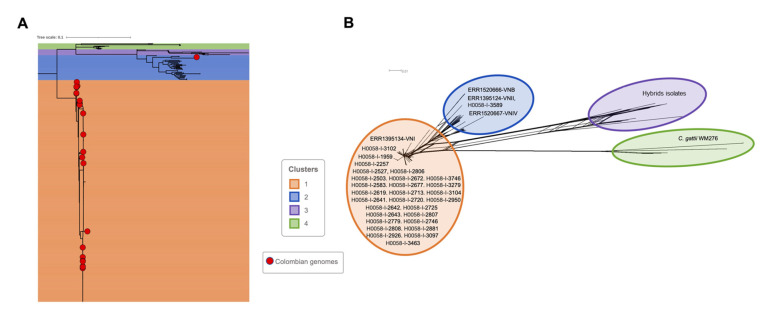
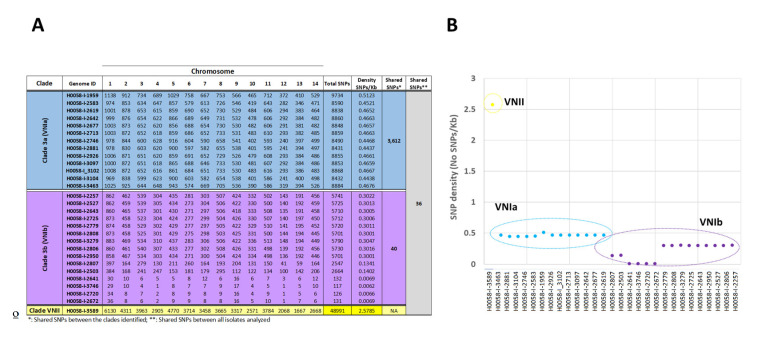
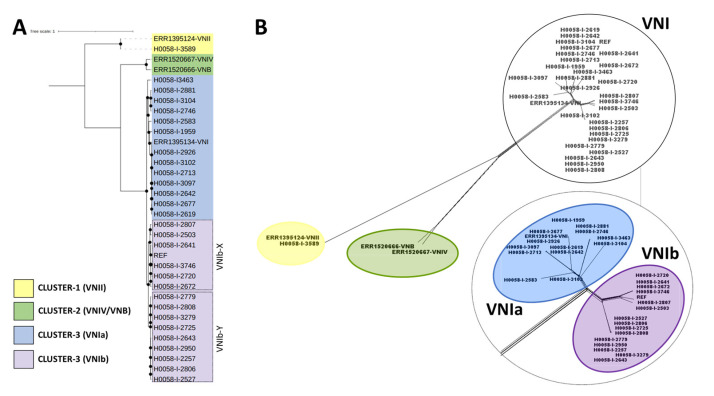
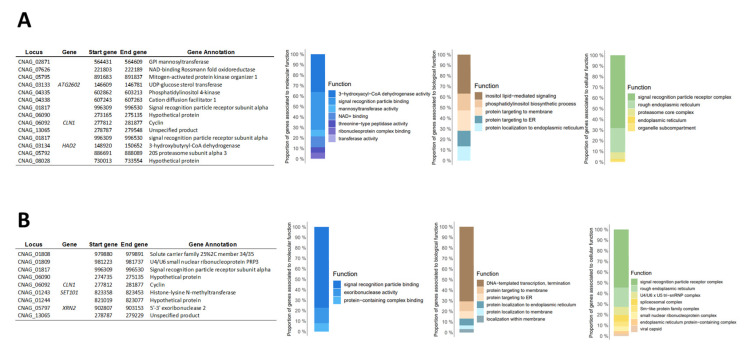
species complexes are recognized as environmental fungi responsible for lethal meningoencephalitis in immunocompromised individuals. Despite the vast knowledge about the epidemiology and genetic diversity of this fungus in different regions of the world, more studies are necessary to comprehend the genomic profiles across South America, including Colombia, considered to be the second country with the highest number of Cryptococcosis. Here, we sequenced and analyzed the genomic architecture of 29 Colombian isolates and evaluated the phylogenetic relationship of these strains with publicly available genomes. The phylogenomic analysis showed that 97% of the isolates belonged to the VNI molecular type and the presence of sub-lineages and sub-clades. We evidenced a karyotype without changes, a low number of genes with copy number variations, and a moderate number of single-nucleotide polymorphisms (SNPs). Additionally, a difference in the number of SNPs between the sub-lineages/sub-clades was observed; some were involved in crucial fungi biological processes. Our study demonstrated the intraspecific divergence of in Colombia. These findings provide evidence that Colombian isolates do not probably require significant structural changes as adaptation mechanisms to the host. To the best of our knowledge, this is the first study to report the whole genome sequence of Colombian isolates.
物种复合体被认为是导致免疫功能低下个体发生致命性脑膜脑炎的环境真菌。尽管在世界不同地区对这种真菌的流行病学和遗传多样性已有广泛了解,但仍需要更多研究来了解包括哥伦比亚在内的南美洲的基因组概况,哥伦比亚被认为是隐球菌病病例数第二多的国家。在此,我们对29株哥伦比亚分离株的基因组结构进行了测序和分析,并评估了这些菌株与公开可用基因组的系统发育关系。系统基因组分析表明,97%的分离株属于VNI分子类型,并且存在亚谱系和亚分支。我们证实了核型无变化、具有拷贝数变异的基因数量较少以及中等数量的单核苷酸多态性(SNP)。此外,观察到亚谱系/亚分支之间SNP数量的差异;其中一些涉及关键的真菌生物学过程。我们的研究证明了哥伦比亚隐球菌的种内差异。这些发现提供了证据,表明哥伦比亚隐球菌分离株作为对宿主的适应机制可能不需要显著的结构变化。据我们所知,这是第一项报道哥伦比亚隐球菌分离株全基因组序列的研究。