Kafyra Maria, Kalafati Ioanna Panagiota, Dimitriou Maria, Grigoriou Effimia, Kokkinos Alexandros, Rallidis Loukianos, Kolovou Genovefa, Trovas Georgios, Marouli Eirini, Deloukas Panos, Moulos Panagiotis, Dedoussis George V
Department of Nutrition and Dietetics, School of Health Science and Education, Harokopio University, 17671 Athens, Greece.
Department of Nutrition and Dietetics, School of Physical Education, Sport Science and Dietetics, University of Thessaly, 42132 Trikala, Greece.
J Pers Med. 2023 Feb 14;13(2):327. doi: 10.3390/jpm13020327.
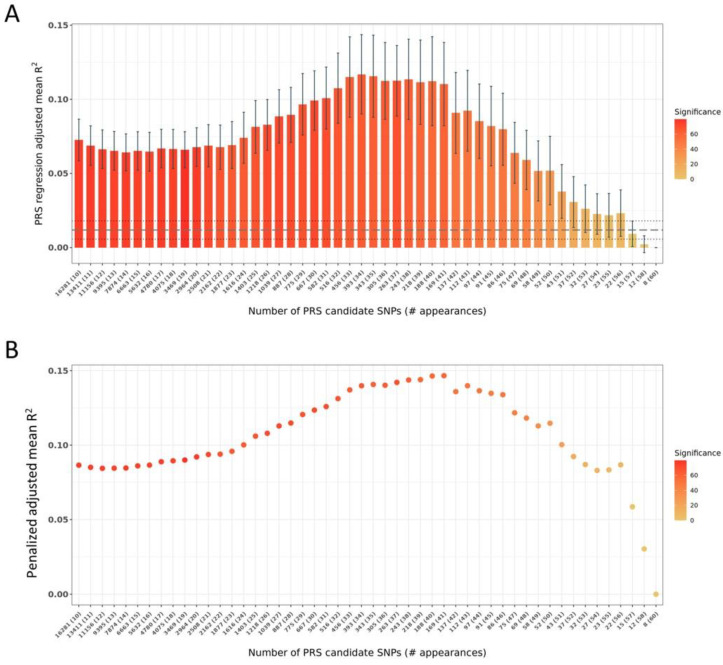
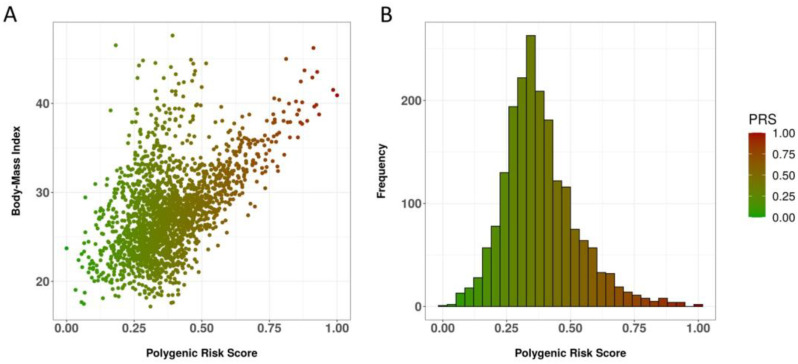
Quantifying the role of genetics via construction of polygenic risk scores (PRSs) is deemed a resourceful tool to enable and promote effective obesity prevention strategies. The present paper proposes a novel methodology for PRS extraction and presents the first PRS for body mass index (BMI) in a Greek population. A novel pipeline for PRS derivation was used to analyze genetic data from a unified database of three cohorts of Greek adults. The pipeline spans various steps of the process, from iterative dataset splitting to training and test partitions, calculation of summary statistics and PRS extraction, up to PRS aggregation and stabilization, achieving higher evaluation metrics. Using data from 2185 participants, implementation of the pipeline enabled consecutive repetitions in splitting training and testing samples and resulted in a 343-single nucleotide polymorphism PRS yielding an R = 0.3241 (beta = 1.011, -value = 4 × 10) for BMI. PRS-included variants displayed a variety of associations with known traits (i.e., blood cell count, gut microbiome, lifestyle parameters). The proposed methodology led to creation of the first-ever PRS for BMI in Greek adults and aims at promoting a facilitating approach to reliable PRS development and integration in healthcare practice.
通过构建多基因风险评分(PRS)来量化遗传学的作用,被认为是一种有助于制定和推动有效肥胖预防策略的有用工具。本文提出了一种提取PRS的新方法,并给出了希腊人群中首个体重指数(BMI)的PRS。采用一种新的PRS推导流程,对来自希腊成年人三个队列的统一数据库中的遗传数据进行分析。该流程涵盖了从迭代数据集拆分到训练和测试分区、汇总统计量计算和PRS提取,直至PRS聚合和稳定化等过程的各个步骤,获得了更高的评估指标。利用2185名参与者的数据,该流程在训练和测试样本拆分中实现了连续重复,并得到了一个包含343个单核苷酸多态性的PRS,其BMI的R值为0.3241(β = 1.011,P值 = 4×10)。包含在PRS中的变异与已知特征(如血细胞计数、肠道微生物群、生活方式参数)呈现出多种关联。所提出的方法促成了希腊成年人中首个BMI的PRS的创建,旨在推动一种有助于可靠的PRS开发及将其整合到医疗实践中的方法。