Second Department of Internal Diseases, Section "Gastroenterology", Medical Faculty, Medical University of Plovdiv, 6000 Plovdiv, Bulgaria.
Gastroenterology Clinic, University Hospital "Kaspela", 4001 Plovdiv, Bulgaria.
Medicina (Kaunas). 2023 Feb 13;59(2):351. doi: 10.3390/medicina59020351.
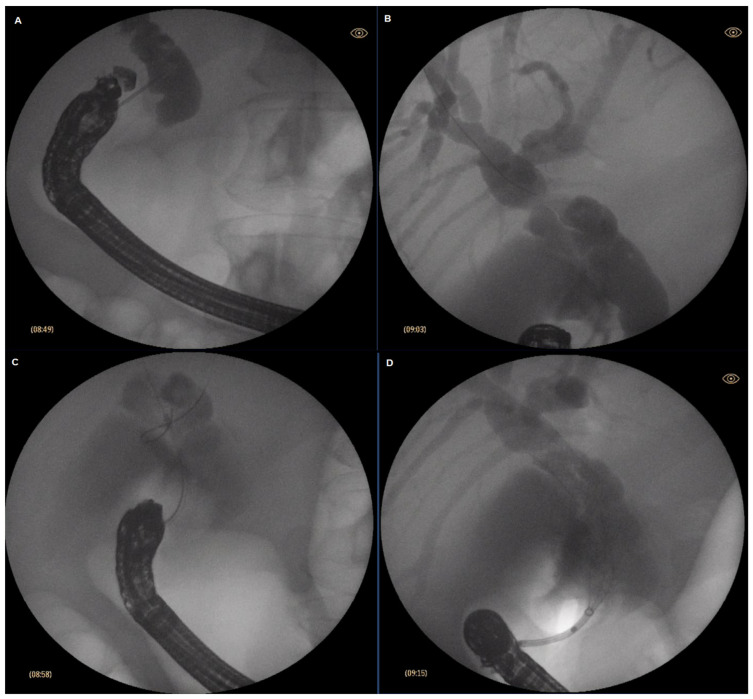
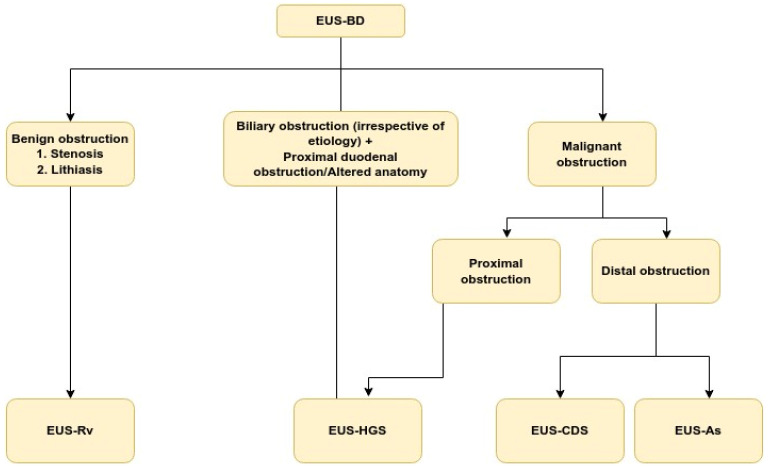
Pancreatic ductal adenocarcinoma (PDA) is associated with poor prognosis and 98% loss-of-life expectancy. 80% of patients with PDA are unfit for radical surgery. In those cases, emphasis is set on management of cancer-related symptoms, among which obstructive jaundice is most common. Endoscopic ultrasound-guided biliary drainage (EUS-BD) emerges as a valid alternative to the well-accepted methods for treatment of biliary obstruction. Five consecutive patients with unresectable pancreatic malignancy, were subjected to EUS-BD, particularly EUS-guided choledochoduodenostomy (EUS-CDS). Oral and written informed consent was obtained in all cases prior procedure. EUS-guided puncture of the common bile duct was performed, followed by advancement of a guidewire to the intrahepatic bile ducts. After dilation of the fistulous tract with a cystotome, a fully covered self-expandable metal stent was inserted below the hepatic confluence and extending at least 3 cm in the duodenum. Technical and clinical success was achieved in four patients without adverse events. In one patient procedure failed due to dislocation of the guidewire, with consequent biliary leakage requiring urgent surgery. Recovery was uneventful with no further clinical sequelae and there was no mortality associated with procedure. Introduced in 2001, EUS-guided biliary drainage has become an accepted option for treatment of obstructive jaundice. According to recent guidelines published by European Society of Gastrointestinal Endoscopy (ESGE) in 2022, EUS-CDS is a preferred modality to percutaneous transhepatic biliary drainage (PTBD) and surgery in patients with failed ERCP, with comparable efficiency and better safety profile, which is supported by our experience with the procedure. Our case series suggests that EUS-CDS is an excellent option for palliative management of malignant distal biliary obstruction, emphasizes on the importance of adequate technique and experience for the technical success, and urges the need for future research on establishing the best choice for guidewire and dilation device.
胰腺导管腺癌(PDA)预后不良,98%的患者失去预期寿命。80%的 PDA 患者不适合根治性手术。在这些情况下,重点是管理癌症相关症状,其中梗阻性黄疸最为常见。超声内镜引导下胆道引流术(EUS-BD)是治疗胆道梗阻的一种有效替代方法,已被广泛接受。连续 5 例不可切除的胰腺恶性肿瘤患者接受了 EUS-BD,特别是超声内镜引导下胆肠吻合术(EUS-CDS)。所有患者在术前均获得了口头和书面知情同意。在所有患者中均进行了超声内镜引导下胆总管穿刺,然后将导丝推进肝内胆管。用膀胱切开刀扩张瘘管后,将完全覆膜自膨式金属支架插入肝汇合部下方,至少在十二指肠内延伸 3 厘米。4 例患者的技术和临床均获得成功,无不良事件发生。在 1 例患者中,由于导丝脱位导致操作失败,随后出现胆汁漏,需要紧急手术。患者恢复顺利,无进一步的临床后遗症,与操作相关的死亡率为零。EUS-BD 于 2001 年推出,现已成为治疗梗阻性黄疸的一种公认选择。根据欧洲胃肠道内镜学会(ESGE)2022 年发布的最新指南,EUS-CDS 是 ERCP 失败患者首选的治疗方法,与经皮经肝胆道引流术(PTBD)和手术具有同等的效率和更好的安全性,这与我们对该手术的经验相符。我们的病例系列表明,EUS-CDS 是治疗恶性远端胆道梗阻的姑息性治疗的极好选择,强调了适当的技术和经验对于技术成功的重要性,并呼吁未来进行研究以确定最佳的导丝和扩张设备选择。