Department of Prosthodontics, Faculty of Stomatology, Yerevan State Medical University after Mkhitar Heratsi, Str. Koryun 2, Yerevan 0025, Armenia.
Conservative Dentistry Unit, School of Dental Sciences, Health Campus, Universiti Sains Malaysia, Kubang Kerian, Kota Bharu 16150, Kelantan, Malaysia.
Molecules. 2023 Feb 8;28(4):1619. doi: 10.3390/molecules28041619.
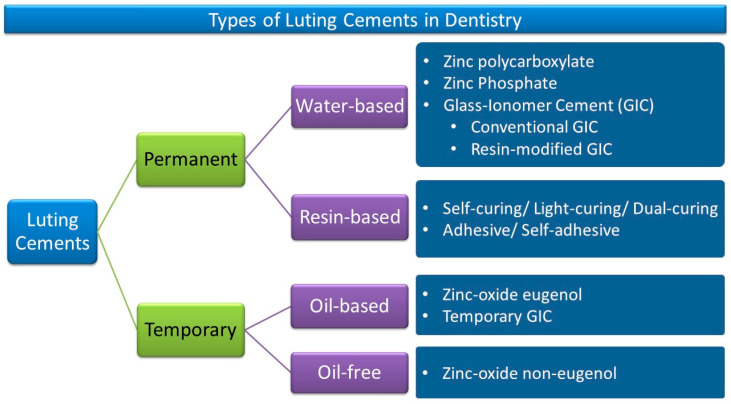
The cementation of indirect restoration is one of the most important steps in prosthetic and restorative dentistry. Cementation aims to bond the prosthetic restoration to the prepared enamel or enamel and dentine. Successful cementation protocols prevent biofilm formation at the margin between tooth and restoration and minimize mechanical and biological complications. With the advancements in dental cements, they have been modified to be versatile in terms of handling, curing, and bond strengths. This review presents updates on dental cements, focusing on the composition, properties, advantages, limitations, and indications of the various cements available. Currently, dental restorations are made from various biomaterials, and depending on each clinical case, an appropriate luting material will be selected. There is no luting material that can be universally used. Therefore, it is important to distinguish the physical, mechanical, and biological properties of luting materials in order to identify the best options for each case. Nowadays, the most commonly used dental cements are glass-ionomer and resin cement. The type, shade, thickness of resin cement and the shade of the ceramic, all together, have a tangible influence on the final restoration color. Surface treatments of the restoration increase the microtensile bond strength. Hence, the proper surface treatment protocol of both the substrate and restoration surfaces is needed before cementation. Additionally, the manufacturer's instructions for the thin cement-layer thickness are important for the long-term success of the restoration.
间接修复体的粘固是修复体和牙体牙髓治疗中最重要的步骤之一。粘固的目的是将修复体粘结到预备好的牙釉质或牙釉质和牙本质上。成功的粘固方案可防止在牙体和修复体之间的边缘形成生物膜,并最大程度地减少机械和生物并发症。随着牙科水门汀的进步,它们在操作、固化和粘结强度方面已经变得更加多样化。本综述介绍了牙科水门汀的最新进展,重点介绍了各种可用水门汀的组成、性能、优点、局限性和适应证。目前,牙科修复体由各种生物材料制成,根据每个临床病例,将选择合适的粘固材料。没有一种粘固材料可以普遍使用。因此,区分粘固材料的物理、机械和生物学特性以确定每种情况的最佳选择非常重要。如今,最常用的牙科水门汀是玻璃离子水门汀和树脂水门汀。树脂水门汀的类型、颜色、厚度和陶瓷的颜色,都会对最终修复体的颜色产生明显的影响。修复体的表面处理会增加微拉伸粘结强度。因此,在粘固之前,需要对基底和修复体表面进行适当的表面处理。此外,制造商对薄水门汀层厚度的说明对修复体的长期成功也很重要。