Beijing Advanced Innovation Center for Materials Genome Engineering, Institute of Physics, Chinese Academy of Sciences, Beijing National Laboratory for Condensed Matter Physics, Beijing, 100190, China.
School of Integrated Circuits, School of Optical and Electronic Information, Wuhan National Laboratory for Optoelectronics (WNLO), Optics Valley Laboratory, Huazhong University of Science and Technology, Wuhan, 430074, China.
Nat Commun. 2023 Feb 25;14(1):1082. doi: 10.1038/s41467-023-36853-x.
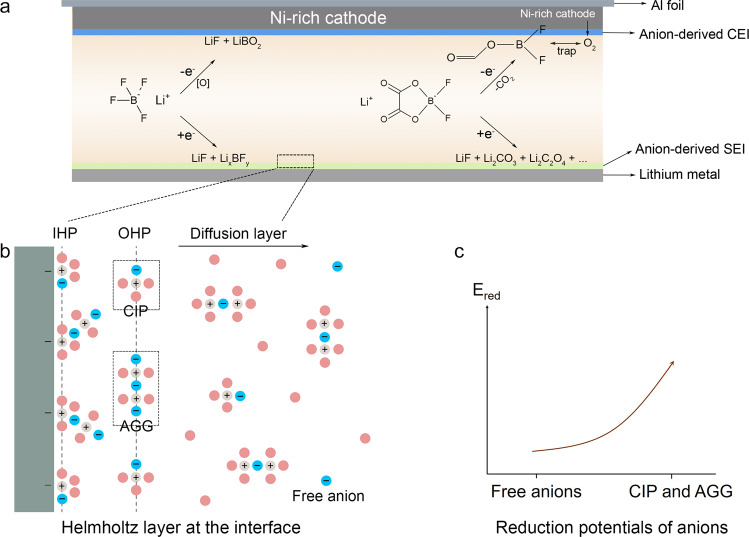
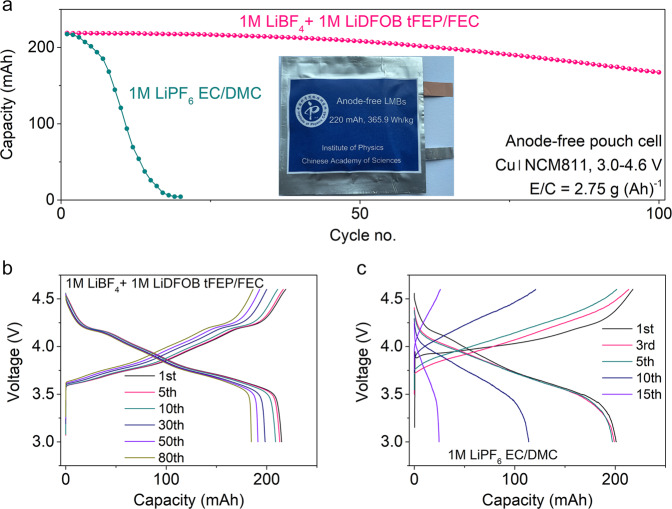
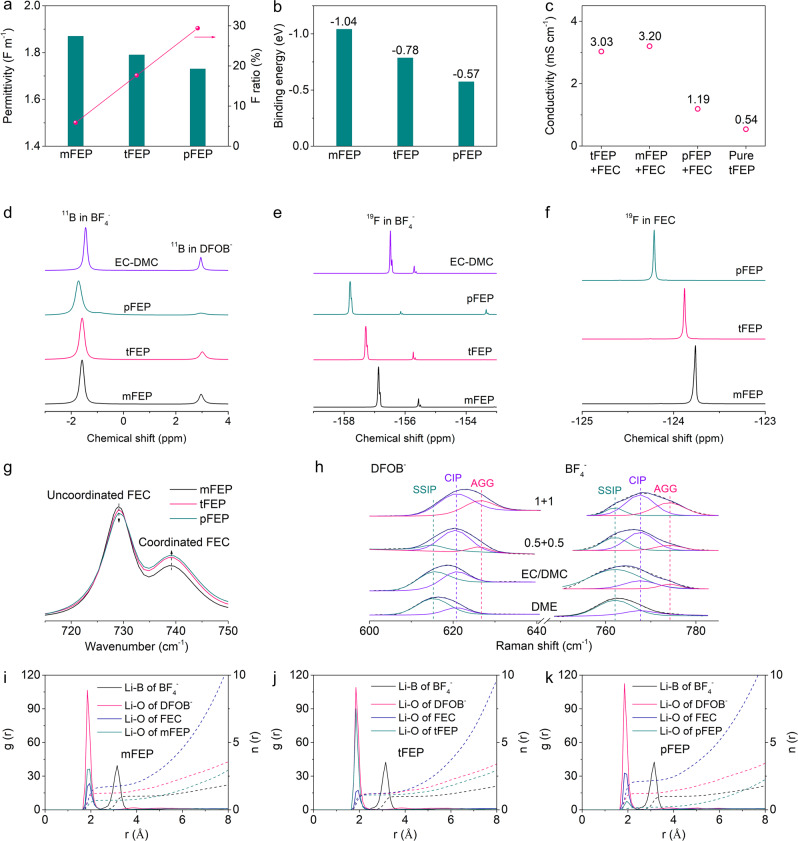
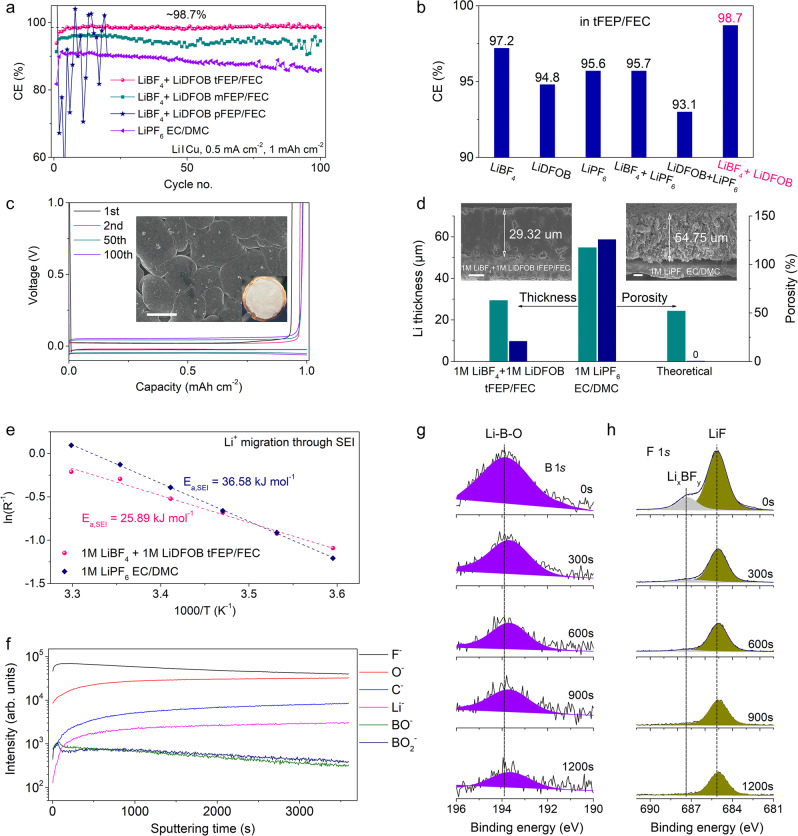
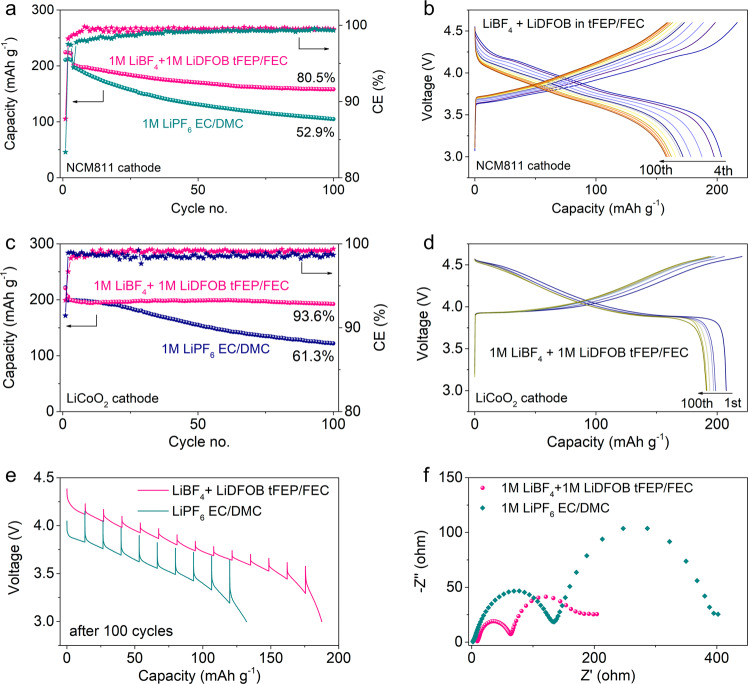
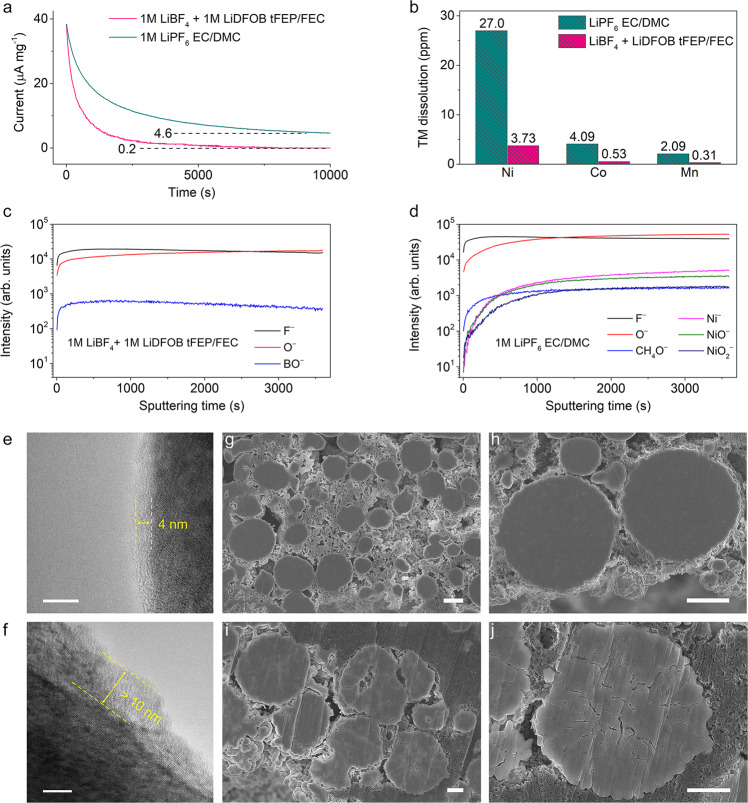
Aggressive chemistry involving Li metal anode (LMA) and high-voltage LiNiMnCoO (NCM811) cathode is deemed as a pragmatic approach to pursue the desperate 400 Wh kg. Yet, their implementation is plagued by low Coulombic efficiency and inferior cycling stability. Herein, we propose an optimally fluorinated linear carboxylic ester (ethyl 3,3,3-trifluoropropanoate, FEP) paired with weakly solvating fluoroethylene carbonate and dissociated lithium salts (LiBF and LiDFOB) to prepare a weakly solvating and dissociated electrolyte. An anion-enrichment interface prompts more anions' decomposition in the inner Helmholtz plane and higher reduction potential of anions. Consequently, the anion-derived interface chemistry contributes to the compact and columnar-structure Li deposits with a high CE of 98.7% and stable cycling of 4.6 V NCM811 and LiCoO cathode. Accordingly, industrial anode-free pouch cells under harsh testing conditions deliver a high energy of 442.5 Wh kg with 80% capacity retention after 100 cycles.
采用含锂金属阳极(LMA)和高压 LiNiMnCoO(NCM811)阴极的激进化学方法被认为是追求迫切需要的 400Whkg 的实用方法。然而,它们的实施受到低库仑效率和较差的循环稳定性的困扰。在此,我们提出了一种优化的氟化线性羧酸酯(乙基 3,3,3-三氟丙酸盐,FEP)与弱溶剂化的氟代碳酸乙烯酯和解离的锂盐(LiBF 和 LiDFOB)配合,制备一种弱溶剂化和解离的电解质。阴离子富集界面促使更多的阴离子在内亥姆霍兹平面中分解和阴离子的还原电位更高。因此,阴离子衍生的界面化学有助于形成紧密和柱状结构的 Li 沉积,具有 98.7%的高 CE 和 4.6V NCM811 和 LiCoO 阴极的稳定循环。相应地,在苛刻的测试条件下,工业无阳极软包电池在 100 次循环后具有 442.5Whkg 的高能量和 80%的容量保持率。