Institute for Immunodeficiency, Center for Chronic Immunodeficiency (CCI), Faculty of Medicine, Medical Center - University of Freiburg, Freiburg, Germany.
Center for Pediatrics and Adolescent Medicine, Department of Pediatric Hematology and Oncology, Faculty of Medicine, Medical Center - University of Freiburg, Mathildenstr. 1, 79106, Freiburg, Germany.
J Clin Immunol. 2023 Jul;43(5):965-978. doi: 10.1007/s10875-023-01450-6. Epub 2023 Feb 27.
T-cell receptor excision circle (TREC)-based newborn screening (NBS) for severe combined immunodeficiencies (SCID) was introduced in Germany in August 2019.
Children with abnormal TREC-NBS were referred to a newly established network of Combined Immunodeficiency (CID) Clinics and Centers. The Working Group for Pediatric Immunology (API) and German Society for Newborn Screening (DGNS) performed 6-monthly surveys to assess the TREC-NBS process after 2.5 years.
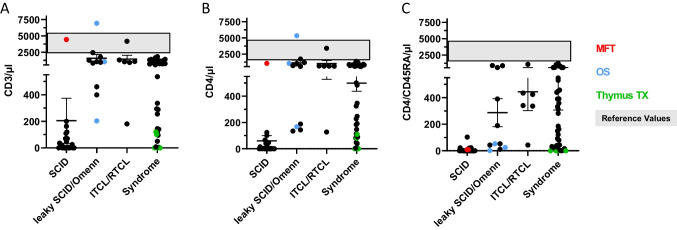
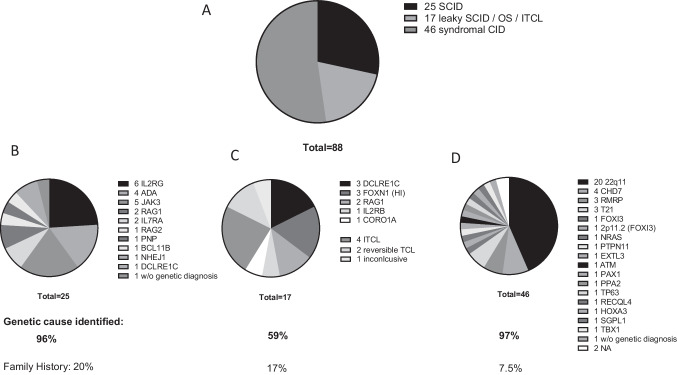
Among 1.9 million screened newborns, 88 patients with congenital T-cell lymphocytopenia were identified (25 SCID, 17 leaky SCID/Omenn syndrome (OS)/idiopathic T-cell lymphocytopenia, and 46 syndromic disorders). A genetic diagnosis was established in 88%. Twenty-six patients underwent hematopoietic stem cell transplantation (HSCT), 23/26 within 4 months of life. Of these, 25/26 (96%) were alive at last follow-up. Two patients presented with in utero onset OS and died after birth. Five patients with syndromic disorders underwent thymus transplantation. Eight syndromic patients deceased, all from non-immunological complications. TREC-NBS missed one patient, who later presented clinically, and one tracking failure occurred after an inconclusive screening result.
The German TREC-NBS represents the largest European SCID screening at this point. The incidence of SCID/leaky SCID/OS in Germany is approximately 1:54,000, very similar to previous observations from North American and European regions and countries where TREC-NBS was implemented. The newly founded API-CID network facilitates tracking and treatment of identified patients. Short-term HSCT outcome was excellent, but NBS and transplant registries will remain essential to evaluate the long-term outcome and to compare results across the rising numbers of TREC-NBS programs across Europe.
德国于 2019 年 8 月引入 T 细胞受体切除环(TREC)为基础的新生儿筛查(NBS)用于严重联合免疫缺陷(SCID)。
TREC-NBS 异常的儿童被转介至新成立的联合免疫缺陷(CID)诊所和中心网络。儿科免疫学工作组(API)和德国新生儿筛查协会(DGNS)每 6 个月进行一次调查,以评估引入 2.5 年后的 TREC-NBS 流程。
在 190 万筛查的新生儿中,发现了 88 例先天性 T 细胞淋巴细胞减少症患者(25 例 SCID、17 例漏诊 SCID/Omenn 综合征(OS)/特发性 T 细胞淋巴细胞减少症和 46 例综合征)。88%的患者建立了基因诊断。26 例患者接受了造血干细胞移植(HSCT),其中 23 例在生命的 4 个月内进行。在这些患者中,25/26(96%)在最后一次随访时仍然存活。两名患者在宫内发病 OS,并在出生后死亡。5 例综合征患者接受了胸腺移植。8 例综合征患者死亡,均死于非免疫性并发症。TREC-NBS 漏诊了一名后来出现临床症状的患者,一次筛查结果不确定后发生了一次跟踪失败。
德国的 TREC-NBS 是目前欧洲最大的 SCID 筛查。德国 SCID/漏诊 SCID/OS 的发病率约为 1:54000,与北美和欧洲地区及实施 TREC-NBS 的其他国家的以往观察结果非常相似。新成立的 API-CID 网络便于跟踪和治疗已识别的患者。短期 HSCT 结果非常好,但 NBS 和移植登记处将仍然是评估长期结果和比较欧洲不断增加的 TREC-NBS 项目结果的关键。