Tobudic Selma, Simader Elisabeth, Deimel Thomas, Straub Jennifer, Kartnig Felix, Heinz Leonhard X, Mandl Peter, Haslacher Helmuth, Perkmann Thomas, Schneider Lisa, Nothnagl Thomas, Radner Helga, Winkler Florian, Burgmann Heinz, Stiasny Karin, Novacek Gottfried, Reinisch Walter, Aletaha Daniel, Winkler Stefan, Blüml Stephan
Division of Infectious Diseases and Tropical Medicine, Department of Internal Medicine I, Medical University of Vienna, Vienna, Austria.
Division of Rheumatology, Department of Internal Medicine III, Medical University of Vienna, Vienna, Austria.
Front Med (Lausanne). 2023 Feb 9;10:1049157. doi: 10.3389/fmed.2023.1049157. eCollection 2023.
This study aimed to assess the duration of humoral responses after two doses of SARS-CoV-2 mRNA vaccines in patients with inflammatory joint diseases and IBD and booster vaccination compared with healthy controls. It also aimed to analyze factors influencing the quantity and quality of the immune response.
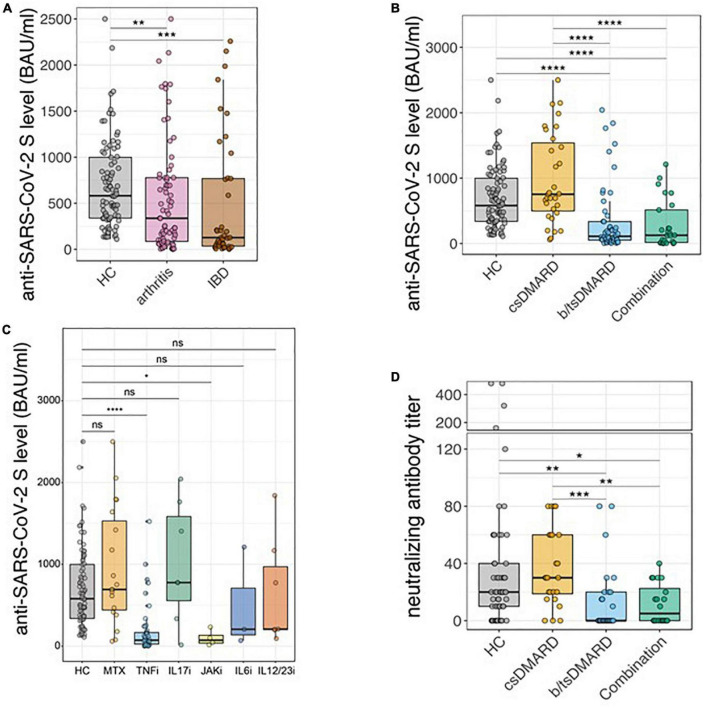
We enrolled 41 patients with rheumatoid arthritis (RA), 35 with seronegative spondyloarthritis (SpA), and 41 suffering from inflammatory bowel disease (IBD), excluding those receiving B-cell-depleting therapies. We assessed total anti-SARS-CoV-2 spike antibodies (Abs) and neutralizing Ab titers 6 months after two and then after three doses of mRNA vaccines compared with healthy controls. We analyzed the influence of therapies on the humoral response.
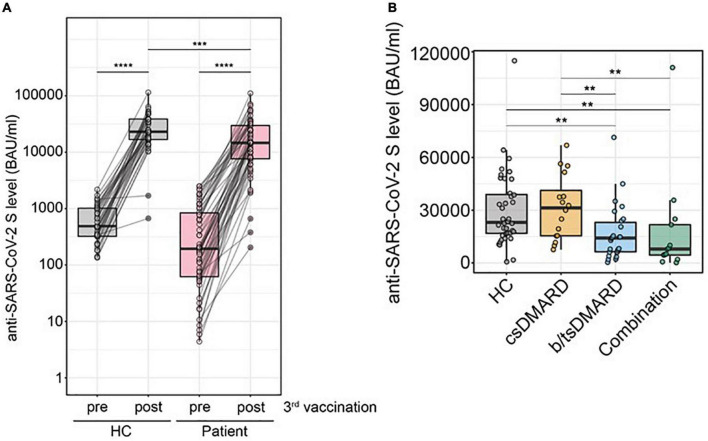
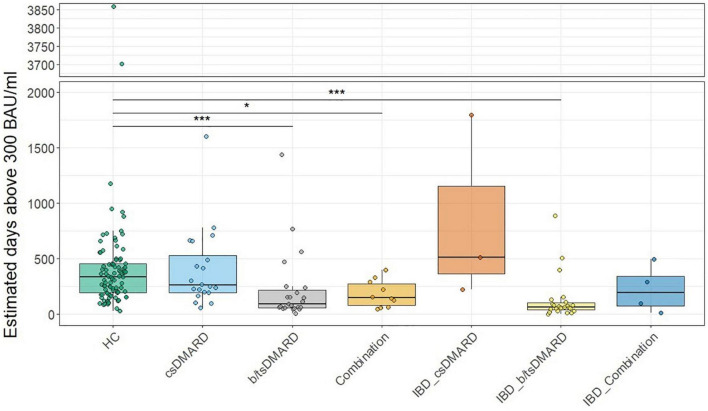
Patients receiving biological or targeted synthetic disease-modifying antirheumatic drugs (b/tsDMARDs) showed reduced anti-SARS-CoV-2 S Abs and neutralizing Ab titers compared with HC or patients receiving conventional synthetic (cs)DMARDs 6 months after the first two vaccination doses. Anti-SARS-CoV-2 S titers of patients with b/tsDMARDs declined more rapidly, leading to a significant reduction in the duration of vaccination-induced immunity after two doses of SARS-CoV-2 mRNA vaccines. While 23% of HC and 19% of patients receiving csDMARDs were without detectable neutralizing Abs 6 months after the first two vaccination doses, this number was 62% in patients receiving b/tsDMARDs and 52% in patients receiving a combination of csDMARDs and b/tsDMARDs. Booster vaccination led to increased anti-SARS-CoV-2 S Abs in all HC and patients. However, anti-SARS-CoV-2 S Abs after booster vaccination was diminished in patients receiving b/tsDMARDs, either alone or in combination with csDMARDs compared to HC.
Patients receiving b/tsDMARDs have significantly reduced Abs and neutralizing Ab titers 6 months after mRNA vaccination against SARS-CoV-2. This was due to a faster decline in Ab levels, indicating a significantly reduced duration of vaccination-induced immunity compared with HC or patients receiving csDMARDs. In addition, they display a reduced response to a booster vaccination, warranting earlier booster vaccination strategies in patients under b/tsDMARD therapy, according to their specific Ab levels.
本研究旨在评估炎症性关节疾病和炎症性肠病(IBD)患者接种两剂严重急性呼吸综合征冠状病毒2(SARS-CoV-2)信使核糖核酸(mRNA)疫苗后的体液免疫反应持续时间,并与健康对照者进行加强免疫接种比较。本研究还旨在分析影响免疫反应数量和质量的因素。
我们招募了41例类风湿关节炎(RA)患者、35例血清阴性脊柱关节炎(SpA)患者和41例炎症性肠病(IBD)患者,排除接受B细胞清除疗法的患者。与健康对照者相比,我们在接种两剂mRNA疫苗6个月后以及接种三剂后评估了抗SARS-CoV-2刺突抗体(Abs)总量和中和抗体滴度。我们分析了各种疗法对体液免疫反应的影响。
与健康对照者或接受传统合成(cs)改善病情抗风湿药物的患者相比,接受生物制剂或靶向合成改善病情抗风湿药物(b/tsDMARDs)的患者在接种前两剂疫苗6个月后,抗SARS-CoV-2 S Abs和中和抗体滴度降低。接受b/tsDMARDs治疗的患者抗SARS-CoV-2 S滴度下降更快,导致接种两剂SARS-CoV-2 mRNA疫苗后疫苗诱导免疫的持续时间显著缩短。在前两剂疫苗接种6个月后,23%的健康对照者和19%接受csDMARDs治疗的患者无法检测到中和抗体,而接受b/tsDMARDs治疗的患者这一比例为62%,接受csDMARDs和b/tsDMARDs联合治疗的患者这一比例为52%。加强免疫接种使所有健康对照者和患者的抗SARS-CoV-2 S Abs增加。然而,与健康对照者相比,接受b/tsDMARDs单独治疗或与csDMARDs联合治疗的患者在加强免疫接种后的抗SARS-CoV-2 S Abs减少。
接种针对SARS-CoV-2的mRNA疫苗6个月后,接受b/tsDMARDs治疗的患者的抗体和中和抗体滴度显著降低。这是由于抗体水平下降更快,表明与健康对照者或接受csDMARDs治疗的患者相比,疫苗诱导免疫的持续时间显著缩短。此外,他们对加强免疫接种的反应降低,根据其特定的抗体水平,有必要对接受b/tsDMARDs治疗的患者采取更早的加强免疫接种策略。