Institute of Specific Prophylaxis and Tropical Medicine, Center for Pathophysiology, Infectiology and Immunology, Medical University Vienna, Vienna, Austria.
Institute for Hygiene and Applied Immunology, Center for Pathophysiology, Infectiology and Immunology, Medical University Vienna, Vienna, Austria.
Front Immunol. 2022 May 12;13:889138. doi: 10.3389/fimmu.2022.889138. eCollection 2022.
Individuals with secondary immunodeficiencies belong to the most vulnerable groups to succumb to COVID-19 and thus are prioritized for SARS-CoV-2 vaccination. However, knowledge about the persistence and anamnestic responses following SARS-CoV-2-mRNA vaccinations is limited in these patients.
In a prospective, open-label, phase four trial we analyzed S1-specific IgG, neutralizing antibodies and cytokine responses in previously non-infected patients with cancer or autoimmune disease during primary mRNA vaccination and up to one month after booster.
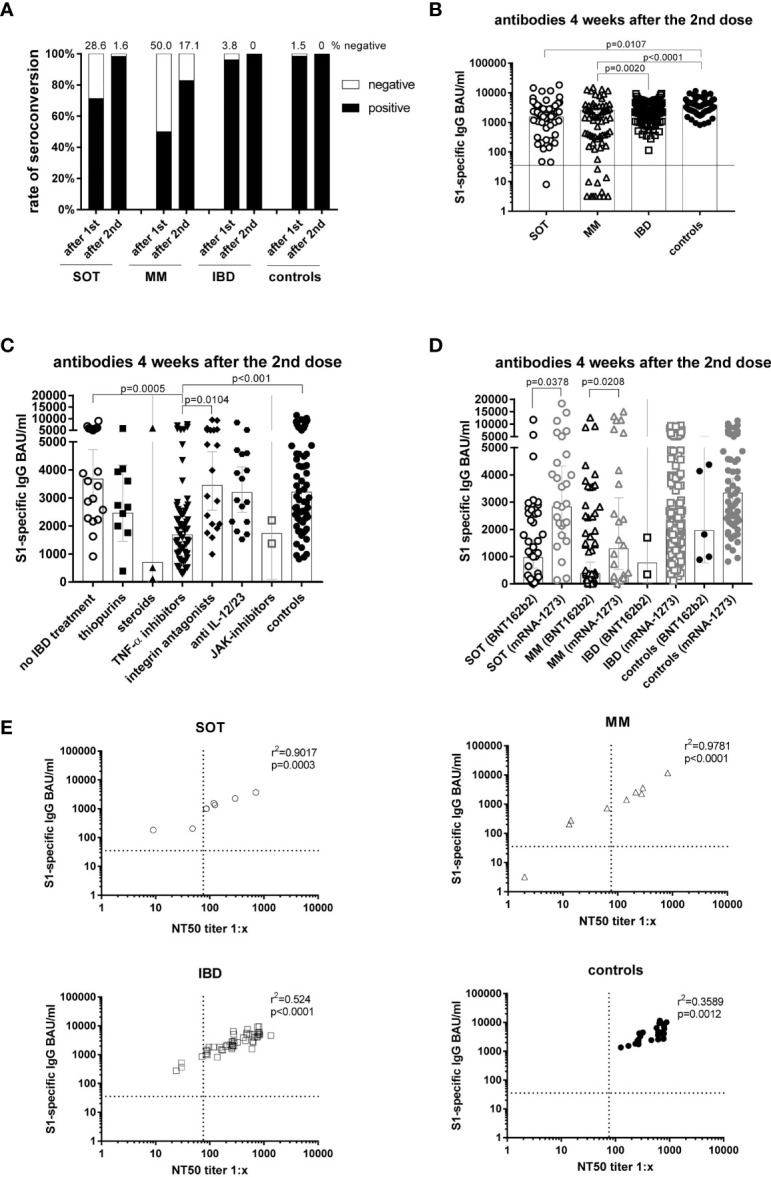
263 patients with solid tumors (SOT, n=63), multiple myeloma (MM, n=70), inflammatory bowel diseases (IBD, n=130) and 66 controls were analyzed. One month after the two-dose primary vaccination the highest non-responder rate was associated with lower CD19 B-cell counts and was found in MM patients (17%). S1-specific IgG levels correlated with IL-2 and IFN-γ responses in controls and IBD patients, but not in cancer patients. Six months after the second dose, 18% of patients with MM, 10% with SOT and 4% with IBD became seronegative; no one from the control group became negative. However, in IBD patients treated with TNF-α inhibitors, antibody levels declined more rapidly than in controls. Overall, vaccination with mRNA-1273 led to higher antibody levels than with BNT162b2. Importantly, booster vaccination increased antibody levels >8-fold in seroresponders and induced anamnestic responses even in those with undetectable pre-booster antibody levels. Nevertheless, in IBD patients with TNF-α inhibitors even after booster vaccination, antibody levels were lower than in untreated IBD patients and controls.
Immunomonitoring of vaccine-specific antibody and cellular responses seems advisable to identify vaccination failures and consequently establishing personalized vaccination schedules, including shorter booster intervals, and helps to improve vaccine effectiveness in all patients with secondary immunodeficiencies.
EudraCT Number: 2021-000291-11.
继发免疫缺陷的个体属于最易感染 COVID-19 的脆弱人群,因此他们被优先接种 SARS-CoV-2 疫苗。然而,这些患者对 SARS-CoV-2-mRNA 疫苗接种后的持久性和记忆应答了解有限。
在一项前瞻性、开放标签、四期临床试验中,我们分析了原发性 mRNA 疫苗接种期间和加强针接种后一个月内,既往未感染的癌症或自身免疫性疾病患者的 S1 特异性 IgG、中和抗体和细胞因子反应。
共分析了 263 例实体瘤(SOT,n=63)、多发性骨髓瘤(MM,n=70)、炎症性肠病(IBD,n=130)和 66 例对照患者。两剂初级疫苗接种一个月后,无反应率最高与较低的 CD19 B 细胞计数相关,且在 MM 患者中(17%)发现。S1 特异性 IgG 水平与对照和 IBD 患者的 IL-2 和 IFN-γ 反应相关,但与癌症患者无关。第二剂接种后 6 个月,18%的 MM 患者、10%的 SOT 患者和 4%的 IBD 患者出现血清阴性;对照组中没有人转为阴性。然而,在接受 TNF-α 抑制剂治疗的 IBD 患者中,抗体水平下降速度快于对照组。总体而言,mRNA-1273 疫苗接种导致的抗体水平高于 BNT162b2。重要的是,加强针接种使血清学应答者的抗体水平增加了 8 倍以上,并诱导了记忆应答,即使在加强针接种前抗体水平无法检测到的患者中也是如此。尽管如此,在接受 TNF-α 抑制剂治疗的 IBD 患者中,即使加强针接种后,抗体水平仍低于未接受治疗的 IBD 患者和对照组。
免疫监测疫苗特异性抗体和细胞反应似乎是明智之举,以识别疫苗接种失败,并相应地制定个性化疫苗接种计划,包括缩短加强针间隔,有助于提高所有继发免疫缺陷患者的疫苗有效性。
EudraCT 编号:2021-000291-11。