Prestagiacomo Licia E, Tradigo Giuseppe, Aracri Federica, Gabriele Caterina, Rota Maria Antonietta, Alba Stefano, Cuda Giovanni, Damiano Rocco, Veltri Pierangelo, Gaspari Marco
Research Centre for Advanced Biochemistry and Molecular Biology, Department of Experimental and Clinical Medicine, Magna Graecia University of Catanzaro, 88100 Catanzaro, Italy.
Ecampus University, 22060 Novedrate, Italy.
ACS Omega. 2023 Feb 7;8(7):6244-6252. doi: 10.1021/acsomega.2c05487. eCollection 2023 Feb 21.
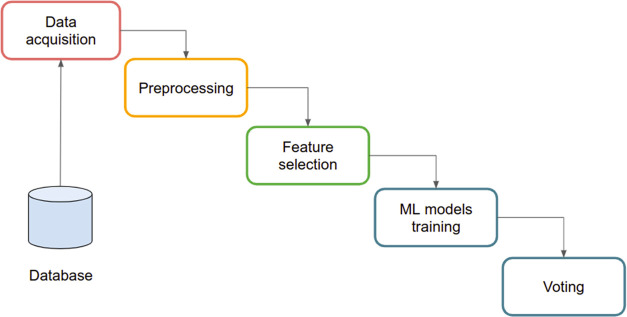
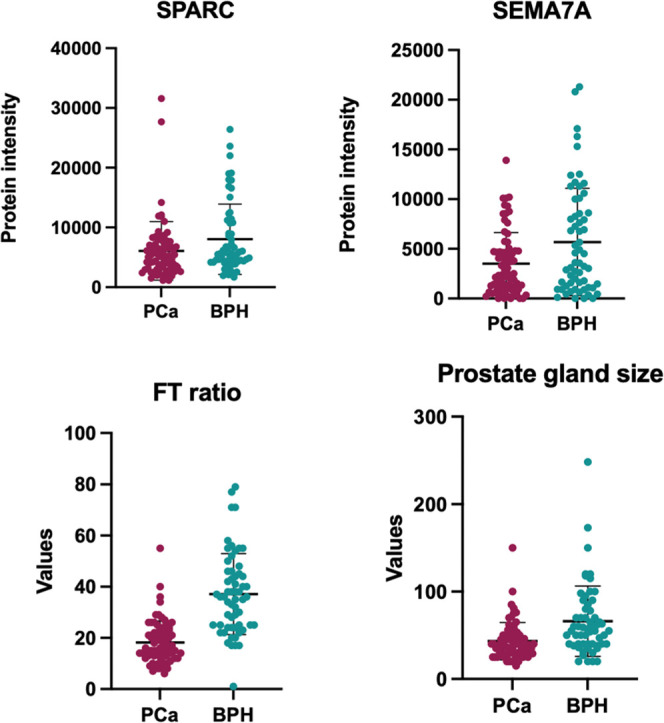
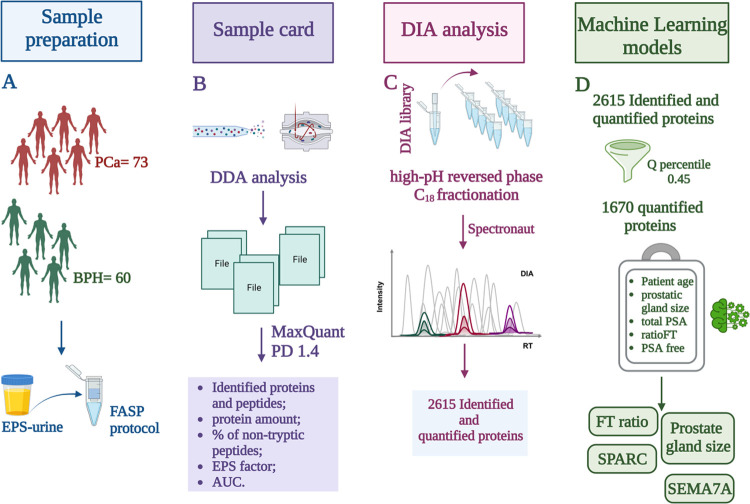
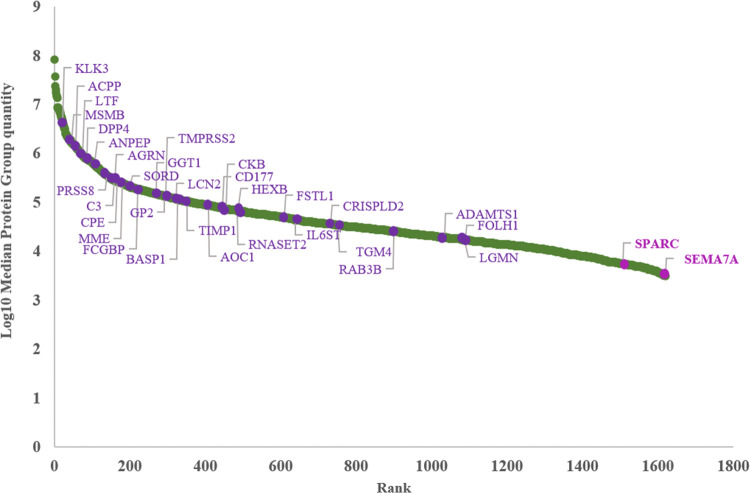
Prostate cancer (PCa) is annually the most frequently diagnosed cancer in the male population. To date, the diagnostic path for PCa detection includes the dosage of serum prostate-specific antigen (PSA) and the digital rectal exam (DRE). However, PSA-based screening has insufficient specificity and sensitivity; besides, it cannot discriminate between the aggressive and indolent types of PCa. For this reason, the improvement of new clinical approaches and the discovery of new biomarkers are necessary. In this work, expressed prostatic secretion (EPS)-urine samples from PCa patients and benign prostatic hyperplasia (BPH) patients were analyzed with the aim of detecting differentially expressed proteins between the two analyzed groups. To map the urinary proteome, EPS-urine samples were analyzed by data-independent acquisition (DIA), a high-sensitivity method particularly suitable for detecting proteins at low abundance. Overall, in our analysis, 2615 proteins were identified in 133 EPS-urine specimens obtaining the highest proteomic coverage for this type of sample; of these 2615 proteins, 1670 were consistently identified across the entire data set. The matrix containing the quantified proteins in each patient was integrated with clinical parameters such as the PSA level and gland size, and the complete matrix was analyzed by machine learning algorithms (by exploiting 90% of samples for training/testing using a 10-fold cross-validation approach, and 10% of samples for validation). The best predictive model was based on the following components: semaphorin-7A (sema7A), secreted protein acidic and rich in cysteine (SPARC), FT ratio, and prostate gland size. The classifier could predict disease conditions (BPH, PCa) correctly in 83% of samples in the validation set. Data are available via ProteomeXchange with the identifier PXD035942.
前列腺癌(PCa)是男性群体中每年诊断出的最常见癌症。迄今为止,PCa检测的诊断途径包括血清前列腺特异性抗原(PSA)检测和直肠指检(DRE)。然而,基于PSA的筛查特异性和敏感性不足;此外,它无法区分侵袭性和惰性类型的PCa。因此,改进新的临床方法和发现新的生物标志物是必要的。在这项工作中,对PCa患者和良性前列腺增生(BPH)患者的前列腺分泌液(EPS)尿液样本进行了分析,目的是检测两个分析组之间差异表达的蛋白质。为了绘制尿液蛋白质组图谱,通过数据非依赖采集(DIA)对EPS尿液样本进行分析,DIA是一种高灵敏度方法,特别适用于检测低丰度蛋白质。总体而言,在我们的分析中,在133个EPS尿液标本中鉴定出2615种蛋白质,获得了此类样本的最高蛋白质组覆盖率;在这2615种蛋白质中,有1670种在整个数据集中得到了一致鉴定。将每个患者中包含定量蛋白质的矩阵与临床参数(如PSA水平和腺体大小)整合,并通过机器学习算法对完整矩阵进行分析(使用10倍交叉验证方法,利用90%的样本进行训练/测试,10%的样本进行验证)。最佳预测模型基于以下成分:信号素-7A(sema7A)、富含半胱氨酸的酸性分泌蛋白(SPARC)、FT比值和前列腺腺体大小。该分类器在验证集中能够正确预测83%样本的疾病状况(BPH、PCa)。数据可通过ProteomeXchange获得,标识符为PXD035942。