Castellotti Serena, D'Agostino Ottavia, Del Viva Maria Michela
Department of Neurofarba, University of Florence, Florence, Italy.
Front Hum Neurosci. 2023 Feb 8;17:1049615. doi: 10.3389/fnhum.2023.1049615. eCollection 2023.
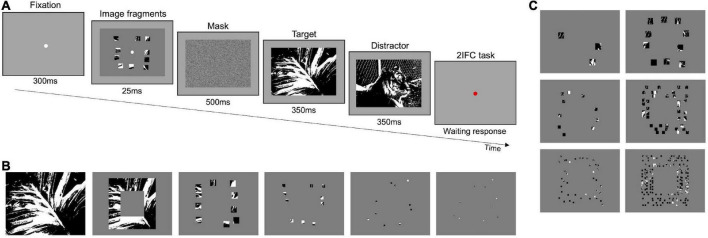
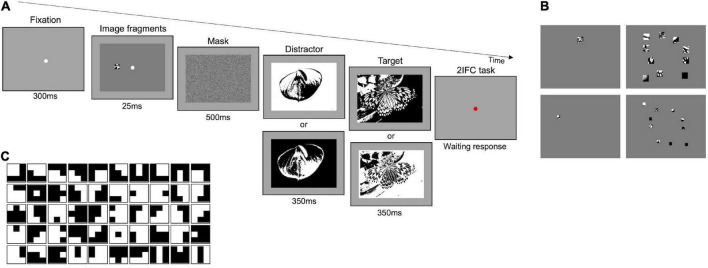
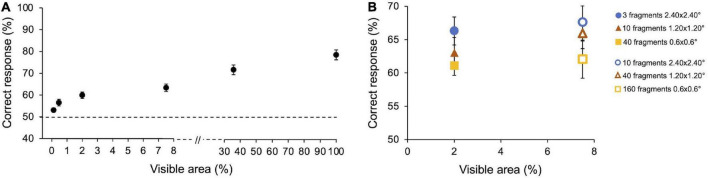
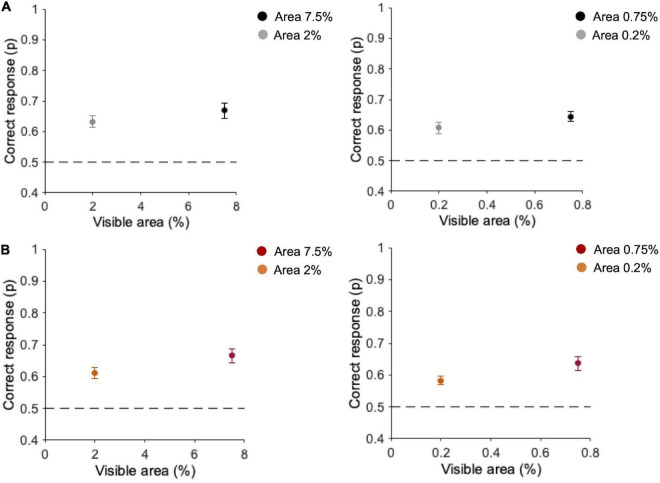
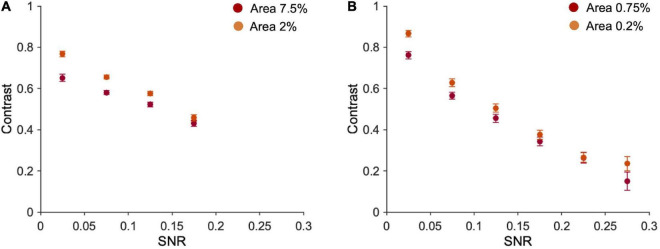
In naturalistic conditions, objects in the scene may be partly occluded and the visual system has to recognize the whole image based on the little information contained in some visible fragments. Previous studies demonstrated that humans can successfully recognize severely occluded images, but the underlying mechanisms occurring in the early stages of visual processing are still poorly understood. The main objective of this work is to investigate the contribution of local information contained in a few visible fragments to image discrimination in fast vision. It has been already shown that a specific set of features, predicted by a constrained maximum-entropy model to be optimal carriers of information (optimal features), are used to build simplified early visual representations (primal sketch) that are sufficient for fast image discrimination. These features are also considered salient by the visual system and can guide visual attention when presented isolated in artificial stimuli. Here, we explore whether these local features also play a significant role in more natural settings, where all existing features are kept, but the overall available information is drastically reduced. Indeed, the task requires discrimination of naturalistic images based on a very brief presentation (25 ms) of a few small visible image fragments. In the main experiment, we reduced the possibility to perform the task based on global-luminance positional cues by presenting randomly inverted-contrast images, and we measured how much observers' performance relies on the local features contained in the fragments or on global information. The size and the number of fragments were determined in two preliminary experiments. Results show that observers are very skilled in fast image discrimination, even when a drastic occlusion is applied. When observers cannot rely on the position of global-luminance information, the probability of correct discrimination increases when the visible fragments contain a high number of optimal features. These results suggest that such optimal local information contributes to the successful reconstruction of naturalistic images even in challenging conditions.
在自然主义条件下,场景中的物体可能会被部分遮挡,而视觉系统必须根据一些可见片段中包含的少量信息来识别整个图像。先前的研究表明,人类能够成功识别严重遮挡的图像,但视觉处理早期阶段发生的潜在机制仍知之甚少。这项工作的主要目的是研究少数可见片段中包含的局部信息对快速视觉中的图像辨别所做的贡献。已经表明,由约束最大熵模型预测为最佳信息载体的一组特定特征(最佳特征),被用于构建足以进行快速图像辨别的简化早期视觉表征(原始草图)。这些特征也被视觉系统视为显著特征,并且当在人工刺激中单独呈现时可以引导视觉注意力。在这里,我们探讨这些局部特征在更自然的环境中是否也发挥重要作用,在这种环境中,所有现有的特征都保留,但总体可用信息大幅减少。实际上,该任务要求根据几个小的可见图像片段的非常短暂的呈现(25毫秒)来辨别自然主义图像。在主要实验中,我们通过呈现随机反转对比度的图像来降低基于全局亮度位置线索执行任务的可能性,并测量观察者的表现有多少依赖于片段中包含的局部特征或全局信息。片段的大小和数量在两个初步实验中确定。结果表明,即使应用了严重遮挡,观察者在快速图像辨别方面也非常熟练。当观察者不能依赖全局亮度信息的位置时,当可见片段包含大量最佳特征时,正确辨别的概率会增加。这些结果表明,即使在具有挑战性的条件下,这种最佳局部信息也有助于自然主义图像的成功重建。