Department of Pathology and Molecular Medicine, Kingston Health Sciences Centre and Queen's University, Kingston K7L 3N6, Ontario, Canada.
Division of Infectious Diseases, Kingston Health Sciences Centre and Queen's University, Kingston K7L 3N6, Ontario, Canada.
Clin Biochem. 2023 Jun;116:1-6. doi: 10.1016/j.clinbiochem.2023.02.010. Epub 2023 Feb 26.
Semi-quantitative and quantitative immunoassays are the most commonly used methodology to evaluate immunity post immunization.
To compare four quantitative SARS-CoV-2 serological assays in COVID-19 patients and immunized healthy individuals, cancer patients, and patients with immunosuppressive therapy.
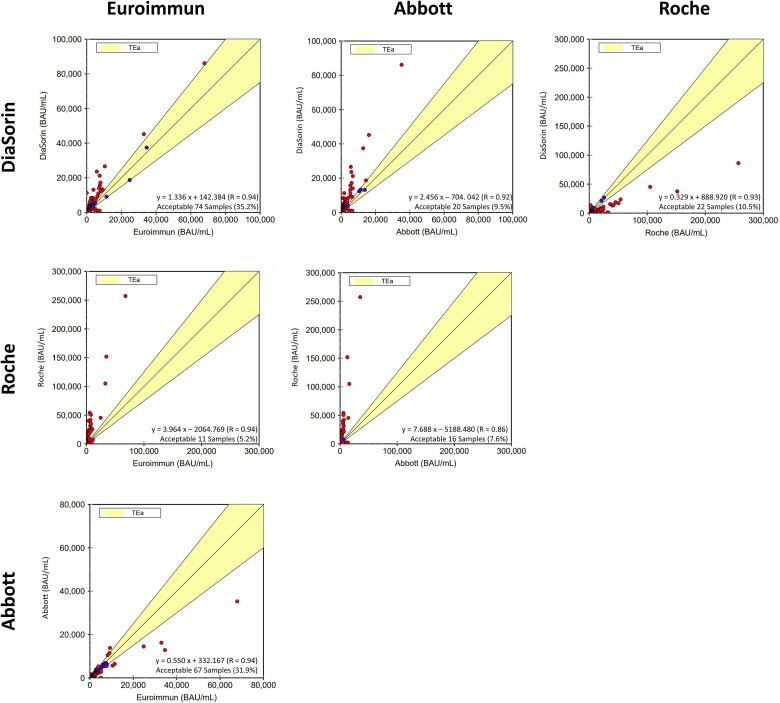
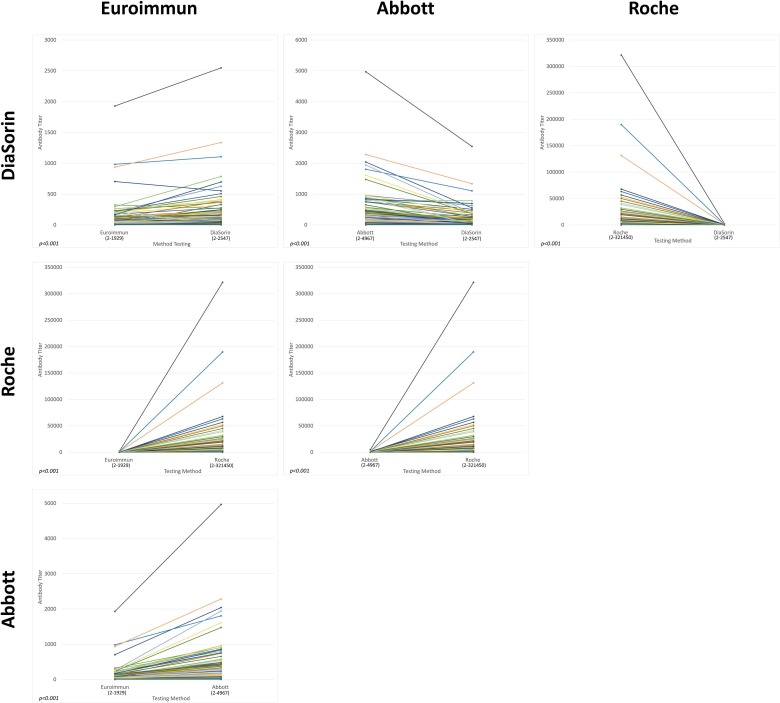
210 serological samples from COVID-19 infection and vaccination cohorts were used to create a serological sample repository. Serological methods from four manufacturers, namely Euroimmun, Roche, Abbott, and DiaSorin, were evaluated for quantitative, semi-quantitative, and qualitative antibody measurements. All four methods measure IgG antibodies against the SARS-CoV-2 spike receptor-binding domain and report the results in Binding Antibody Unit/mL (BAU/mL). A Total Error Allowable (TEa) of ±25% was chosen as the criteria to determine whether two methods are clinically equivalent quantitatively. Semi-quantitative results (titers) were derived using numeric antibody concentration divided by the cut-off value for each method.
All paired quantitative comparisons demonstrated unacceptable performance. With ±25% as TEa, the best agreement was 74 (35.2% out of 210 samples) between Euroimmun and DiaSorin, whereas the lowest agreement was 11 (5.2% out of 210 samples) between Euroimmun and Roche. Antibody titers amongst all four methods were significantly different (p < 0.001). The highest titer difference from the same sample is between Roche and DiaSorin with a 1392-fold difference. On qualitative comparison, none of the paired comparison showed acceptable comparison (p < 0.001).
Poor correlation exists between four evaluated assays, quantitatively, semi-quantitatively, and qualitatively. Further harmonization of assays is required to achieve comparable measurements.
半定量和定量免疫测定是评估免疫接种后免疫的最常用方法。
比较四种定量 SARS-CoV-2 血清学检测方法在 COVID-19 患者和免疫接种的健康个体、癌症患者和接受免疫抑制治疗的患者中的应用。
使用来自 COVID-19 感染和疫苗接种队列的 210 份血清学样本创建了一个血清学样本库。评估了来自四个制造商的血清学方法,即 Euroimmun、罗氏、雅培和 DiaSorin,用于定量、半定量和定性抗体测量。所有四种方法均测量针对 SARS-CoV-2 刺突受体结合域的 IgG 抗体,并以结合抗体单位/毫升(BAU/mL)报告结果。选择允许总误差 ±25%作为确定两种方法在定量上是否具有临床等效性的标准。半定量结果(滴度)是使用每个方法的抗体浓度除以截止值得到的数字。
所有配对的定量比较均显示出不可接受的性能。以允许总误差 ±25%为标准,Euroimmun 和 DiaSorin 之间的最佳一致性为 74(210 个样本中的 35.2%),而 Euroimmun 和罗氏之间的最低一致性为 11(210 个样本中的 5.2%)。所有四种方法的抗体滴度均存在显著差异(p<0.001)。同一样本中罗氏和 DiaSorin 之间的滴度差异最大,相差 1392 倍。在定性比较方面,没有一对比较显示出可接受的比较(p<0.001)。
四种评估方法在定量、半定量和定性方面相关性较差。需要进一步协调检测方法,以实现可比的测量。