From the Department of Biostatistics (M.C.B., D-E.L., C.C-G., C.S.C.), College of Public Health, University of Iowa, Iowa City, IA; Elucidate Health, LLC (K.A.P.), Brookfield, CT; Department of Neurology (A.S.), Perelman School of Medicine, University of Pennsylvania, Philadelphia, PA; Institute for Neurodegenerative Disorders (K.M.), New Haven, CT.
Neurology. 2023 Apr 18;100(16):e1691-e1701. doi: 10.1212/WNL.0000000000207077. Epub 2023 Feb 27.
The University of Pennsylvania Smell Identification Test (UPSIT) is commonly used to assess olfaction and screen for early detection of disorders including Parkinson (PD) and Alzheimer disease. Our objective was to develop updated percentiles, based on substantially larger samples than previous norms, to more finely discriminate age- and sex-specific UPSIT performance among ≥50-year-old adults who may be candidates for studies of prodromal neurodegenerative diseases.
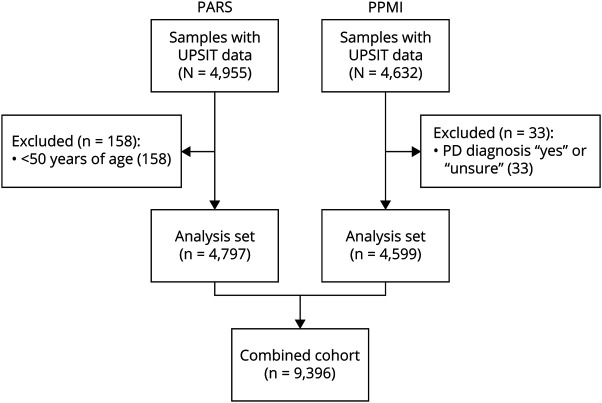
The UPSIT was administered cross-sectionally to participants recruited between 2007-2010 and 2013-2015 for the Parkinson Associated Risk Syndrome (PARS) and Parkinson's Progression Markers Initiative (PPMI) cohort studies, respectively. Exclusion criteria included age <50 years and a confirmed or suspected PD diagnosis. Demographics, family history, and prodromal features of PD including self-reported hyposmia were collected. Normative data including mean, SDs, and percentiles were derived by age and sex.
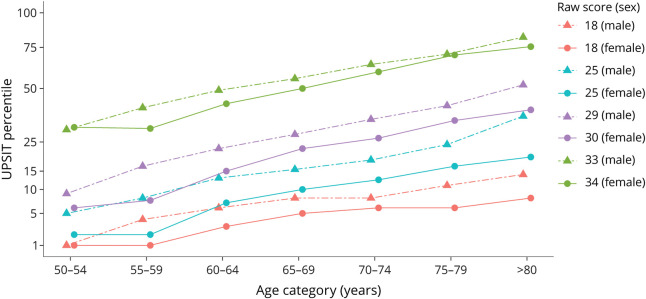
The analytic sample included 9,396 individuals (5,336 female and 4,060 male), aged 50-95 years, who were predominantly White, non-Hispanic US residents. UPSIT percentiles were derived and are provided across 7 age categories (50-54, 55-59, 60-64, 65-69, 70-74, 75-79, and ≥80 years) for female and male participants separately; relative to existing norms, subgroups included between 2.4 and 20 times as many participants. Olfactory function declined with age and was better among women than men; accordingly, the percentile corresponding to a given raw score varied markedly by age and sex. UPSIT performance was comparable among individuals with vs without first-degree family history of PD. Comparisons of self-reported hyposmia vs UPSIT percentiles indicated a strong association (χ < 0.0001) but minimal agreement (Cohen simple kappa [95% CI]: = 0.32 [0.28-0.36] for female participants; 0.34 [0.30-0.38] for male participants).
Updated age/sex-specific UPSIT percentiles are provided for ≥50-year-old adults who reflect a population likely to be recruited into studies of prodromal neurodegenerative diseases. Our findings highlight the potential advantages of evaluating olfaction relative to age and sex instead of in absolute terms (i.e., based on raw UPSIT scores) or based on subjective (i.e., self-reported) measures. This information addresses the need to support studies of disorders including PD and Alzheimer disease by providing updated normative data from a larger sample of older adults.
NCT00387075 and NCT01141023.
宾夕法尼亚大学嗅觉识别测试(UPSIT)常用于评估嗅觉,并筛查帕金森病(PD)和阿尔茨海默病等疾病的早期症状。我们的目的是基于比以往规范更大的样本量,制定更新的百分位数,以便更精确地区分 50 岁以上成年人的年龄和性别特异性 UPSIT 表现,这些成年人可能是进行神经退行性疾病前驱期研究的候选者。
UPSIT 分别在 2007-2010 年和 2013-2015 年参加帕金森相关风险综合征(PARS)和帕金森进展标志物倡议(PPMI)队列研究的参与者中进行横断面测试。排除标准包括年龄<50 岁以及已确诊或疑似 PD 诊断。收集了人口统计学数据、家族史以及 PD 的前驱症状,包括自我报告的嗅觉减退。按年龄和性别计算均值、标准差和百分位数,得出正态数据。
分析样本包括 9396 名年龄在 50-95 岁的参与者,其中 5336 名为女性,4060 名为男性,他们主要是白人,非西班牙裔美国居民。为女性和男性参与者分别制定了 UPSIT 百分位数,并在 7 个年龄类别(50-54、55-59、60-64、65-69、70-74、75-79 和≥80 岁)中提供;与现有规范相比,每个亚组的参与者数量增加了 2.4 到 20 倍。嗅觉功能随年龄增长而下降,女性优于男性;因此,给定原始分数对应的百分位数因年龄和性别而异。有与无 PD 一级家族史的个体之间的 UPSIT 表现相当。自我报告的嗅觉减退与 UPSIT 百分位数的比较表明,两者之间存在强烈关联(χ<0.0001),但一致性很小(女性参与者的 Cohen 简单 Kappa[95%CI]:=0.32[0.28-0.36];男性参与者:0.34[0.30-0.38])。
为 50 岁以上的成年人提供了新的年龄/性别特定 UPSIT 百分位数,他们反映了可能被招募到神经退行性疾病前驱期研究中的人群。我们的发现强调了相对于年龄和性别评估嗅觉的潜在优势,而不是基于绝对值(即基于 UPSIT 原始分数)或基于主观(即自我报告)测量。这些信息满足了提供更大的老年人群体的更新规范数据来支持包括 PD 和阿尔茨海默病在内的疾病研究的需求。
NCT00387075 和 NCT01141023。