Tuyji Tok Yesim, Can Sarinoglu Rabia, Ordekci Seyhan, Yilmaz Serife, Ozcolpan Gunes, Bayram Aysen, Nohut Okan Kadir, Kocer Ipek, Hasdemir Ufuk, Kuskucu Mert Ahmet, Konukoglu Dildar, Gozalan Aysegul, Midilli Kenan, Celik Gulden
Department of Medical Microbiology, Istanbul University-Cerrahpasa, Cerrahpasa Medical School, 34098 Istanbul, Turkey.
Department of Medical Microbiology, Bahcesehir University Medical School, 34353 Istanbul, Turkey.
Vaccines (Basel). 2023 Feb 3;11(2):355. doi: 10.3390/vaccines11020355.
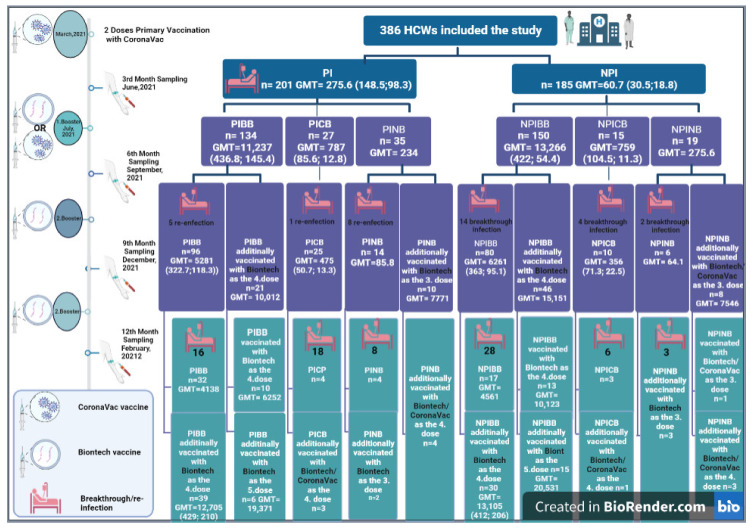
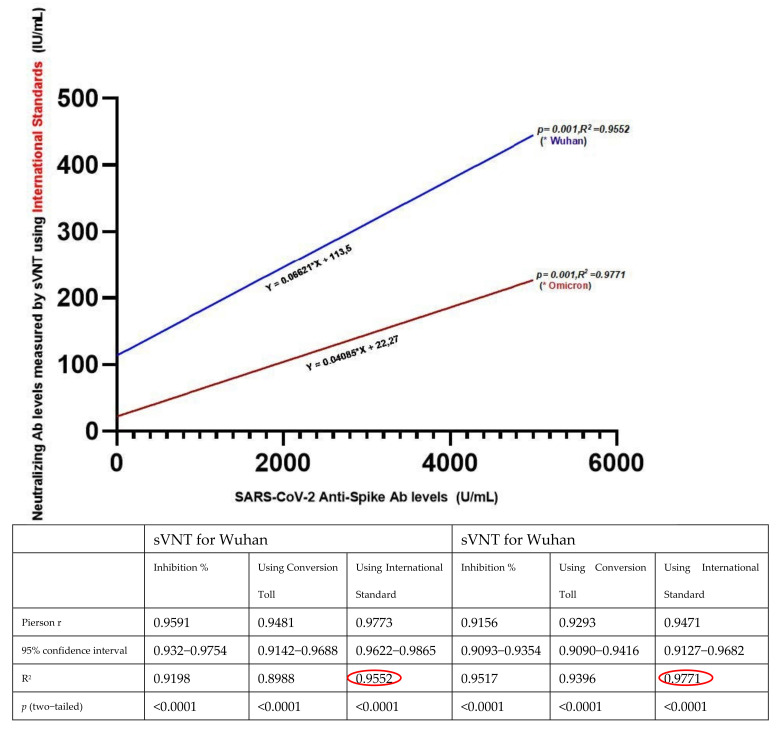
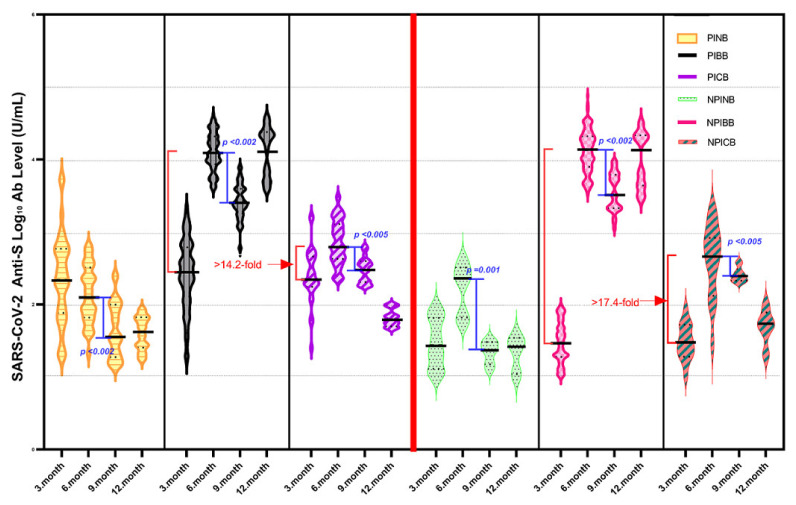
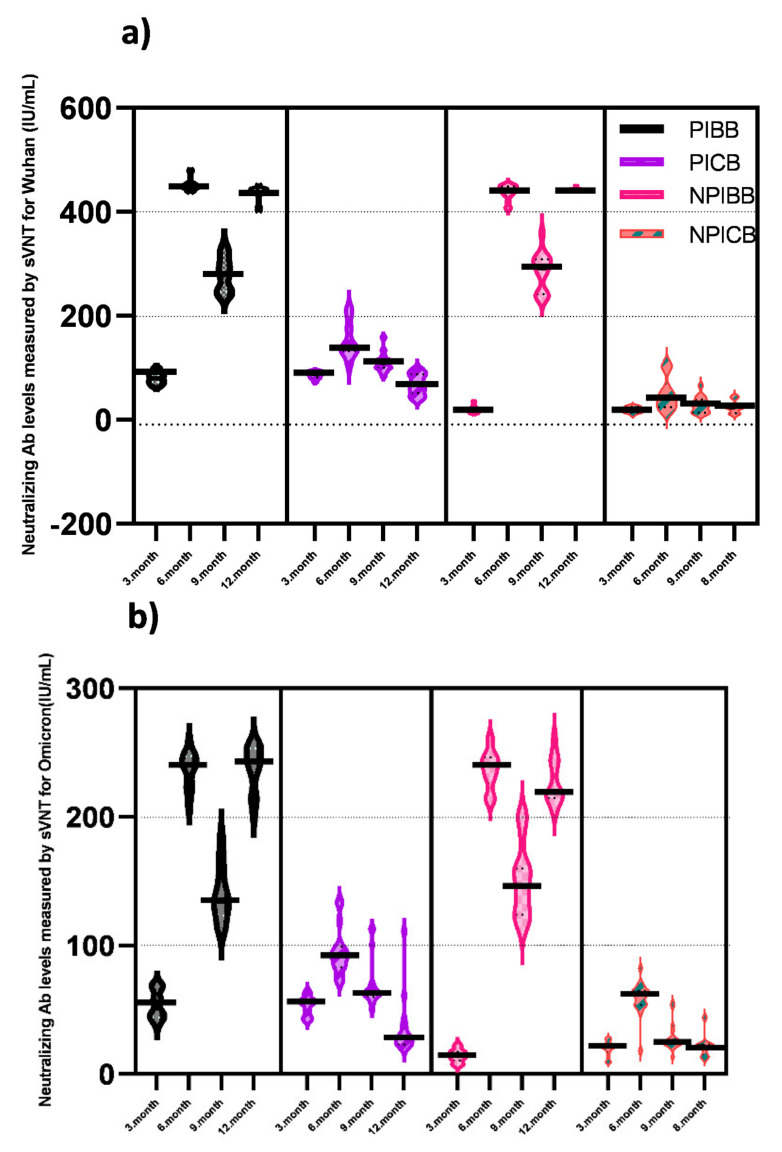
Numerous vaccines have been generated to decrease the morbidity and mortality of COVID-19. This study aims to evaluate the immunogenicity of the heterologous boosts by BioNTech against homologous boosts by CoronaVac at three-month intervals in two health care worker (HCW) cohorts, with or without prior COVID-19, for one year post-vaccination. This is a prospective cohort study in which the humoral responses of 386 HCWs were followed-up longitudinally in six main groups according to their previous COVID-19 exposure and vaccination status. Anti-SARS-CoV-2 spike-RBD total antibody levels were measured and SARS-CoV-2 neutralization antibody (NAbs) responses against the ancestral Wuhan and the Omicron variant were evaluated comparatively using international standard serum for Wuhan and Omicron, as well as with the aid of a conversion tool. The anti-SARS-CoV-2 spike-RBD total Ab and Nab difference between with and without prior COVID-19, three months after two-dose primary vaccination with CoronaVac, was statistically significant ( = 0.001). In the subsequent follow-ups, this difference was not observed between the groups. Those previously infected (PI) and non-previously infected (NPI) groups receiving BioNTech as the third dose had higher anti-SARS-CoV-2 spike total Ab levels (14.2-fold and 17.4-fold, respectively, = 0.001) and Nab responses (against Wuhan and Omicron) than those receiving CoronaVac. Ab responses after booster vaccination decreased significantly in all groups at the ninth-month follow-up ( < 0.05); however, Abs were still higher in all booster received groups than that in the primary vaccination. Abs were above the protective level at the twelfth-month measurement in the entire of the second BioNTech received group as the fourth dose of vaccination. In the one-year follow-up period, the increased incidence of COVID-19 in the groups vaccinated with two or three doses of CoronaVac compared with the groups vaccinated with BioNTech as a booster suggested that continuing the heterologous CoronaVac/BioNTech vaccination, revised according to current SARS-CoV-2 variants and with at least a six-month interval booster would be an effective and safe strategy for protection against COVID-19, particularly in health care workers.
已经研发出多种疫苗来降低新冠病毒疾病(COVID-19)的发病率和死亡率。本研究旨在评估在两个医护人员(HCW)队列中,间隔三个月接种BioNTech异源加强针与科兴生物新冠疫苗(CoronaVac)同源加强针的免疫原性,这两个队列中部分人员有过新冠病毒感染史,部分没有,研究对其接种疫苗后一年的情况进行观察。这是一项前瞻性队列研究,根据386名医护人员之前的新冠病毒暴露情况和疫苗接种状态,将他们纵向随访分为六个主要组,对其体液免疫反应进行跟踪。测量抗SARS-CoV-2刺突蛋白受体结合域(spike-RBD)的总抗体水平,并使用针对武汉株和奥密克戎变异株的国际标准血清,借助转换工具,比较评估针对原始武汉株和奥密克戎变异株的SARS-CoV-2中和抗体(NAb)反应。在使用科兴生物新冠疫苗进行两剂次基础免疫接种三个月后,有过新冠病毒感染史和没有感染史的两组之间,抗SARS-CoV-2刺突蛋白受体结合域的总抗体和中和抗体差异具有统计学意义(P = 0.001)。在随后的随访中,两组之间未观察到这种差异。接受BioNTech作为第三剂疫苗接种的既往感染组(PI)和未感染组(NPI),其抗SARS-CoV-2刺突蛋白总抗体水平(分别为14.2倍和17.4倍,P = 0.001)以及中和抗体反应(针对武汉株和奥密克戎变异株)均高于接受科兴生物新冠疫苗接种的组。在第九个月随访时,所有组加强免疫接种后的抗体反应均显著下降(P < 0.05);然而,所有接受加强针接种组的抗体水平仍高于基础免疫接种组。在接受第二剂BioNTech作为第四剂疫苗接种的整个组中,在第十二个月测量时抗体水平均高于保护水平。在一年的随访期内,与接受BioNTech作为加强针接种的组相比,接种两剂或三剂科兴生物新冠疫苗的组中新冠病毒疾病发病率增加,这表明根据当前SARS-CoV-2变异株情况持续进行异源的科兴生物新冠疫苗/BioNTech接种,并至少间隔六个月进行加强针接种,将是预防新冠病毒疾病的一种有效且安全的策略,尤其是在医护人员中。