Lu Dasheng, Hu Jiancheng, Qian Jiahui, Cheng Fangfang
Department of Cardiology, The Second Affiliated Hospital of Wannan Medical College, 10# Kangfu road, Wuhu, Anhui Province, 241000, China.
Vascular Diseases research center of Wannan Medical College, Wuhu, 241000, China.
BMC Cardiovasc Disord. 2024 Dec 23;24(1):738. doi: 10.1186/s12872-024-04405-w.
The aim of this study was to investigate the dynamic changes in QTc interval duration among patients with COVID-19 infection before, during, and after infection, in order to assess the short- and potential long-term impact of COVID-19 on cardiac electrophysiology.
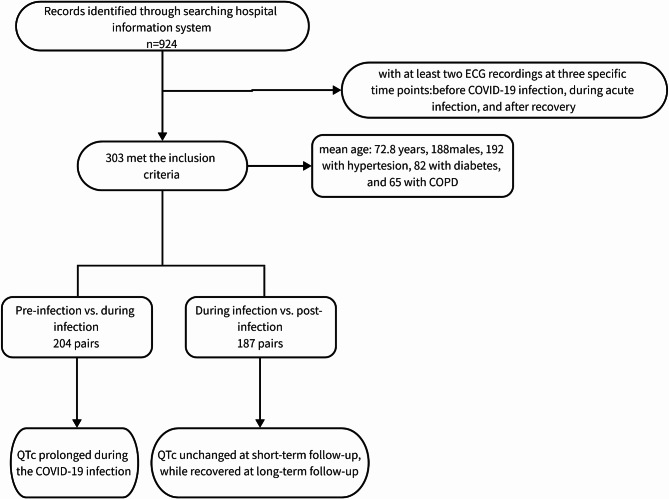
A retrospective analysis was conducted on 303 inpatients diagnosed with COVID-19 who visited a tertiary Grade A hospital in China between August 2022 and December 2023. Inclusion criteria required patients to have at least two electrocardiogram (ECG) recordings at three specific time points: before COVID-19 infection, during acute infection, and after recovery (more than one month post-infection).
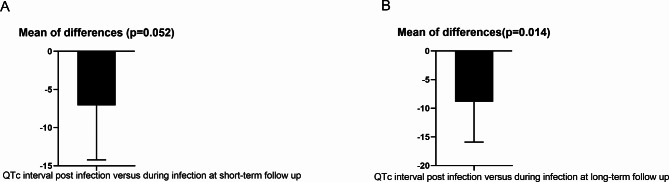
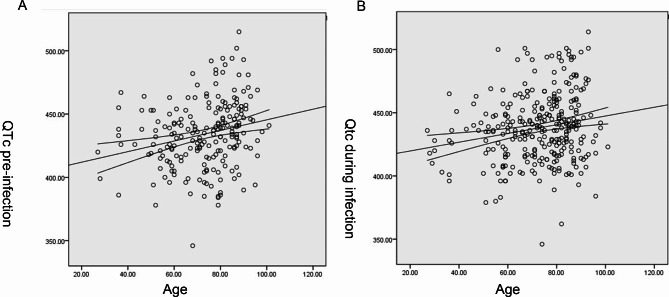
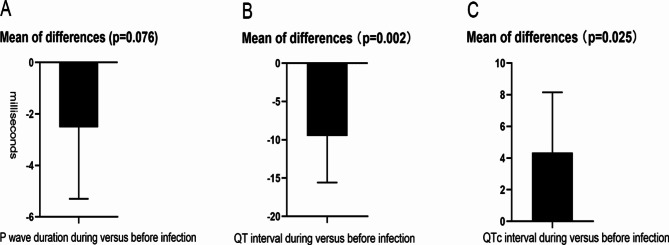
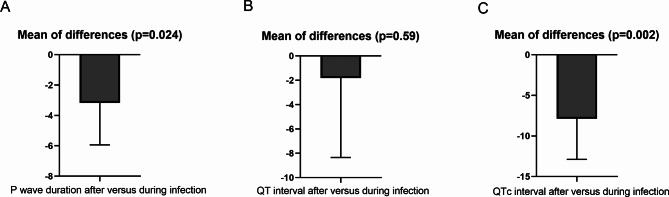
The mean age of participants was 72.8 ± 14.7 years, with a male preponderance (62%, n = 188). A significant prolongation of QTc interval was observed during COVID-19 infection compared to pre-infection levels (438.3 ± 26.7 ms vs. 433.9 ± 26.6 ms, p = 0.025). QTc interval was positively correlated with age both before (r = 0.23, p = 0.001) and during infection (r = 0.19, p = 0.001). In short-term follow-up (≤ 6 months), QTc interval remained unchanged from the infectious period (p > 0.05), whereas it significantly decreased during long-term follow-up (> 6 months; 429.6 ± 32.5 ms vs. 437.5 ± 28.2 ms, p = 0.002). Additionally, P-wave duration significantly decreased from the infectious period to long-term follow-up (99.5 ± 14.8 ms to 96.4 ± 15.2 ms, p = 0.024).
COVID-19 infection demonstrated a significant correlation with prolonged QTc interval, persisting in the short term but gradually returning to normal in the long term. Similarly, P-wave duration shortened over time, suggesting potential cardiac electrophysiological recovery.
Not applicable.
本研究旨在调查新型冠状病毒肺炎(COVID-19)感染患者在感染前、感染期间和感染后的QTc间期持续时间的动态变化,以评估COVID-19对心脏电生理学的短期和潜在长期影响。
对2022年8月至2023年12月期间在中国一家三级甲等医院就诊的303例确诊为COVID-19的住院患者进行回顾性分析。纳入标准要求患者在三个特定时间点至少有两次心电图(ECG)记录:COVID-19感染前、急性感染期间和康复后(感染后一个多月)。
参与者的平均年龄为72.8±14.7岁,男性占多数(62%,n=188)。与感染前水平相比,COVID-19感染期间观察到QTc间期显著延长(438.3±26.7毫秒对433.9±26.6毫秒,p=0.025)。QTc间期在感染前(r=0.23,p=0.001)和感染期间(r=0.19,p=0.001)均与年龄呈正相关。在短期随访(≤6个月)中,QTc间期与感染期相比无变化(p>0.05),而在长期随访(>6个月)中显著缩短(429.6±32.5毫秒对437.5±28.2毫秒,p=0.002)。此外,从感染期到长期随访,P波持续时间显著缩短(99.5±14.8毫秒至96.4±15.2毫秒,p=0.024)。
COVID-19感染与QTc间期延长显著相关,短期持续存在,但长期逐渐恢复正常。同样,P波持续时间随时间缩短,提示心脏电生理可能恢复。
不适用。