Institute for Genomic Medicine, Nationwide Children's Hospital, Columbus, OH, USA.
Department of Pediatrics and Neurological Surgery, The Ohio State University Wexner Medical Center, Columbus, OH, USA.
Cancer Gene Ther. 2023 Jul;30(7):964-972. doi: 10.1038/s41417-023-00600-7. Epub 2023 Feb 28.
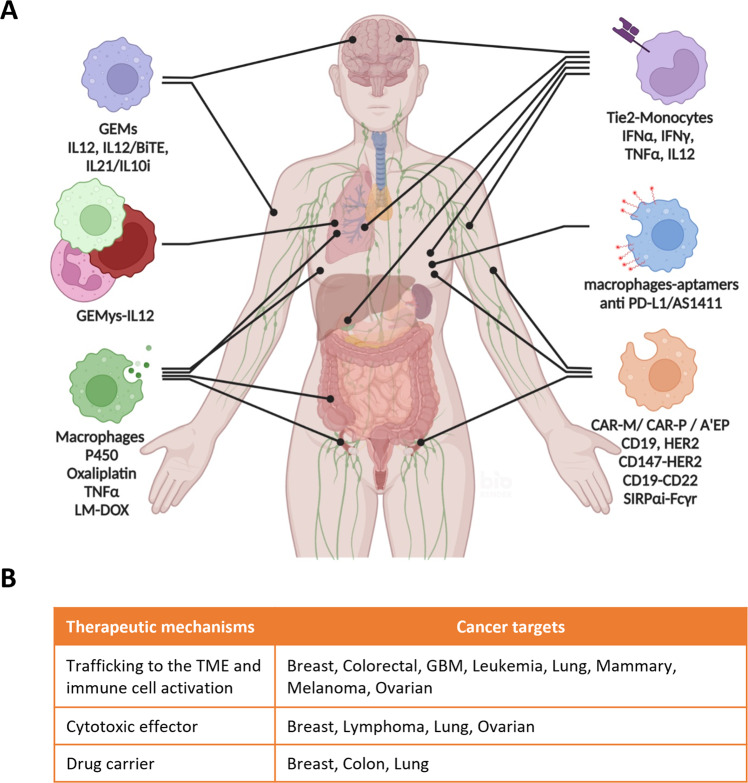
Despite promising results shown in hematologic tumors, immunotherapies for the treatment of solid tumors have mostly failed so far. The immunosuppressive tumor microenvironment and phenotype of tumor infiltrating macrophages are among the more prevalent reasons for this failure. Tumor associated macrophages (TAMs, M2-macrophages) are circulating myeloid cells recruited to the local tumor microenvironment, and together with regulatory T cells (T-regs), are reprogrammed to become immune suppressive. This results in the inactivation or hampered recruitment of cytotoxic CD8 + T and Natural Killer (NK) cells. Recently, attempts have been made to try to leverage specific myeloid functions and properties, including their ability to reach the TME and to mediate the phagocytosis of cancer cells. Additionally, myeloid cells have been used for drug delivery and reprogramming the tumor microenvironment in cancer patients. This approach, together with the advancements in genome editing, paved the way for the development of novel cell-mediated immunotherapies. This article focuses on the latest studies that detail the therapeutic properties of genetically engineered or pharmacologically modulated myeloid cells in cancer preclinical models, limitations, pitfalls, and evaluations of these approaches in patients with cancer.
尽管在血液肿瘤中显示出有前景的结果,但免疫疗法治疗实体瘤迄今为止大多失败。免疫抑制性肿瘤微环境和肿瘤浸润巨噬细胞的表型是导致这种失败的更普遍原因之一。肿瘤相关巨噬细胞(TAMs,M2-巨噬细胞)是募集到局部肿瘤微环境中的循环髓样细胞,与调节性 T 细胞(T-regs)一起被重新编程为免疫抑制性。这导致细胞毒性 CD8+T 和自然杀伤(NK)细胞的失活或募集受阻。最近,人们试图利用特定的髓样细胞功能和特性,包括它们到达肿瘤微环境的能力和介导癌细胞吞噬的能力。此外,髓样细胞已被用于药物递送和重塑癌症患者的肿瘤微环境。这种方法,加上基因组编辑的进步,为开发新型细胞介导的免疫疗法铺平了道路。本文重点介绍了最新的研究,这些研究详细说明了基因工程或药理学调节的髓样细胞在癌症临床前模型中的治疗特性、局限性、陷阱以及这些方法在癌症患者中的评估。