• 文献检索
  • 文档翻译
  • 深度研究
  • 学术资讯
  • Suppr Zotero 插件Zotero 插件
  • 邀请有礼
  • 套餐&价格
  • 历史记录
应用&插件
Suppr Zotero 插件Zotero 插件浏览器插件Mac 客户端Windows 客户端微信小程序
定价
高级版会员购买积分包购买API积分包
服务
文献检索文档翻译深度研究API 文档MCP 服务
关于我们
关于 Suppr公司介绍联系我们用户协议隐私条款
关注我们

Suppr 超能文献

核心技术专利:CN118964589B侵权必究
粤ICP备2023148730 号-1Suppr @ 2026

文献检索

告别复杂PubMed语法,用中文像聊天一样搜索,搜遍4000万医学文献。AI智能推荐,让科研检索更轻松。

立即免费搜索

文件翻译

保留排版,准确专业,支持PDF/Word/PPT等文件格式,支持 12+语言互译。

免费翻译文档

深度研究

AI帮你快速写综述,25分钟生成高质量综述,智能提取关键信息,辅助科研写作。

立即免费体验

免疫球蛋白、糖皮质激素或联合治疗儿童多系统炎症综合征:一项倾向加权队列研究。

Immunoglobulin, glucocorticoid, or combination therapy for multisystem inflammatory syndrome in children: a propensity-weighted cohort study.

作者信息

Channon-Wells Samuel, Vito Ortensia, McArdle Andrew J, Seaby Eleanor G, Patel Harsita, Shah Priyen, Pazukhina Ekaterina, Wilson Clare, Broderick Claire, D'Souza Giselle, Keren Ilana, Nijman Ruud G, Tremoulet Adriana, Munblit Daniel, Ulloa-Gutierrez Rolando, Carter Michael J, Ramnarayan Padmanabhan, De Tisham, Hoggart Clive, Whittaker Elizabeth, Herberg Jethro A, Kaforou Myrsini, Cunnington Aubrey J, Blyuss Oleg, Levin Michael

机构信息

Centre for Paediatrics and Child Health, Faculty of Medicine, Imperial College London, London, UK.

Department of Infectious Disease, Section of Paediatric Infectious Disease, Faculty of Medicine, Imperial College London, London, UK.

出版信息

Lancet Rheumatol. 2023 Apr;5(4):e184-e199. doi: 10.1016/S2665-9913(23)00029-2. Epub 2023 Feb 14.

DOI:10.1016/S2665-9913(23)00029-2
PMID:36855438
原文链接:https://pmc.ncbi.nlm.nih.gov/articles/PMC9949883/
Abstract

BACKGROUND

Multisystem inflammatory syndrome in children (MIS-C), a hyperinflammatory condition associated with SARS-CoV-2 infection, has emerged as a serious illness in children worldwide. Immunoglobulin or glucocorticoids, or both, are currently recommended treatments.

METHODS

The Best Available Treatment Study evaluated immunomodulatory treatments for MIS-C in an international observational cohort. Analysis of the first 614 patients was previously reported. In this propensity-weighted cohort study, clinical and outcome data from children with suspected or proven MIS-C were collected onto a web-based Research Electronic Data Capture database. After excluding neonates and incomplete or duplicate records, inverse probability weighting was used to compare primary treatments with intravenous immunoglobulin, intravenous immunoglobulin plus glucocorticoids, or glucocorticoids alone, using intravenous immunoglobulin as the reference treatment. Primary outcomes were a composite of inotropic or ventilator support from the second day after treatment initiation, or death, and time to improvement on an ordinal clinical severity scale. Secondary outcomes included treatment escalation, clinical deterioration, fever, and coronary artery aneurysm occurrence and resolution. This study is registered with the ISRCTN registry, ISRCTN69546370.

FINDINGS

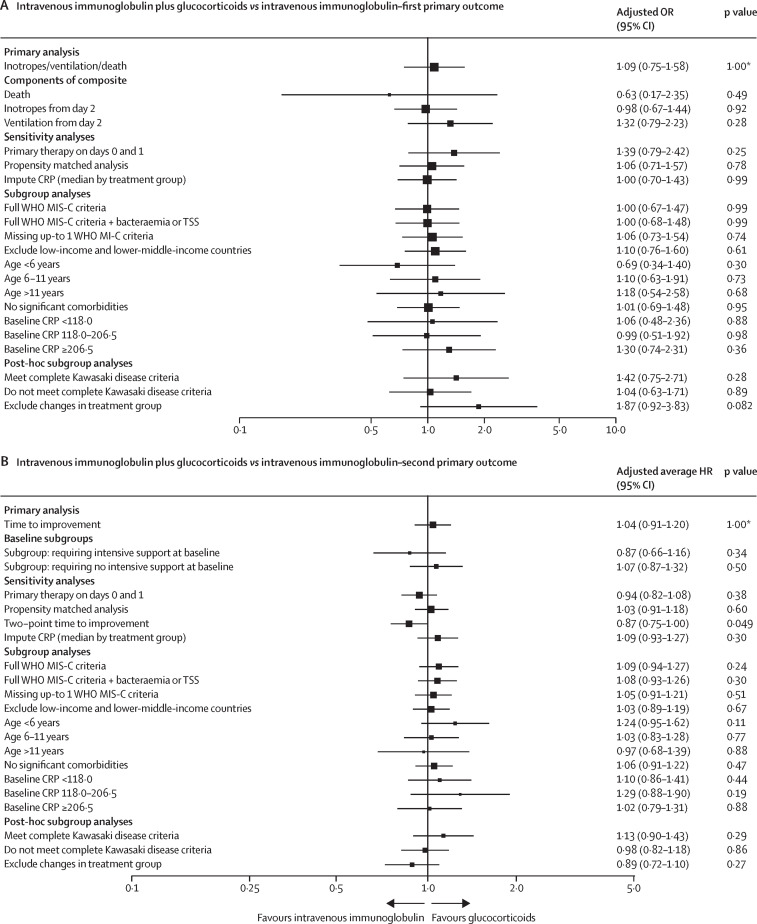
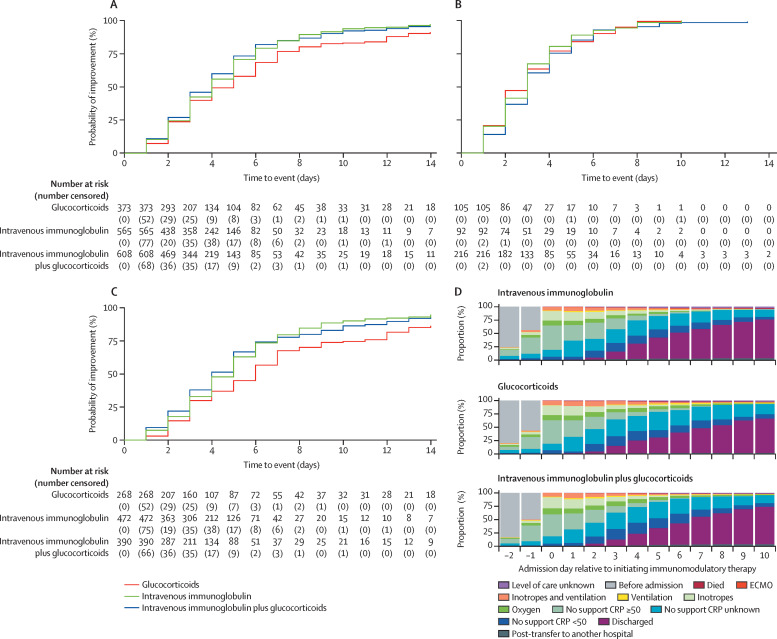
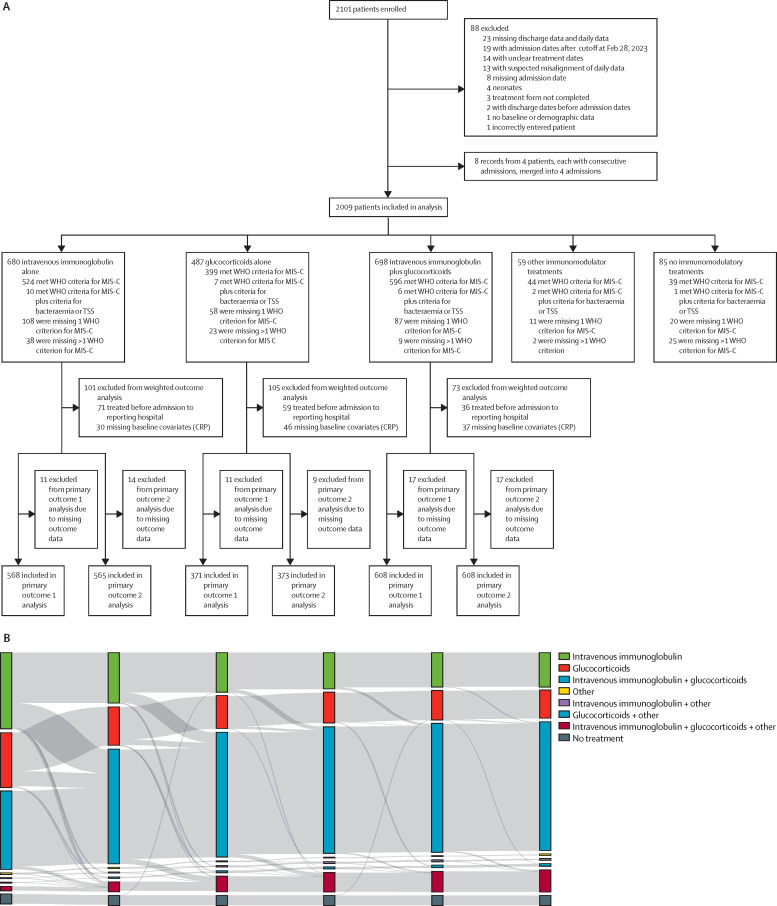
We enrolled 2101 children (aged 0 months to 19 years) with clinically diagnosed MIS-C from 39 countries between June 14, 2020, and April 25, 2022, and, following exclusions, 2009 patients were included for analysis (median age 8·0 years [IQR 4·2-11·4], 1191 [59·3%] male and 818 [40·7%] female, and 825 [41·1%] White). 680 (33·8%) patients received primary treatment with intravenous immunoglobulin, 698 (34·7%) with intravenous immunoglobulin plus glucocorticoids, 487 (24·2%) with glucocorticoids alone; 59 (2·9%) patients received other combinations, including biologicals, and 85 (4·2%) patients received no immunomodulators. There were no significant differences between treatments for primary outcomes for the 1586 patients with complete baseline and outcome data that were considered for primary analysis. Adjusted odds ratios for ventilation, inotropic support, or death were 1·09 (95% CI 0·75-1·58; corrected p value=1·00) for intravenous immunoglobulin plus glucocorticoids and 0·93 (0·58-1·47; corrected p value=1·00) for glucocorticoids alone, versus intravenous immunoglobulin alone. Adjusted average hazard ratios for time to improvement were 1·04 (95% CI 0·91-1·20; corrected p value=1·00) for intravenous immunoglobulin plus glucocorticoids, and 0·84 (0·70-1·00; corrected p value=0·22) for glucocorticoids alone, versus intravenous immunoglobulin alone. Treatment escalation was less frequent for intravenous immunoglobulin plus glucocorticoids (OR 0·15 [95% CI 0·11-0·20]; p<0·0001) and glucocorticoids alone (0·68 [0·50-0·93]; p=0·014) versus intravenous immunoglobulin alone. Persistent fever (from day 2 onward) was less common with intravenous immunoglobulin plus glucocorticoids compared with either intravenous immunoglobulin alone (OR 0·50 [95% CI 0·38-0·67]; p<0·0001) or glucocorticoids alone (0·63 [0·45-0·88]; p=0·0058). Coronary artery aneurysm occurrence and resolution did not differ significantly between treatment groups.

INTERPRETATION

Recovery rates, including occurrence and resolution of coronary artery aneurysms, were similar for primary treatment with intravenous immunoglobulin when compared to glucocorticoids or intravenous immunoglobulin plus glucocorticoids. Initial treatment with glucocorticoids appears to be a safe alternative to immunoglobulin or combined therapy, and might be advantageous in view of the cost and limited availability of intravenous immunoglobulin in many countries.

FUNDING

Imperial College London, the European Union's Horizon 2020, Wellcome Trust, the Medical Research Foundation, UK National Institute for Health and Care Research, and National Institutes of Health.

摘要

背景

儿童多系统炎症综合征(MIS-C)是一种与严重急性呼吸综合征冠状病毒2(SARS-CoV-2)感染相关的高炎症状态,已在全球范围内成为儿童的一种严重疾病。目前推荐使用免疫球蛋白或糖皮质激素,或两者联合进行治疗。

方法

最佳可用治疗研究在一个国际观察性队列中评估了MIS-C的免疫调节治疗。先前已报告了对前614例患者的分析。在这项倾向加权队列研究中,将疑似或确诊为MIS-C的儿童的临床和结局数据收集到基于网络的研究电子数据采集数据库中。在排除新生儿以及不完整或重复的记录后,使用逆概率加权法,以静脉注射免疫球蛋白作为对照治疗,比较静脉注射免疫球蛋白、静脉注射免疫球蛋白加糖皮质激素或单独使用糖皮质激素的主要治疗方法。主要结局是治疗开始后第二天开始使用血管活性药物或呼吸机支持,或死亡的综合情况,以及在序数临床严重程度量表上改善的时间。次要结局包括治疗升级、临床恶化、发热以及冠状动脉瘤的发生和消退情况。本研究已在国际标准随机对照试验编号注册中心注册,编号为ISRCTN69546370。

研究结果

我们纳入了2020年6月14日至2022年4月25日期间来自39个国家的2101名临床诊断为MIS-C的儿童(年龄从0个月至19岁),排除后,纳入2009例患者进行分析(中位年龄8.0岁[四分位间距4.2 - 11.4],男性1191例[59.3%],女性818例[40.7%],白人825例[41.1%])。680例(33.8%)患者接受静脉注射免疫球蛋白作为主要治疗,698例(34.7%)接受静脉注射免疫球蛋白加糖皮质激素,487例(24.2%)接受单独使用糖皮质激素;59例(2.9%)患者接受其他联合治疗,包括生物制剂,85例(4.2%)患者未接受免疫调节剂治疗。在1586例有完整基线和结局数据并纳入主要分析的患者中,各治疗组在主要结局方面无显著差异。与单独使用静脉注射免疫球蛋白相比,静脉注射免疫球蛋白加糖皮质激素的通气、血管活性药物支持或死亡的校正比值比为1.09(95%置信区间0.75 - 1.58;校正p值 = 1.00),单独使用糖皮质激素的校正比值比为0.93(0.58 - 1.47;校正p值 = 1.00)。与单独使用静脉注射免疫球蛋白相比,静脉注射免疫球蛋白加糖皮质激素改善时间的校正平均风险比为1.04(95%置信区间0.91 - 1.20;校正p值 = 1.00),单独使用糖皮质激素的校正平均风险比为0.84(0.70 - 1.00;校正p值 = 0.22)。与单独使用静脉注射免疫球蛋白相比,静脉注射免疫球蛋白加糖皮质激素(比值比0.15[95%置信区间0.11 - 0.20];p < 0.0001)和单独使用糖皮质激素(0.68[0.50 - 0.93];p = 0.014)治疗升级的频率较低。与单独使用静脉注射免疫球蛋白(比值比0.50[95%置信区间0.38 - 0.67];p < 0.0001)或单独使用糖皮质激素(0.63[0.45 - 0.88];p = 0.0058)相比,静脉注射免疫球蛋白加糖皮质激素持续发热(从第2天起)的情况较少见。各治疗组冠状动脉瘤的发生和消退情况无显著差异。

解读

与糖皮质激素或静脉注射免疫球蛋白加糖皮质激素相比,静脉注射免疫球蛋白作为主要治疗的恢复率,包括冠状动脉瘤的发生和消退情况相似。糖皮质激素初始治疗似乎是免疫球蛋白或联合治疗的一种安全替代方案,鉴于许多国家静脉注射免疫球蛋白的成本和供应有限,可能具有优势。

资金来源

伦敦帝国学院、欧盟地平线2020计划、惠康信托基金会、医学研究基金会、英国国家健康与照护研究机构以及美国国立卫生研究院。
https://cdn.ncbi.nlm.nih.gov/pmc/blobs/a9ec/9949883/1a5f0ae4880a/gr4_lrg.jpg
https://cdn.ncbi.nlm.nih.gov/pmc/blobs/a9ec/9949883/6ada566f1ea1/gr1_lrg.jpg
https://cdn.ncbi.nlm.nih.gov/pmc/blobs/a9ec/9949883/9b3bc86778f5/gr2a_lrg.jpg
https://cdn.ncbi.nlm.nih.gov/pmc/blobs/a9ec/9949883/221dab5b215a/gr3_lrg.jpg
https://cdn.ncbi.nlm.nih.gov/pmc/blobs/a9ec/9949883/1a5f0ae4880a/gr4_lrg.jpg
https://cdn.ncbi.nlm.nih.gov/pmc/blobs/a9ec/9949883/6ada566f1ea1/gr1_lrg.jpg
https://cdn.ncbi.nlm.nih.gov/pmc/blobs/a9ec/9949883/9b3bc86778f5/gr2a_lrg.jpg
https://cdn.ncbi.nlm.nih.gov/pmc/blobs/a9ec/9949883/221dab5b215a/gr3_lrg.jpg
https://cdn.ncbi.nlm.nih.gov/pmc/blobs/a9ec/9949883/1a5f0ae4880a/gr4_lrg.jpg

相似文献

1
Immunoglobulin, glucocorticoid, or combination therapy for multisystem inflammatory syndrome in children: a propensity-weighted cohort study.免疫球蛋白、糖皮质激素或联合治疗儿童多系统炎症综合征:一项倾向加权队列研究。
Lancet Rheumatol. 2023 Apr;5(4):e184-e199. doi: 10.1016/S2665-9913(23)00029-2. Epub 2023 Feb 14.
2
Treatment of Multisystem Inflammatory Syndrome in Children.儿童多系统炎症综合征的治疗。
N Engl J Med. 2021 Jul 1;385(1):11-22. doi: 10.1056/NEJMoa2102968. Epub 2021 Jun 16.
3
Multisystem Inflammatory Syndrome in Children - Initial Therapy and Outcomes.儿童多系统炎症综合征 - 初始治疗和结局。
N Engl J Med. 2021 Jul 1;385(1):23-34. doi: 10.1056/NEJMoa2102605. Epub 2021 Jun 16.
4
Comparison of methylprednisolone alone versus intravenous immunoglobulin plus methylprednisolone for multisystem inflammatory syndrome in children (MIS-C).单独使用甲泼尼龙与静脉注射免疫球蛋白联合甲泼尼龙治疗儿童多系统炎症综合征(MIS-C)的比较。
BMJ Paediatr Open. 2025 Mar 5;9(1):e003148. doi: 10.1136/bmjpo-2024-003148.
5
Immunomodulatory therapy in children with paediatric inflammatory multisystem syndrome temporally associated with SARS-CoV-2 (PIMS-TS, MIS-C; RECOVERY): a randomised, controlled, open-label, platform trial.儿童 SARS-CoV-2 相关儿童多系统炎症综合征(PIMS-TS,MIS-C;RECOVERY)的免疫调节治疗:一项随机、对照、开放标签、平台试验。
Lancet Child Adolesc Health. 2024 Mar;8(3):190-200. doi: 10.1016/S2352-4642(23)00316-4. Epub 2024 Jan 22.
6
Association of Intravenous Immunoglobulins Plus Methylprednisolone vs Immunoglobulins Alone With Course of Fever in Multisystem Inflammatory Syndrome in Children.静脉注射免疫球蛋白联合甲泼尼龙与单独使用免疫球蛋白治疗儿童多系统炎症综合征发热病程的关联。
JAMA. 2021 Mar 2;325(9):855-864. doi: 10.1001/jama.2021.0694.
7
Folic acid supplementation and malaria susceptibility and severity among people taking antifolate antimalarial drugs in endemic areas.在流行地区,服用抗叶酸抗疟药物的人群中,叶酸补充剂与疟疾易感性和严重程度的关系。
Cochrane Database Syst Rev. 2022 Feb 1;2(2022):CD014217. doi: 10.1002/14651858.CD014217.
8
Variation in Early Anakinra Use and Short-Term Outcomes in Multisystem Inflammatory Syndrome in Children.早期阿那白滞素使用的差异与儿童多系统炎症综合征的短期结局。
Arthritis Rheumatol. 2023 Aug;75(8):1466-1476. doi: 10.1002/art.42495. Epub 2023 May 16.
9
Immunosuppressive agents or intravenous immunoglobulin in addition to glucocorticoids in the treatment of Susac syndrome: a French national cohort study.除糖皮质激素外,免疫抑制剂或静脉注射免疫球蛋白治疗Susac综合征:一项法国全国队列研究。
Lancet Rheumatol. 2025 Jan;7(1):e15-e20. doi: 10.1016/S2665-9913(24)00220-0. Epub 2024 Sep 18.
10
Treatments for multi-system inflammatory syndrome in children - discharge, fever, and second-line therapies.儿童多系统炎症综合征的治疗 - 出院、发热和二线治疗。
Eur J Pediatr. 2023 Jan;182(1):461-466. doi: 10.1007/s00431-022-04649-8. Epub 2022 Oct 25.

引用本文的文献

1
A Clinical Case of Multisystem Inflammatory Syndrome After SARS-CoV-2 Infection Associated with Group A β-Hemolytic Streptococcus Coinfection and Venous Thrombosis in a Child with Congenital Thrombophilia.1例感染严重急性呼吸综合征冠状病毒2后多系统炎症综合征合并A组β溶血性链球菌共感染及静脉血栓形成的先天性易栓症儿童临床病例
Curr Issues Mol Biol. 2025 May 7;47(5):334. doi: 10.3390/cimb47050334.
2
Glucocorticoids and immunoglobulin alone or in combination in the treatment of multisystemic inflammatory syndrome in children: a systematic review and network meta-analysis.糖皮质激素和免疫球蛋白单独或联合用于治疗儿童多系统炎症综合征:一项系统评价和网状Meta分析
Front Pediatr. 2025 May 29;13:1545788. doi: 10.3389/fped.2025.1545788. eCollection 2025.
3

本文引用的文献

1
The immunopathogenesis of SARS-CoV-2 infection in children: diagnostics, treatment and prevention.儿童感染新型冠状病毒的免疫发病机制:诊断、治疗与预防
Clin Transl Immunology. 2022 Jul 25;11(7):e1405. doi: 10.1002/cti2.1405. eCollection 2022.
2
Hyper inflammatory syndrome following COVID-19 mRNA vaccine in children: A national post-authorization pharmacovigilance study.儿童接种新冠病毒mRNA疫苗后出现的高炎症综合征:一项全国性上市后药物警戒研究。
Lancet Reg Health Eur. 2022 Jun;17:100393. doi: 10.1016/j.lanepe.2022.100393. Epub 2022 Apr 29.
3
Short-term Outcomes of Corticosteroid Monotherapy in Multisystem Inflammatory Syndrome in Children.
Comparison of methylprednisolone alone versus intravenous immunoglobulin plus methylprednisolone for multisystem inflammatory syndrome in children (MIS-C).单独使用甲泼尼龙与静脉注射免疫球蛋白联合甲泼尼龙治疗儿童多系统炎症综合征(MIS-C)的比较。
BMJ Paediatr Open. 2025 Mar 5;9(1):e003148. doi: 10.1136/bmjpo-2024-003148.
4
Fostering Global Collaboration Around Kawasaki Disease. Reflections From the 14th International Kawasaki Disease Symposium.促进全球范围内关于川崎病的合作。来自第14届国际川崎病研讨会的思考。
CJC Pediatr Congenit Heart Dis. 2024 Oct 22;3(6):237-240. doi: 10.1016/j.cjcpc.2024.10.004. eCollection 2024 Dec.
5
An Update on Multi-System Inflammatory Syndrome in Children.儿童多系统炎症综合征的最新情况
Curr Rheumatol Rep. 2025 Jan 30;27(1):16. doi: 10.1007/s11926-025-01182-z.
6
Impact of social determinants of health on the outcomes of Latin American children with Multisystem Inflammatory Syndrome (MIS-C).健康的社会决定因素对患有多系统炎症综合征(MIS-C)的拉丁美洲儿童结局的影响。
Pediatr Pulmonol. 2025 Jan;60(1):e27313. doi: 10.1002/ppul.27313. Epub 2024 Dec 26.
7
Consequences beyond acute SARS-CoV-2 infection in children.儿童急性 SARS-CoV-2 感染以外的后果。
Sci Transl Med. 2024 Nov 13;16(773):eado2099. doi: 10.1126/scitranslmed.ado2099.
8
Shared neutrophil and T cell dysfunction is accompanied by a distinct interferon signature during severe febrile illnesses in children.在儿童严重发热性疾病期间,中性粒细胞和 T 细胞功能障碍伴随着明显的干扰素特征。
Nat Commun. 2024 Sep 19;15(1):8224. doi: 10.1038/s41467-024-52246-0.
9
The seroprevalence of SARS-CoV-2-specific antibodies in Australian children: A cross-sectional study.澳大利亚儿童中 SARS-CoV-2 特异性抗体的血清流行率:一项横断面研究。
PLoS One. 2024 Sep 18;19(9):e0300555. doi: 10.1371/journal.pone.0300555. eCollection 2024.
10
Should we be afraid of long-term cardiac consequences in children with multisystem inflammatory syndrome? Experience from subsequent waves of COVID-19.儿童多系统炎症综合征是否应担心长期心脏后果?来自 COVID-19 后续波次的经验。
Eur J Pediatr. 2024 Jun;183(6):2683-2692. doi: 10.1007/s00431-024-05528-0. Epub 2024 Mar 22.
儿童多系统炎症综合征中单用皮质类固醇激素治疗的短期结局。
JAMA Pediatr. 2022 Jun 1;176(6):576-584. doi: 10.1001/jamapediatrics.2022.0292.
4
Immune response to intravenous immunoglobulin in patients with Kawasaki disease and MIS-C.川崎病和 MIS-C 患者静脉注射免疫球蛋白的免疫反应。
J Clin Invest. 2021 Oct 15;131(20). doi: 10.1172/JCI147076.
5
Multisystem Inflammatory Syndrome in Children - Initial Therapy and Outcomes.儿童多系统炎症综合征 - 初始治疗和结局。
N Engl J Med. 2021 Jul 1;385(1):23-34. doi: 10.1056/NEJMoa2102605. Epub 2021 Jun 16.
6
Treatment of Multisystem Inflammatory Syndrome in Children.儿童多系统炎症综合征的治疗。
N Engl J Med. 2021 Jul 1;385(1):11-22. doi: 10.1056/NEJMoa2102968. Epub 2021 Jun 16.
7
Neurologic Involvement in Children and Adolescents Hospitalized in the United States for COVID-19 or Multisystem Inflammatory Syndrome.美国因新冠病毒病或多系统炎症综合征住院的儿童和青少年的神经系统受累情况
JAMA Neurol. 2021 May 1;78(5):536-547. doi: 10.1001/jamaneurol.2021.0504.
8
Characteristics and Outcomes of US Children and Adolescents With Multisystem Inflammatory Syndrome in Children (MIS-C) Compared With Severe Acute COVID-19.美国儿童多系统炎症综合征(MIS-C)与严重急性 COVID-19 患儿的特征和结局比较。
JAMA. 2021 Mar 16;325(11):1074-1087. doi: 10.1001/jama.2021.2091.
9
Clinical characteristics, treatment and outcomes of paediatric COVID-19: a systematic review and meta-analysis.儿童 COVID-19 的临床特征、治疗和结局:系统评价和荟萃分析。
Arch Dis Child. 2021 Apr 21;106(5):440-448. doi: 10.1136/archdischild-2020-321385.
10
Association of Intravenous Immunoglobulins Plus Methylprednisolone vs Immunoglobulins Alone With Course of Fever in Multisystem Inflammatory Syndrome in Children.静脉注射免疫球蛋白联合甲泼尼龙与单独使用免疫球蛋白治疗儿童多系统炎症综合征发热病程的关联。
JAMA. 2021 Mar 2;325(9):855-864. doi: 10.1001/jama.2021.0694.