Grocke Garrett L, Dong Ban Xuan, Taggart Aaron D, Martinson Alex B F, Niklas Jens, Poluektov Oleg G, Strzalka Joseph W, Patel Shrayesh N
Pritzker School of Molecular Engineering, University of Chicago, Illinois 60637, United States.
Materials Science Division, Argonne National Laboratory, Lemont, Illinois 60439, United States.
ACS Polym Au. 2022 Apr 11;2(4):275-286. doi: 10.1021/acspolymersau.2c00005. eCollection 2022 Aug 10.
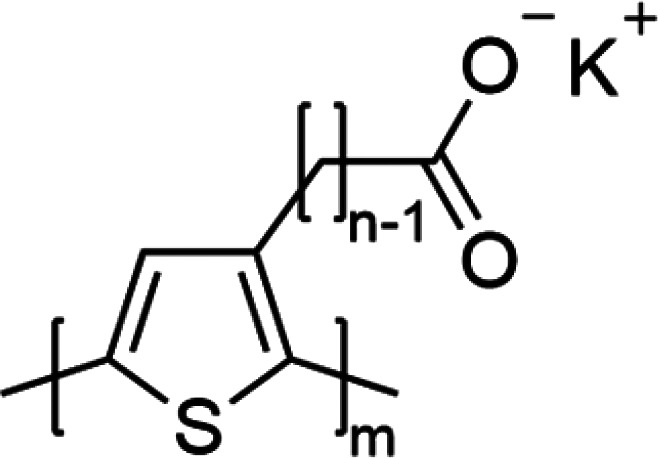
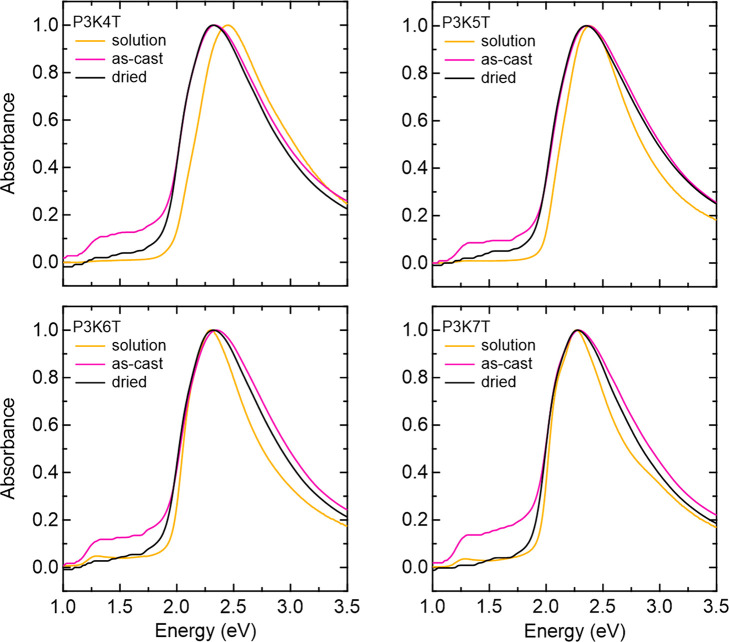
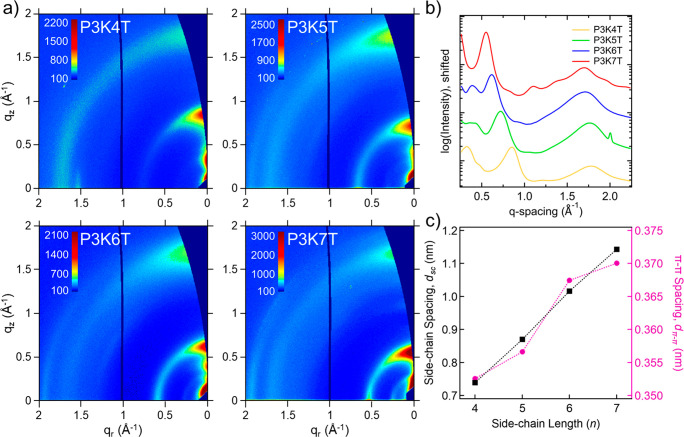
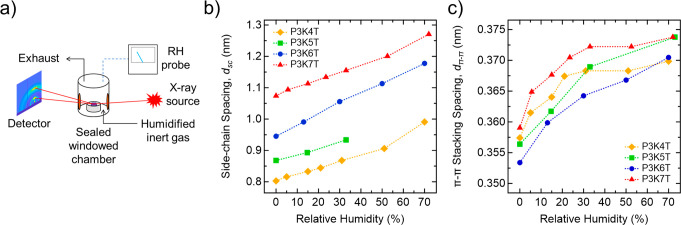
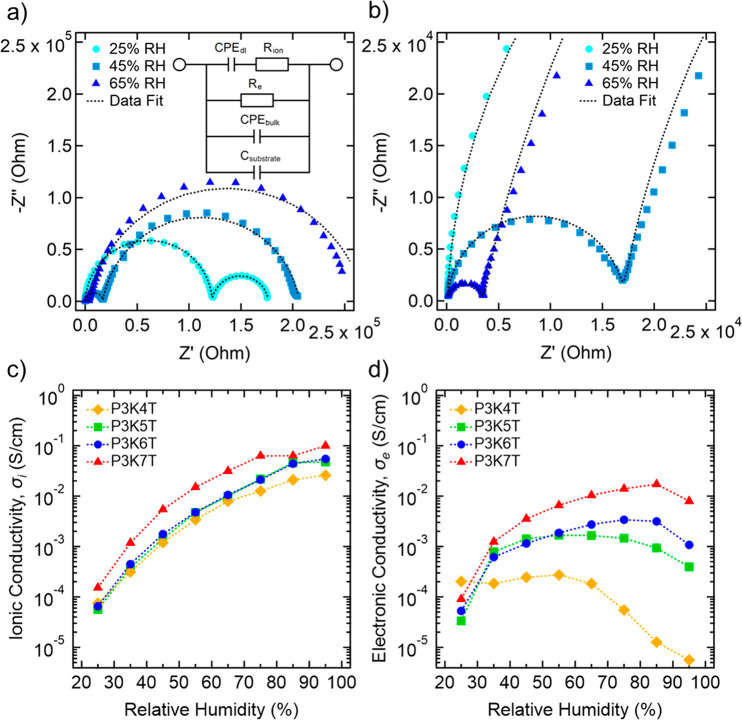
Polymeric mixed ionic-electronic conductors (MIECs) are of broad interest in the field of energy storage and conversion, optoelectronics, and bioelectronics. A class of polymeric MIECs are conjugated polyelectrolytes (CPEs), which possess a π-conjugated backbone imparting electronic transport characteristics along with side chains composed of a pendant ionic group to allow for ionic transport. Here, our study focuses on the humidity-dependent structure-transport properties of poly[3-(potassium--alkanoate) thiophene-2,5-diyl] (P3KT) CPEs with varied side-chain lengths of = 4-7. UV-vis spectroscopy along with electronic paramagnetic resonance (EPR) spectroscopy reveals that the infiltration of water leads to a hydrated, self-doped state that allows for electronic transport. The resulting humidity-dependent ionic conductivity (σ) of the thin films shows a monotonic increase with relative humidity (RH) while electronic conductivity (σ) follows a non-monotonic profile. The values of σ continue to rise with increasing RH reaching a local maximum after which σ begins to decrease. P3KTs with higher values demonstrate greater resiliency to increasing RH before suffering a decrease in σ. This drop in σ is attributed to two factors. First, disruption of the locally ordered π-stacked domains observed through in situ humidity-dependent grazing incidence wide-angle X-ray scattering (GIWAXS) experiments can account for some of the decrease in σ. A second and more dominant factor is attributed to the swelling of the amorphous domains where electronic transport pathways connecting ordered domains are impeded. P3K7T is most resilient to swelling (based on ellipsometry and water uptake measurements) where sufficient hydration allows for high σ (1.0 × 10 S/cm at 95% RH) while not substantially disrupting σ (1.7 × 10 S/cm at 85% RH and 8.0 × 10 S/cm at 95% RH). Overall, our study highlights the complexity of balancing electronic and ionic transport in hydrated CPEs.
聚合物混合离子 - 电子导体(MIECs)在能量存储与转换、光电子学和生物电子学领域引起了广泛关注。一类聚合物MIECs是共轭聚电解质(CPEs),其具有赋予电子传输特性的π共轭主链以及由侧挂离子基团组成的侧链以实现离子传输。在此,我们的研究聚焦于侧链长度(n = 4 - 7)变化的聚[3 - (钾 - 链烷酸酯)噻吩 - 2,5 - 二基](P3KT)CPEs的湿度依赖结构 - 传输性质。紫外 - 可见光谱以及电子顺磁共振(EPR)光谱表明,水的渗入导致形成一种水合的、自掺杂状态,从而实现电子传输。薄膜所产生的湿度依赖离子电导率((\sigma_i))随相对湿度(RH)单调增加,而电子电导率((\sigma_e))呈现非单调分布。(\sigma_i)的值随着RH增加持续上升,达到局部最大值后(\sigma_e)开始下降。具有较高(n)值的P3KTs在(\sigma_e)下降之前对RH增加表现出更大的弹性。(\sigma_e)的这种下降归因于两个因素。首先,通过原位湿度依赖掠入射广角X射线散射(GIWAXS)实验观察到的局部有序π堆积域的破坏可以解释(\sigma_e)下降的一部分原因。第二个也是更主要的因素归因于无定形域的膨胀,其中连接有序域的电子传输途径受到阻碍。P3K7T对膨胀最具弹性(基于椭偏仪和吸水率测量),在足够水合的情况下允许高(\sigma_i)(在95%RH时为(1.0×10^{-3} S/cm)),同时不会大幅破坏(\sigma_e)(在85%RH时为(1.7×10^{-3} S/cm),在95%RH时为(8.0×10^{-4} S/cm))。总体而言,我们的研究突出了在水合CPEs中平衡电子和离子传输的复杂性。