Centre for Human Performance, School of Medical and Health Sciences, Edith Cowan University, 270 Joondalup Drive, Joondalup, WA, 6027, Australia.
Eur J Appl Physiol. 2023 Jun;123(6):1381-1396. doi: 10.1007/s00421-023-05157-9. Epub 2023 Mar 1.
Connected adaptive resistance exercise (CARE) machines are new equipment purported to adjust resistances within and between repetitions to make eccentric (ECC) overload and drop sets more feasible. Here, we examined muscle strength, endurance, electromyographic activity (EMG), and perceptions of fatigue during unilateral bicep curl exercise with a CARE machine and dumbbells. We also tested for sex differences in muscle fatigability.
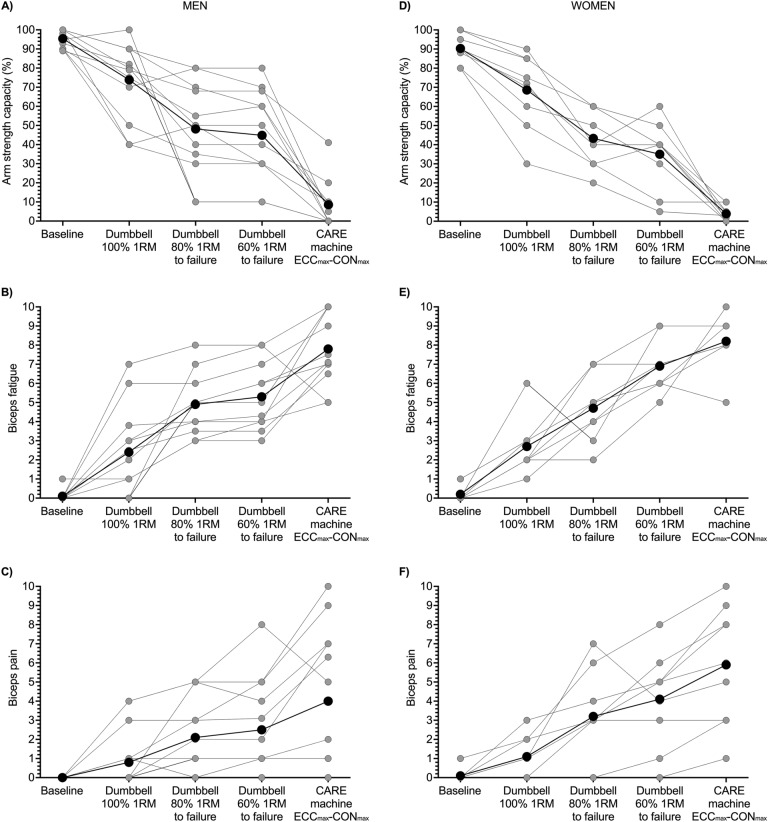
Twelve men and nine women attempted 25 consecutive coupled maximal ECC-concentric (CON) repetitions (ECC-CON) on a CARE machine. Participants also completed a CON one repetition maximum (1RM) and repetitions-to-failure tests with 60 and 80% 1RM dumbbells.
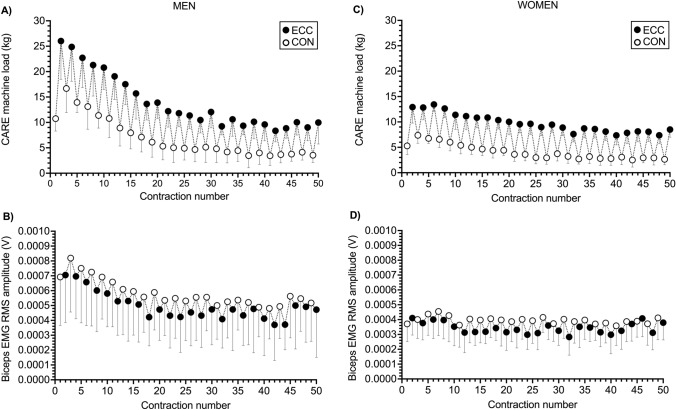
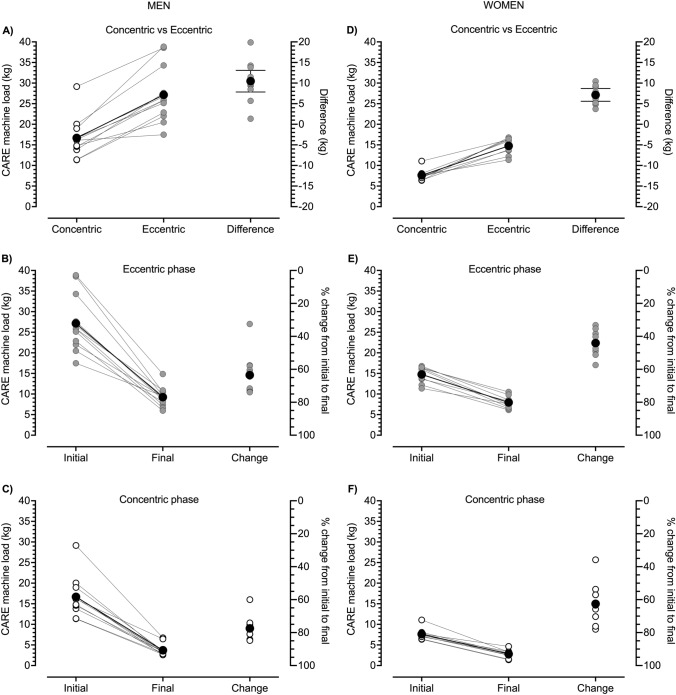
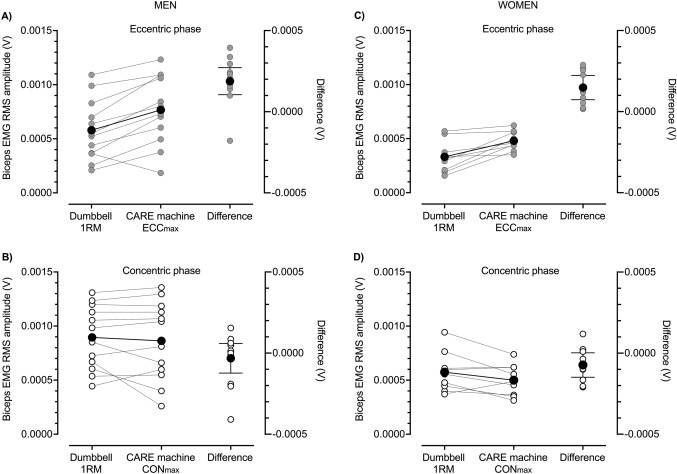
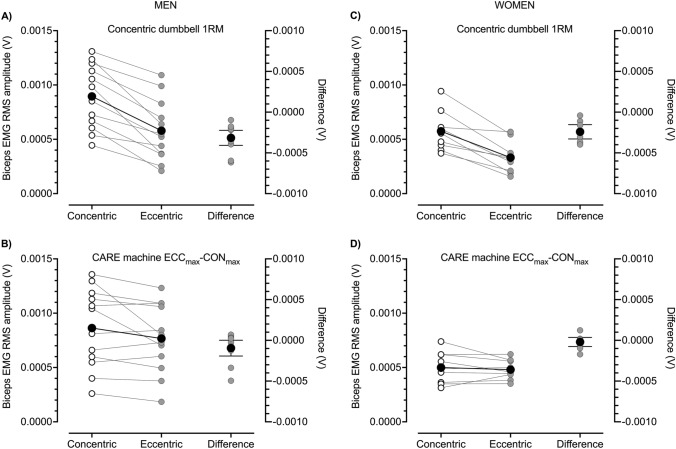
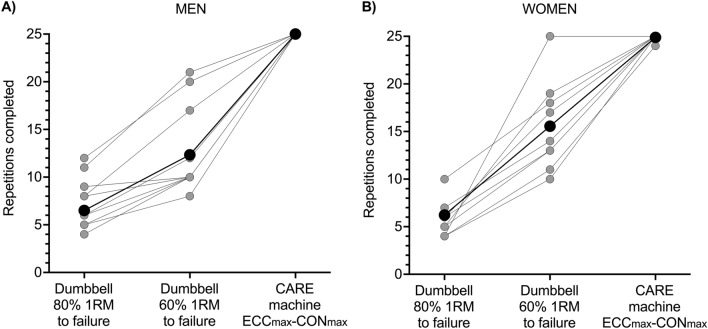
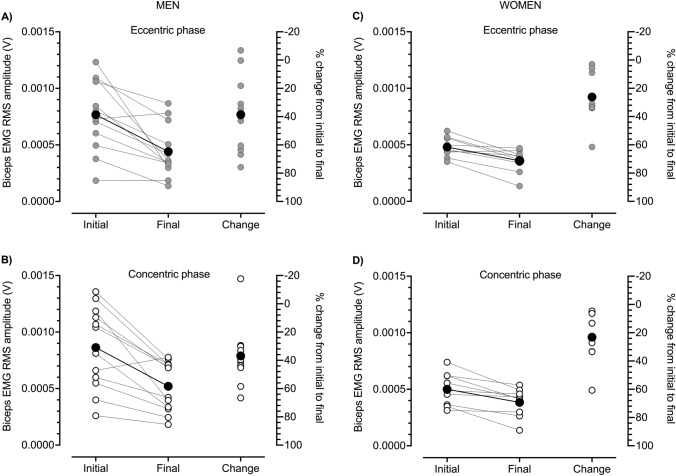
Maximal strength on the CARE machine was greater during the ECC than CON phase, illustrating ECC overload (men: 27.1 ± 6.8, 14.7 ± 2.0 kg; women: 16.7 ± 4.7, 7.6 ± 1.4 kg). These maximal resistances demanded large neural drive. Biceps brachii EMG amplitude relative to CON dumbbell 1RM EMG was 140.1 ± 40.2% (ECC) and 96.7 ± 25.0% (CON) for men and 165.1 ± 61.1% (ECC) and 89.4 ± 20.4% (CON) for women. The machine's drop setting algorithm permitted 25 consecutive maximal effort repetitions without stopping. By comparison, participants completed fewer repetitions-to-failure with the submaximal dumbbells (e.g., 60%1RM-men: 12.3 ± 4.4; women: 15.6 ± 4.7 repetitions). By the 25th CARE repetition, participants reported heightened biceps fatigue (~ 8 of 10) and exhibited large decreases in ECC strength (men: 63.5 ± 11.6%; women: 44.1 ± 8.0%), CON strength (men: 77.5 ± 6.5%; women: 62.5 ± 12.8%), ECC EMG (men: 38.6 ± 20.4%; women: 26.2 ± 18.3%), and CON EMG (men: 36.8 ± 20.4%; women: 23.1 ± 18.4%).
ECC overload and drop sets occurred automatically and feasibly with CARE technology and caused greater strength and EMG loss in men than women.
连接式自适应抗阻训练(CARE)器械是一种新设备,据称可在重复动作的过程中调整阻力,从而使离心(ECC)超负荷和递减组更可行。在这里,我们研究了使用 CARE 器械和哑铃进行单臂弯举运动时肌肉力量、耐力、肌电图活动(EMG)和疲劳感。我们还测试了肌肉疲劳的性别差异。
12 名男性和 9 名女性在 CARE 器械上尝试了 25 次连续的耦合最大 ECC-向心(CON)重复动作(ECC-CON)。参与者还完成了 CON 一次重复最大力量(1RM)和 60%和 80%1RM 哑铃的失败重复次数测试。
在 ECC 阶段,CARE 器械上的最大力量大于 CON 阶段,表明 ECC 超负荷(男性:27.1±6.8、14.7±2.0kg;女性:16.7±4.7、7.6±1.4kg)。这些最大阻力需要大量的神经驱动。与 CON 哑铃 1RM EMG 相比,二头肌肱肌 EMG 幅度为男性 140.1±40.2%(ECC)和 96.7±25.0%(CON),女性 165.1±61.1%(ECC)和 89.4±20.4%(CON)。机器的下降设置算法允许进行 25 次连续的最大努力重复动作,无需停止。相比之下,参与者使用亚最大哑铃完成的失败重复次数更少(例如,60%1RM-男性:12.3±4.4;女性:15.6±4.7 次)。到第 25 次 CARE 重复时,参与者报告二头肌疲劳感增加(~8 级中的 10 级),ECC 力量(男性:63.5±11.6%;女性:44.1±8.0%)、CON 力量(男性:77.5±6.5%;女性:62.5±12.8%)、ECC EMG(男性:38.6±20.4%;女性:26.2±18.3%)和 CON EMG(男性:36.8±20.4%;女性:23.1±18.4%)显著下降。
ECC 超负荷和递减组通过 CARE 技术自动且可行地发生,并导致男性的力量和 EMG 损失大于女性。