Brigham and Women's Hospital, Harvard University, Boston, Massachusetts.
Analysis Group Inc, Boston, Massachusetts.
JAMA Dermatol. 2023 Apr 1;159(4):411-418. doi: 10.1001/jamadermatol.2023.0002.
Alopecia areata (AA) is characterized by nonscarring hair loss of the scalp, face, and/or body. Alopecia totalis (AT) and alopecia universalis (AU) involve complete loss of the scalp and body hair, respectively. The epidemiology of AA in the US remains unclear, having previously been extrapolated from older studies that were limited to specific geographic areas or clinical settings, or from self-reported data.
To estimate the annual prevalence and incidence of AA and AT and/or AU (AT/AU) in the US.
DESIGN, SETTING, AND PARTICIPANTS: This retrospective, population-based cohort study was conducted from January 2016 to December 2019 and included enrollees in the IBM MarketScan Commercial Claims and Encounters and Medicare Supplemental databases and their dependents, with plan enrollment during each study calendar year and the year prior.
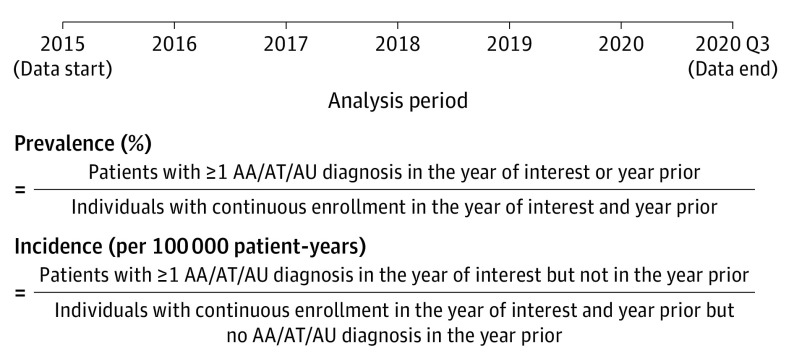
Prevalent cases were identified by 1 or more claims for AA or AT/AU (International Statistical Classification of Diseases, Tenth Revision, Clinical Modification [ICD-10-CM] codes L63.x, L63.0, L63.1) during each year of interest or the year prior. Incident cases were identified by 1 or more claims for AA or AT/AU during a specific year and no diagnosis the year prior.
Annual incidence and prevalence rates were calculated and stratified by age, sex, and region. National employer-sponsored insurance population estimates were obtained using population-based weights.
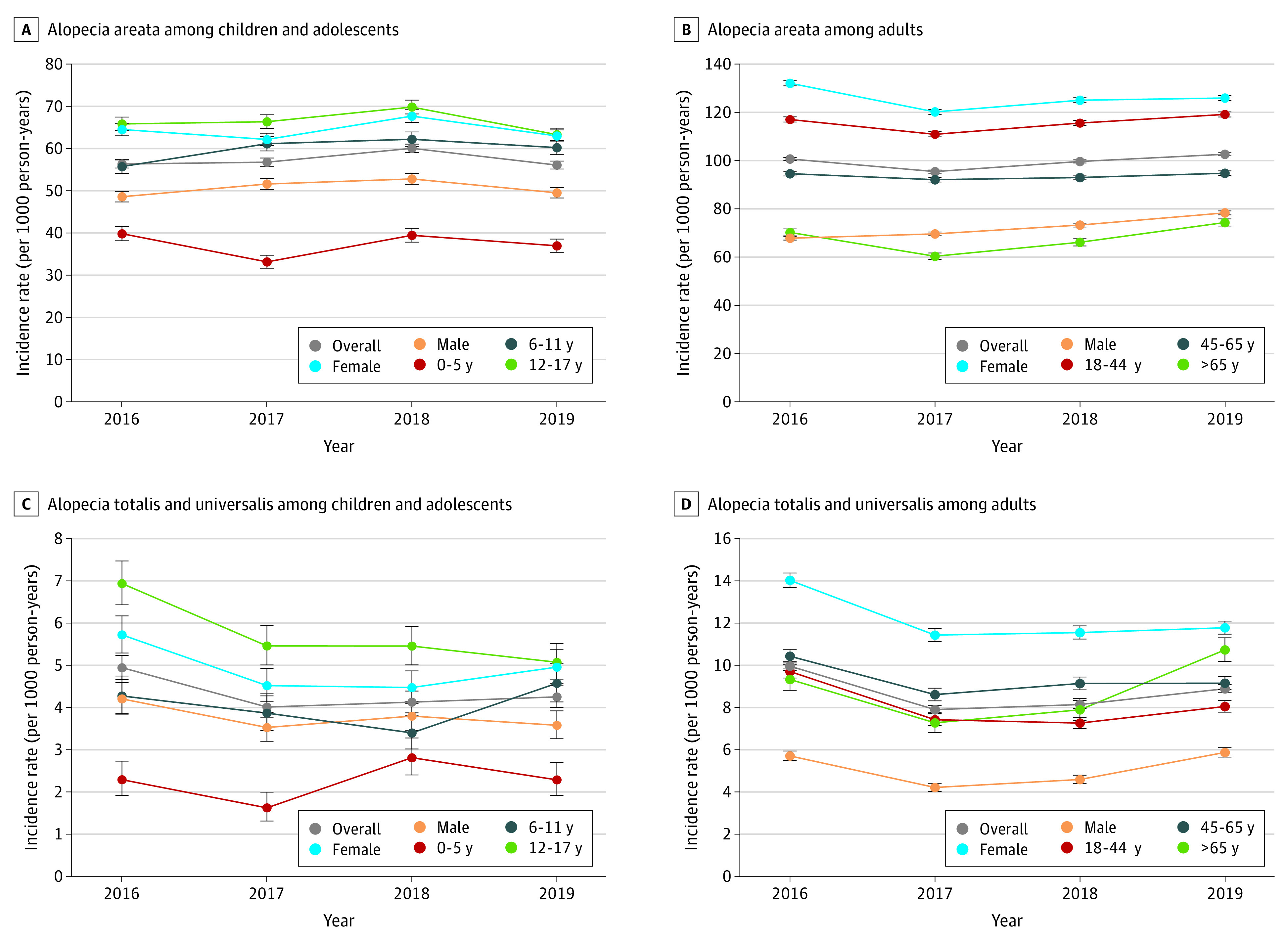
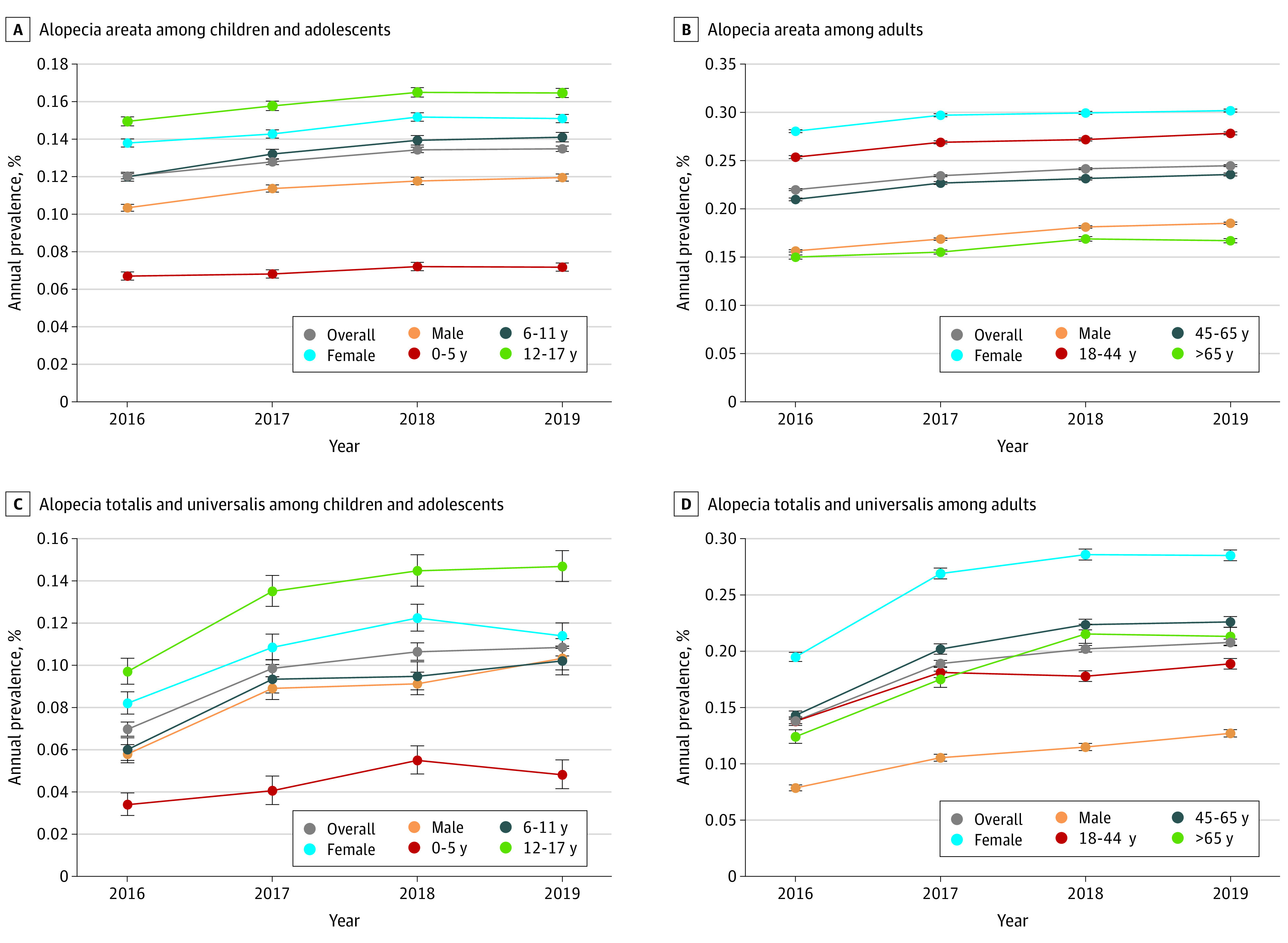
Among eligible patients (2016: n = 18 368 [mean (SD) age, 40.6 (17.9) years; 12 295 women (66.9%)]; 2017: n = 14 372 [mean (SD) age, 39.6 (17.7) years; 9195 women (64.0%)]; 2018: n = 14 231 [mean (SD) age, 38.9 (17.3) years; 8998 women (63.2%)]; 2019: n = 13 455 [mean (SD) age, 39.1 (17.4) years; 8322 women (61.9%)]), AA prevalence increased from 0.199% (95% CI, 0.198%-0.200%) in 2016 to 0.222% (95% CI, 0.221%-0.223%) in 2019. Roughly 5% to 10% of prevalent and incident cases of AA were AT/AU. The prevalence of AT/AU increased from 0.012% (95% CI, 0.012%-0.013%) to 0.019% (95% CI, 0.018%-0.019%) from 2016 to 2019. Incidence of AA per 100 000 person-years ranged from 87.39 (95% CI, 86.84-87.96) in 2017 to 92.90 (95% CI, 92.35-93.45) in 2019. Incidence of AT/AU ranged from 7.09 (95% CI, 6.94-7.25) in 2017 to 8.92 (95% CI, 8.75-9.09) in 2016. Prevalence and incidence of AA and AT/AU were higher among female vs male individuals, adults vs children and adolescents, and in the Northeast vs other regions.
The results of this cohort study suggest that these recent AA prevalence and incidence estimates could help improve current understanding of the disease burden. Further research is warranted to elucidate subpopulation differences and trends in AA in the broader US population.
斑秃(AA)的特征是非瘢痕性脱发的头皮,面部和/或身体。全秃(AT)和普秃(AU)分别涉及头皮和全身毛发的完全丧失。美国 AA 的流行病学情况尚不清楚,此前曾从仅限于特定地理区域或临床环境的较旧研究中推断出来,或从自我报告的数据中推断出来。
估计美国 AA 和 AT/AU(AT/AU)的年患病率和发病率。
设计、地点和参与者:这项回顾性、基于人群的队列研究于 2016 年 1 月至 2019 年 12 月进行,纳入了 IBM MarketScan 商业索赔和遭遇以及 Medicare 补充数据库中的参保者及其家属,在每个研究日历年内和前一年都有计划参保。
通过在每个感兴趣的年份或前一年的一个或多个 AA 或 AT/AU(国际疾病分类第十版临床修正版 [ICD-10-CM] 代码 L63.x、L63.0、L63.1)的索赔来确定现患病例。通过在特定年份的一个或多个 AA 或 AT/AU 的索赔来确定新发病例,且前一年没有诊断。
计算了每年的发病率和患病率,并按年龄、性别和地区进行了分层。使用基于人群的权重获得了全国雇主赞助的保险人口估计数。
在合格患者中(2016 年:n=18368[平均(SD)年龄,40.6(17.9)岁;12295 名女性(66.9%)];2017 年:n=14372[平均(SD)年龄,39.6(17.7)岁;9195 名女性(64.0%)];2018 年:n=14231[平均(SD)年龄,38.9(17.3)岁;8998 名女性(63.2%)];2019 年:n=13455[平均(SD)年龄,39.1(17.4)岁;8322 名女性(61.9%)]),AA 的患病率从 2016 年的 0.199%(95%CI,0.198%-0.200%)增加到 2019 年的 0.222%(95%CI,0.221%-0.223%)。大约 5%到 10%的 AA 现患和新发病例为 AT/AU。AT/AU 的患病率从 2016 年的 0.012%(95%CI,0.012%-0.013%)增加到 2019 年的 0.019%(95%CI,0.018%-0.019%)。每 100000 人年 AA 的发病率范围为 2017 年的 87.39(95%CI,86.84-87.96)至 2019 年的 92.90(95%CI,92.35-93.45)。AT/AU 的发病率范围为 2017 年的 7.09(95%CI,6.94-7.25)至 2016 年的 8.92(95%CI,8.75-9.09)。女性与男性个体、成年人与儿童和青少年、东北地区与其他地区相比,AA 和 AT/AU 的患病率和发病率更高。
这项队列研究的结果表明,这些最近的 AA 患病率和发病率估计数可能有助于提高对疾病负担的现有认识。需要进一步研究以阐明更广泛的美国人群中 AA 的亚群差异和趋势。