Ivanov Nicolas, Chau Tom
PRISM Lab, Bloorview Research Institute, Holland Bloorview Kids Rehabilitation Hospital, Toronto, ON, Canada.
Institute of Biomedical Engineering, University of Toronto, Toronto, ON, Canada.
Front Comput Neurosci. 2023 Feb 13;17:1108889. doi: 10.3389/fncom.2023.1108889. eCollection 2023.
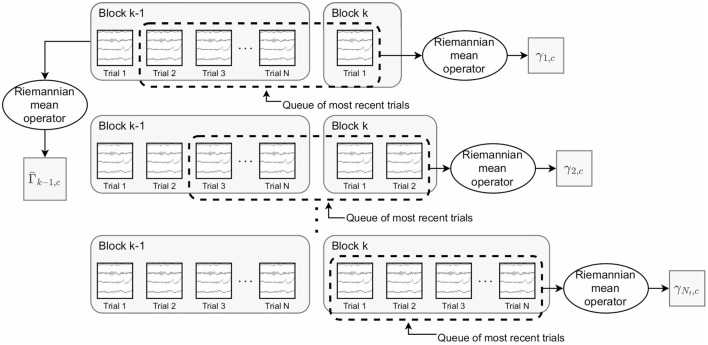
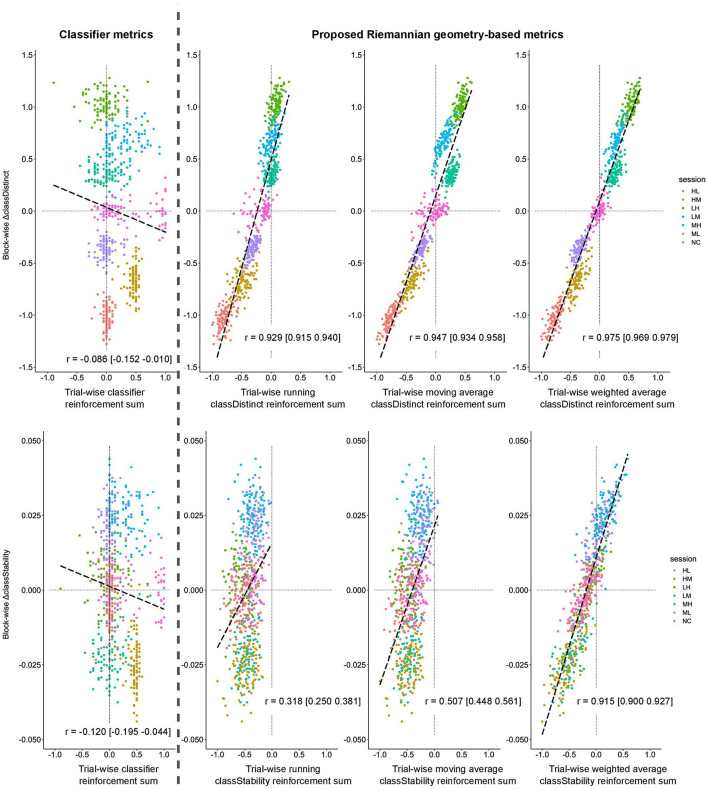
Despite growing interest and research into brain-computer interfaces (BCI), their usage remains limited outside of research laboratories. One reason for this is BCI inefficiency, the phenomenon where a significant number of potential users are unable to produce machine-discernible brain signal patterns to control the devices. To reduce the prevalence of BCI inefficiency, some have advocated for novel user-training protocols that enable users to more effectively modulate their neural activity. Important considerations for the design of these protocols are the assessment measures that are used for evaluating user performance and for providing feedback that guides skill acquisition. Herein, we present three trial-wise adaptations (running, sliding window and weighted average) of Riemannian geometry-based user-performance metrics ( reflecting the degree of class separability and reflecting the level of within-class consistency) to enable feedback to the user following each individual trial. We evaluated these metrics, along with conventional classifier feedback, using simulated and previously recorded sensorimotor rhythm-BCI data to assess their correlation with and discrimination of broader trends in user performance. Analysis revealed that the sliding window and weighted average variants of our proposed trial-wise Riemannian geometry-based metrics more accurately reflected performance changes during BCI sessions compared to conventional classifier output. The results indicate the metrics are a viable method for evaluating and tracking user performance changes during BCI-user training and, therefore, further investigation into how these metrics may be presented to users during training is warranted.
尽管对脑机接口(BCI)的兴趣和研究不断增加,但其在研究实验室之外的使用仍然有限。造成这种情况的一个原因是BCI效率低下,即大量潜在用户无法产生机器可识别的脑信号模式来控制设备的现象。为了降低BCI效率低下的发生率,一些人主张采用新颖的用户训练方案,使用户能够更有效地调节其神经活动。设计这些方案时的重要考虑因素是用于评估用户表现以及提供指导技能获取反馈的评估措施。在此,我们提出了基于黎曼几何的用户表现指标的三种逐次试验调整方法(运行、滑动窗口和加权平均),以在每次单独试验后向用户提供反馈。我们使用模拟数据和先前记录的感觉运动节律BCI数据评估了这些指标以及传统的分类器反馈,以评估它们与用户表现的更广泛趋势的相关性和区分能力。分析表明,与传统分类器输出相比,我们提出的基于逐次试验黎曼几何的指标的滑动窗口和加权平均变体更准确地反映了BCI会话期间的表现变化。结果表明,这些指标是评估和跟踪BCI用户训练期间用户表现变化的可行方法,因此,有必要进一步研究如何在训练期间向用户呈现这些指标。