Research & Data Analysis, Population Council, India Habitat Centre, New Delhi, India.
Population Council, India Habitat Centre, New Delhi, India.
PLoS One. 2023 Mar 2;18(3):e0282468. doi: 10.1371/journal.pone.0282468. eCollection 2023.
India has the largest adolescent population in the world. However, many unprivileged Indian adolescents are still unable to complete schooling. Hence, there is a need to understand the reasons for school dropout among this population. The present study is an attempt to understand the determinants of school dropout among adolescents and identify the factors and reasons that contribute to it.
Longitudinal survey data- Understanding Adults and Young Adolescents (UDAYA) for Bihar and Uttar Pradesh has been used to identify the determinants of school dropout among adolescents aged 10-19. The first wave of the survey was conducted in 2015-2016, and the follow-up survey in 2018-2019. Descriptive statistics along with bivariate and multivariate analysis was used to observe school dropout rates and factors associated with it among adolescents.
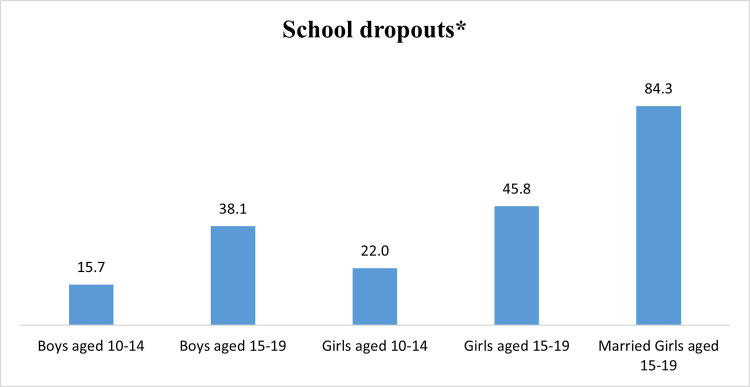
Results show that the school dropout rate was highest among married girls aged 15-19 years (84%), followed by unmarried girls (46%), and boys (38%) of the same age group. The odds of school dropout among adolescents decreased with an increase in household wealth status. School dropout was significantly less likely among adolescents whose mothers were educated as compared to mothers who had no education. Younger boys [AOR: 6.67; CI: 4.83-9.23] and girls [AOR: 2.56; CI: 1.79-3.84] who engaged in paid work were 6.67 times and 2.56 times more likely to drop out of school than those who were not. The likelihood of school dropout was 3.14 times more likely among younger boys [AOR: 3.14; CI: 2.26-4.35], and it was 89% more likely among older boys [AOR: 1.89; CI: 1.55-2.30] who consumed any substances as compared to those who did not consume any substances. Both younger [AOR: 2.05; CI: 1.37-3.05] and older girls [AOR: 1.30; CI: 1.05-1.62] who acknowledged at least one form of discriminatory practice by parents were more likely to drop out of school than their counterparts. Lack of interest in studies/education not necessary (43%) was the predominant reason among younger boys for school dropout, followed by family reasons (23%) and paid work (21%).
Dropout was prevalent among lower social and economic strata. Mother's education, parental interaction, participation in sports and having role models reduce school dropout. Conversely, factors such as being engaged in paid work, substance abuse among boys, and gender discriminatory practices towards girls, are risk factors for dropout among adolescents. Lack of interest in studies and familial reasons also increase dropout. There is a need to improve the socio-economic status, delay the marital age of girls, and enhance the government incentives for education, give rightful work to girls after schooling, and provide awareness.
印度拥有世界上最大的青少年人口。然而,许多贫困的印度青少年仍然无法完成学业。因此,有必要了解这一人群辍学的原因。本研究试图了解青少年辍学的决定因素,并确定导致辍学的因素和原因。
使用理解比哈尔邦和北方邦的成年人和青少年(UDAYA)的纵向调查数据,以确定 10-19 岁青少年辍学的决定因素。该调查的第一波于 2015-2016 年进行,后续调查于 2018-2019 年进行。使用描述性统计以及双变量和多变量分析来观察青少年的辍学率及其相关因素。
结果表明,15-19 岁已婚女孩的辍学率最高(84%),其次是未婚女孩(46%)和同年龄组的男孩(38%)。青少年辍学的几率随着家庭财富状况的增加而降低。与没有受过教育的母亲相比,母亲受过教育的青少年辍学的可能性较小。与没有从事有薪工作的青少年相比,从事有薪工作的年轻男孩(AOR:6.67;CI:4.83-9.23)和女孩(AOR:2.56;CI:1.79-3.84)更有可能辍学。与年龄较大的男孩相比,年轻男孩(AOR:3.14;CI:2.26-4.35)和年龄较大的男孩(AOR:1.89;CI:1.55-2.30)更有可能辍学,而年龄较大的男孩更有可能辍学。他们摄入任何物质的可能性是不摄入任何物质的可能性的 3.14 倍。与没有承认父母至少有一种歧视行为的同龄人相比,承认父母至少有一种歧视行为的年轻女孩(AOR:2.05;CI:1.37-3.05)和年龄较大的女孩(AOR:1.30;CI:1.05-1.62)更有可能辍学。缺乏对学习/教育的兴趣并非必要(43%)是年轻男孩辍学的主要原因,其次是家庭原因(23%)和有薪工作(21%)。
辍学现象在社会经济地位较低的阶层中较为普遍。母亲的教育、父母的互动、参与体育活动和有榜样都可以减少辍学。相反,男孩从事有薪工作、滥用药物以及女孩受到性别歧视等因素是青少年辍学的危险因素。缺乏对学习的兴趣和家庭原因也会增加辍学率。有必要提高社会经济地位,推迟女孩的结婚年龄,加强政府对教育的激励措施,为女孩提供毕业后的正当工作,并提高认识。
