Department of Noncommunicable Diseases and Mental Health, Pan American Health Organization, Washington, District of Columbia, USA
Department of Noncommunicable Diseases and Mental Health, Pan American Health Organization, Washington, District of Columbia, USA.
BMJ Open. 2023 Mar 2;13(3):e070085. doi: 10.1136/bmjopen-2022-070085.
This article presents the Americas regional results of the WHO non-communicable diseases (NCDs) Country Capacity Survey from 2019 to 2021, on NCD service capacity and disruptions from the COVID-19 pandemic.
Information on public sector primary care services for NCDs, and related technical inputs from 35 countries in the Americas region are provided.
All Ministry of Health officials managing a national NCD programme, from a WHO Member State in the Americas region, were included throughout this study. Government health officials from countries that are not WHO Member States were excluded.
The availability of evidence-based NCD guidelines, essential NCD medicines and basic technologies in primary care, cardiovascular disease risk stratification, cancer screening and palliative care services were measured in 2019, 2020 and 2021. NCD service interruptions, reassignments of NCD staff during the COVID-19 pandemic and mitigation strategies to reduce disruptions for NCD services were measured in 2020 and 2021.
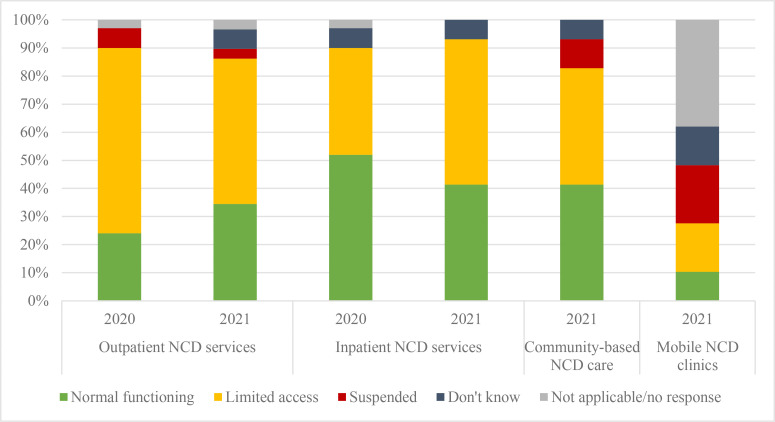
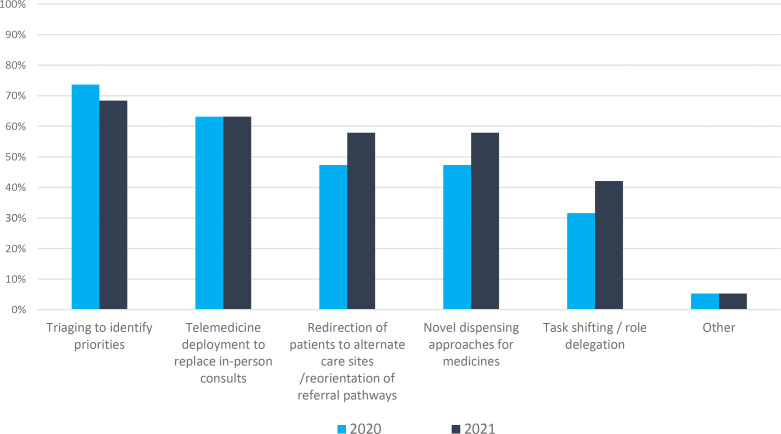
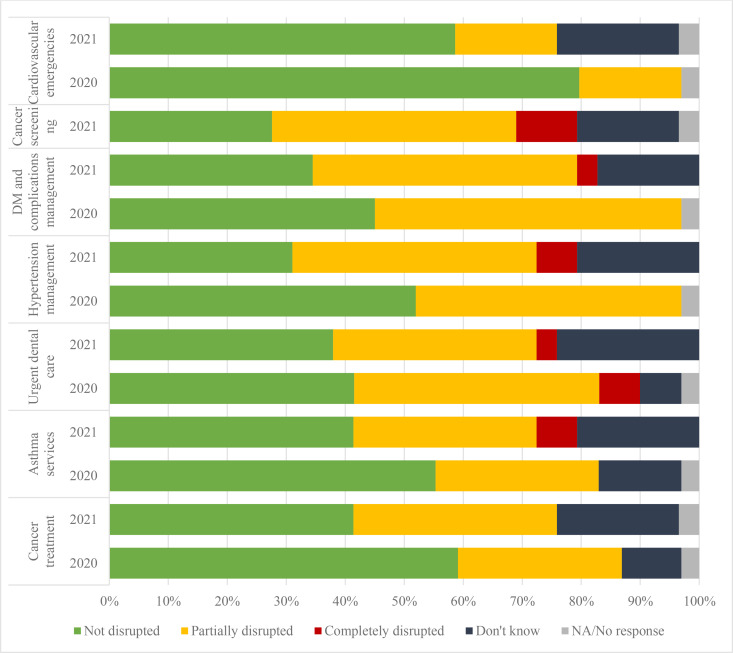
More than 50% of countries reported a lack of comprehensive package of NCD guidelines, essential medicines and related service inputs. Extensive disruptions in NCD services resulted from the pandemic, with only 12/35 countries (34%), reporting that outpatient NCD services were functioning normally. Ministry of Health staff were largely redirected to work on the COVID-19 response, either full time or partially, reducing the human resources available for NCD services. Six of 24 countries (25%) reported stock out of essential NCD medicines and/or diagnostics at health facilities which affected service continuity. Mitigation strategies to ensure continuity of care for people with NCDs were deployed in many countries and included triaging patients, telemedicine and teleconsultations, and electronic prescriptions and other novel prescribing practices.
The findings from this regional survey suggest significant and sustained disruptions, affecting all countries regardless of the country's level of investments in healthcare or NCD burden.
本文呈现了 2019 年至 2021 年世卫组织非传染性疾病(NCD)国家能力调查在美洲区域的结果,内容涉及 NCD 服务能力以及 COVID-19 大流行带来的中断。
提供了美洲区域 35 个国家公共部门初级保健服务的 NCD 信息以及相关技术投入。
本研究涵盖了来自美洲区域世卫组织会员国的管理国家 NCD 规划的所有卫生部官员。不属世卫组织会员国的国家的政府卫生官员被排除在外。
2019 年、2020 年和 2021 年衡量了初级保健中基于证据的 NCD 指南、基本 NCD 药物和基本技术的可用性、心血管疾病风险分层、癌症筛查和姑息治疗服务。2020 年和 2021 年衡量了 COVID-19 大流行期间 NCD 服务中断、NCD 工作人员重新分配以及减少 NCD 服务中断的缓解策略。
超过 50%的国家报告缺乏全面的 NCD 指南、基本药物和相关服务投入包。大流行导致 NCD 服务广泛中断,仅有 12/35 个国家(34%)报告门诊 NCD 服务正常运作。卫生部工作人员大部分被重新部署到 COVID-19 应对工作中,无论是全职还是部分时间,减少了用于 NCD 服务的人力资源。24 个国家中有 6 个(25%)报告卫生机构基本 NCD 药物和/或诊断试剂缺货,影响了服务连续性。许多国家都采取了缓解策略来确保 NCD 患者的护理连续性,包括分诊患者、远程医疗和远程咨询、电子处方和其他新型处方实践。
本区域调查结果表明,所有国家都受到了重大且持续的干扰,无论其对医疗保健或 NCD 负担的投资水平如何。