Centre for Safe Medication Practice and Research, Department of Pharmacology and Pharmacy, Li Ka Shing Faculty of Medicine, The University of Hong Kong, Hong Kong SAR, China.
Department of Social Work and Social Administration, Faculty of Social Sciences, The University of Hong Kong, Hong Kong SAR, China.
Transl Psychiatry. 2023 Mar 3;13(1):76. doi: 10.1038/s41398-023-02383-9.
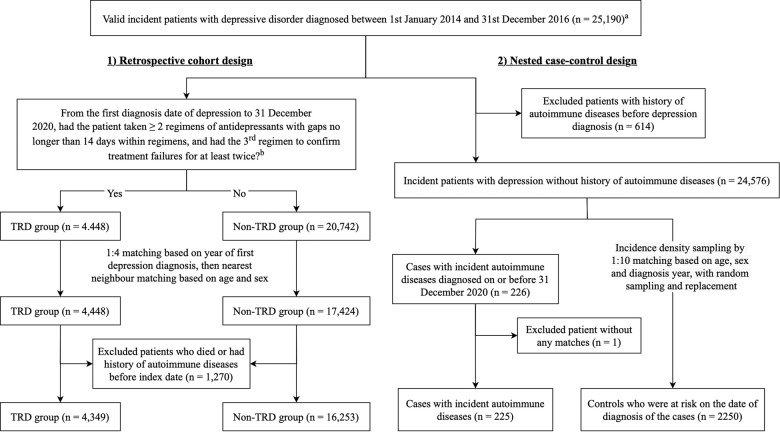
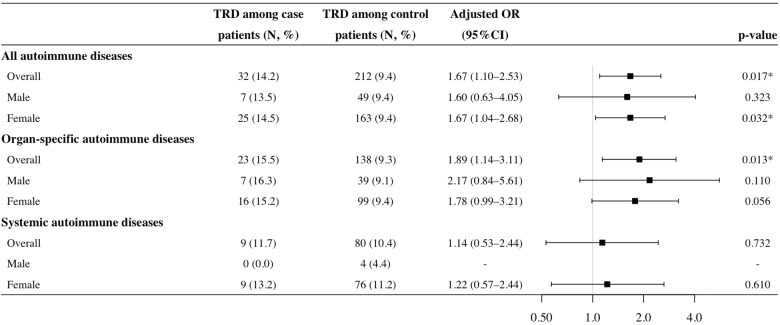
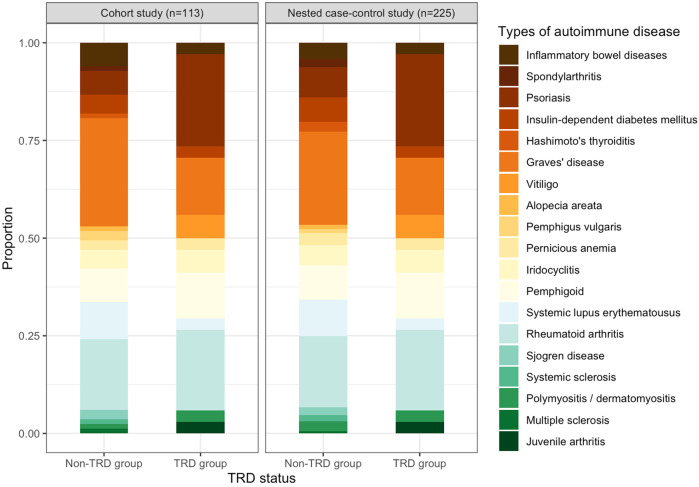
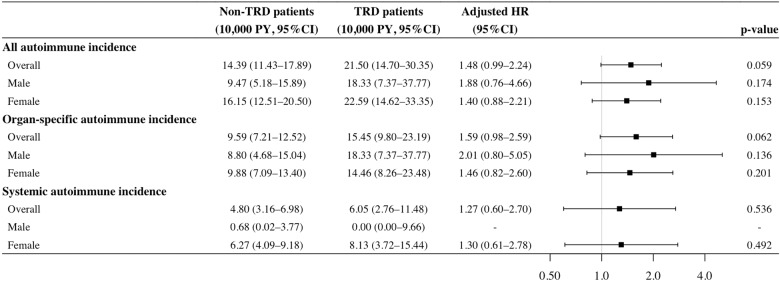
Recent literature indicates that patients with depression had increased immune activation. We hypothesised that treatment-resistant depression (TRD), an indicator of non-responsive depression with long-term dysregulated inflammation, could be an independent risk factor for subsequent autoimmune diseases. We performed a cohort study and a nested case-control study to examine the association between TRD and risk of autoimmune diseases, and to explore potential sex-specific difference. Using electronic medical records in Hong Kong, we identified 24,576 patients with incident depression between 2014 and 2016 without autoimmune history and followed up from diagnosis to death or December 2020 to identify TRD status and autoimmune incidence. TRD was defined as having at least two antidepressant regimens and the third regimen to confirm previous treatment failures. Based on age, sex and year of depression, we matched TRD patients 1:4 to the non-TRD in the cohort analysis using nearest-neighbour matching, and matched cases and controls 1:10 using incidence density sampling in the nested case-control analysis. We conducted survival analyses and conditional logistic regression respectively for risk estimation, adjusting for medical history. Across the study period, 4349 patients without autoimmune history (17.7%) developed TRD. With 71,163 person-years of follow-up, the cumulative incidence of 22 types of autoimmune diseases among the TRD patients was generally higher than the non-TRD (21.5 vs. 14.4 per 10,000 person-years). Cox model suggested a non-significant association (HR:1.48, 95% CI: 0.99-2.24, p = 0.059), whereas conditional logistic model showed a significant association (OR: 1.67, 95% CI: 1.10-2.53, p = 0.017) between TRD status and autoimmune diseases. Subgroup analysis showed that the association was significant in organ-specific diseases but not in systemic diseases. Risk magnitudes were generally higher among men compared to women. In conclusion, our findings provide evidence for an increased risk of autoimmune diseases in patients with TRD. Controlling chronic inflammation in hard-to-treat depression might play a role in preventing subsequent autoimmunity.
最近的文献表明,抑郁症患者的免疫激活增加。我们假设,治疗抵抗性抑郁症(TRD),即长期炎症失调导致的无反应性抑郁症的指标,可能是随后发生自身免疫性疾病的独立危险因素。我们进行了一项队列研究和一项巢式病例对照研究,以检查 TRD 与自身免疫性疾病风险之间的关联,并探讨潜在的性别特异性差异。我们使用香港的电子病历,确定了 2014 年至 2016 年间无自身免疫病史且从诊断开始至死亡或 2020 年 12 月的 24576 名新发抑郁症患者,以确定 TRD 状态和自身免疫性疾病的发生率。TRD 的定义是至少有两种抗抑郁药方案,第三种方案用于确认先前的治疗失败。在队列分析中,根据年龄、性别和抑郁症发病年份,我们使用最近邻匹配,将 TRD 患者与非 TRD 患者按 1:4 匹配;在巢式病例对照分析中,使用发病率密度抽样将病例和对照按 1:10 匹配。我们分别进行了生存分析和条件逻辑回归,以估计风险,调整了病史。在整个研究期间,4349 名无自身免疫病史的患者(17.7%)发展为 TRD。在 71163 人年的随访中,TRD 患者的 22 种自身免疫性疾病的累积发病率普遍高于非 TRD 患者(每 10000 人年 21.5 比 14.4)。Cox 模型提示两者无显著关联(HR:1.48,95%CI:0.99-2.24,p=0.059),而条件逻辑模型显示 TRD 状态与自身免疫性疾病之间存在显著关联(OR:1.67,95%CI:1.10-2.53,p=0.017)。亚组分析显示,这种关联在器官特异性疾病中显著,但在系统性疾病中不显著。与女性相比,男性的风险幅度普遍较高。总之,我们的研究结果为 TRD 患者发生自身免疫性疾病的风险增加提供了证据。控制难治性抑郁症的慢性炎症可能在预防随后的自身免疫中发挥作用。