Department of Biomedicine, Århus University, Århus, Denmark.
Department of Clinical Medicine, Aalborg University, Aalborg, Denmark.
Histochem Cell Biol. 2023 Mar;159(3):225-232. doi: 10.1007/s00418-023-02182-9. Epub 2023 Mar 2.
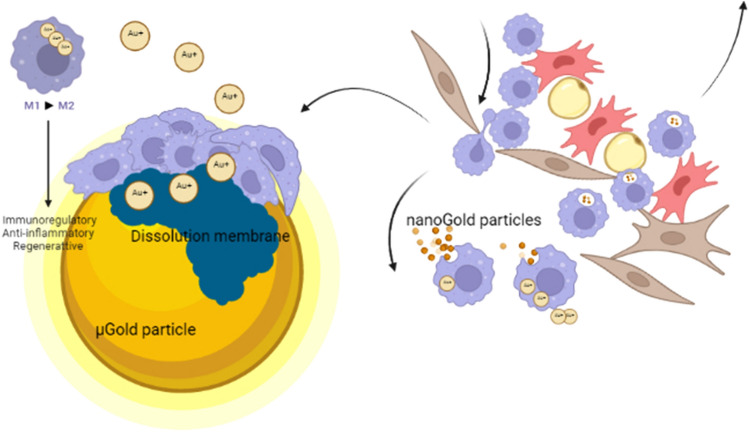
The newest data on metallic gold have placed the noble metal central in the fight for the safe treatment of autoimmune inflammation. There are two different ways to use gold for the treatment of inflammation: gold microparticles > 20 µm and gold nanoparticles. The injection of gold microparticles (µGold) is a purely local therapy. µGold particles stay put where injected, and gold ions released from them are relatively few and taken up by cells within a sphere of only a few millimeters in diameter from their origin particles. The macrophage-induced release of gold ions may continue for years. Injection of gold nanoparticles (nanoGold), on the other hand, is spread throughout the whole body, and the bio-released gold ions, therefore, affect multitudes of cells all over the body, as when using gold-containing drugs such as Myocrisin. Since macrophages and other phagocytotic cells take up and transport nanoGold and remove it after a short period, repeated treatment is necessary. This review describes the details of the cellular mechanisms that lead to the bio-release of gold ions in µGold and nanoGold.
最新的金属金数据将贵金属置于治疗自身免疫炎症的安全治疗的核心位置。有两种不同的方法将金用于炎症治疗:大于 20µm 的金纳米颗粒和金纳米颗粒。金纳米颗粒(µGold)的注射是一种纯粹的局部治疗。µGold 颗粒留在注射部位,从它们释放的金离子相对较少,并且被直径只有几毫米的球体中的细胞摄取,该球体起源于颗粒。巨噬细胞诱导的金离子释放可能会持续多年。另一方面,金纳米颗粒(nanoGold)的注射会扩散到全身,因此,生物释放的金离子会影响全身的众多细胞,就像使用含有金的药物(如 Myocrisin)一样。由于巨噬细胞和其他吞噬细胞摄取并运输纳米金,并在短时间后将其去除,因此需要重复治疗。这篇综述描述了导致 µGold 和 nanoGold 中生物释放金离子的细胞机制的细节。