Tang Qijun, Godschall Elizabeth, Brennan Charles D, Zhang Qi, Abraham-Fan Ruei-Jen, Williams Sydney P, Güngül Taha Buğra, Onoharigho Roberta, Buyukaksakal Aleyna, Salinas Ricardo, Olivieri Joey J, Deppmann Christopher D, Campbell John N, Podyma Brandon, Güler Ali D
Department of Biology, University of Virginia, Charlottesville, VA 22904, USA.
Program in Fundamental Neuroscience, Charlottesville, VA 22904, USA.
bioRxiv. 2023 Feb 26:2023.02.24.529901. doi: 10.1101/2023.02.24.529901.
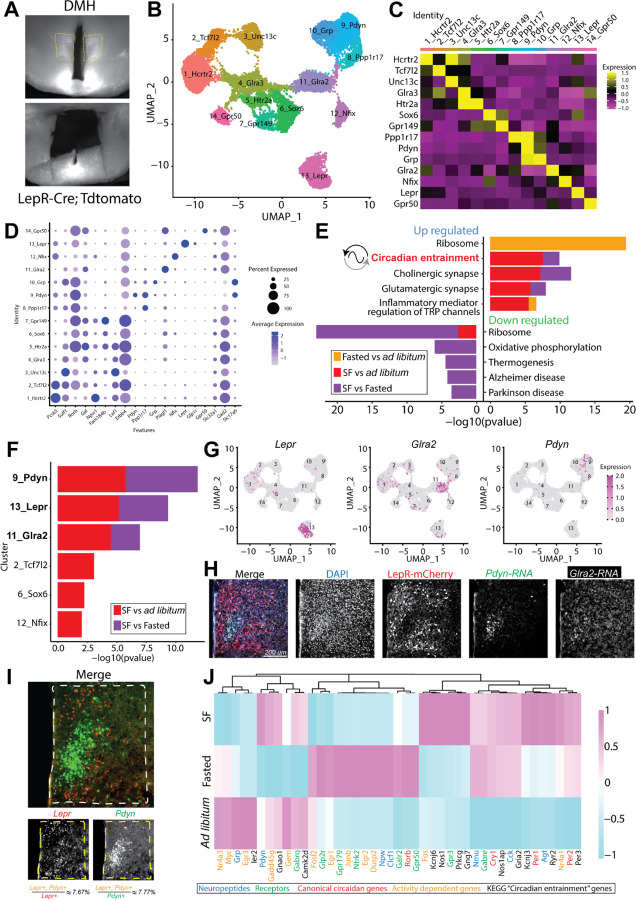
Salient cues, such as the rising sun or the availability of food, play a crucial role in entraining biological clocks, allowing for effective behavioral adaptation and ultimately, survival. While the light-dependent entrainment of the central circadian pacemaker (suprachiasmatic nucleus, SCN) is relatively well defined, the molecular and neural mechanisms underlying entrainment associated with food availability remains elusive. Using single nucleus RNA sequencing during scheduled feeding (SF), we identified a leptin receptor (LepR) expressing neuron population in the dorsomedial hypothalamus (DMH) that upregulates circadian entrainment genes and exhibits rhythmic calcium activity prior to an anticipated meal. We found that disrupting DMH neuron activity had a profound impact on both molecular and behavioral food entrainment. Specifically, silencing DMH neurons, mis-timed exogenous leptin administration, or mis-timed chemogenetic stimulation of these neurons all interfered with the development of food entrainment. In a state of energy abundance, repetitive activation of DMH neurons led to the partitioning of a secondary bout of circadian locomotor activity that was in phase with the stimulation and dependent on an intact SCN. Lastly, we discovered that a subpopulation of DMH neurons project to the SCN with the capacity to influence the phase of the circadian clock. This leptin regulated circuit serves as a point of integration between the metabolic and circadian systems, facilitating the anticipation of meal times.
显著线索,如日出或食物的可得性,在调节生物钟方面起着至关重要的作用,使有效的行为适应成为可能,并最终关乎生存。虽然中枢昼夜节律起搏器(视交叉上核,SCN)的光依赖性调节相对明确,但与食物可得性相关的调节的分子和神经机制仍不清楚。通过在定时喂食(SF)期间进行单核RNA测序,我们在背内侧下丘脑(DMH)中鉴定出一群表达瘦素受体(LepR)的神经元,它们上调昼夜节律调节基因,并在预期进食前表现出有节律的钙活动。我们发现,破坏DMH神经元活动对分子和行为上的食物调节都有深远影响。具体而言,沉默DMH神经元、不合时宜地给予外源性瘦素或对这些神经元进行不合时宜的化学遗传刺激,都会干扰食物调节的发展。在能量充足的状态下,DMH神经元的重复激活导致了第二轮昼夜节律运动活动的划分,该活动与刺激同步且依赖于完整的SCN。最后,我们发现DMH神经元的一个亚群投射到SCN,具有影响生物钟相位的能力。这个瘦素调节的回路是代谢系统和昼夜节律系统之间的一个整合点,有助于预测用餐时间。