Department of Obstetrics, The First Hospital of China Medical University, Shenyang, China.
Front Immunol. 2023 Feb 14;14:1009867. doi: 10.3389/fimmu.2023.1009867. eCollection 2023.
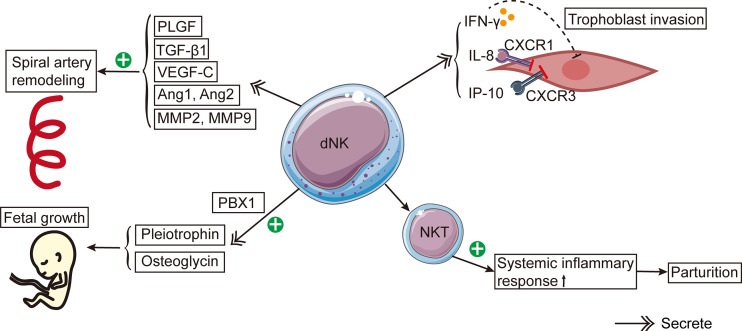
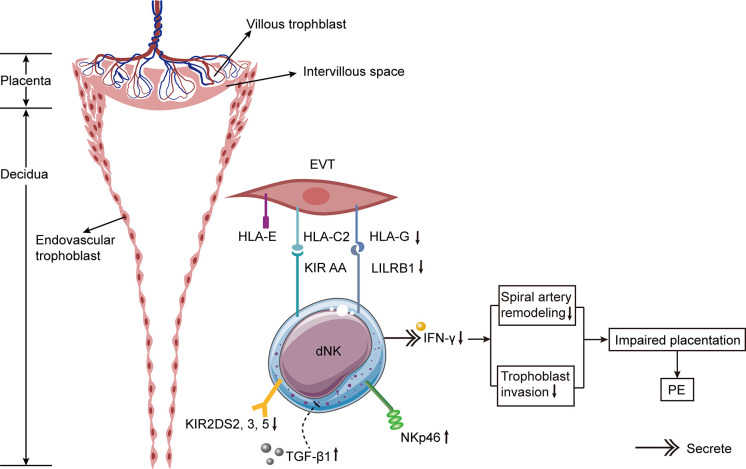
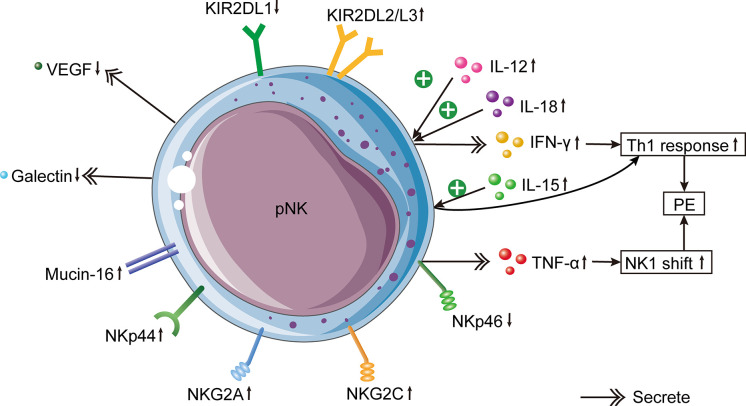
Preeclampsia (PE) is a disease that is unique to pregnancy and affects multiple systems. It can lead to maternal and perinatal mortality. The precise etiology of PE is unclear. Patients with PE may have systemic or local immune abnormalities. A group of researchers has proposed that the immune communication between the fetus and mother is primarily moderated by natural killer (NK) cells as opposed to T cells, since NK cells are the most abundant immune cells in the uterus. This review examines the immunological roles of NK cells in the pathogenesis of PE. Our aim is to provide obstetricians with a comprehensive and updated research progress report on NK cells in PE patients. It has been reported that decidual NK (dNK) cells contribute to the process of uterine spiral artery remodeling and can modulate trophoblast invasion. Additionally, dNK cells can stimulate fetal growth and regulate delivery. It appears that the count or proportion of circulating NK cells is elevated in patients with or at risk for PE. Changes in the number or function of dNK cells may be the cause of PE. The Th1/Th2 equilibrium in PE has gradually shifted to an NK1/NK2 equilibrium based on cytokine production. An improper combination of killer cell immunoglobulin-like receptor (KIR) and human leukocyte antigen (HLA)-C may lead to insufficient activation of dNK cells, thereby causing PE. In the etiology of PE, NK cells appear to exert a central effect in both peripheral blood and the maternal-fetal interface. To maintain immune equilibrium both locally and systemically, it is necessary to take therapeutic measures directed at NK cells.
子痫前期(PE)是一种妊娠特有的疾病,可影响多个系统。它可导致母婴死亡。PE 的确切病因尚不清楚。PE 患者可能存在全身或局部免疫异常。有研究小组提出,胎儿和母亲之间的免疫通讯主要由自然杀伤(NK)细胞调节,而不是 T 细胞,因为 NK 细胞是子宫中最丰富的免疫细胞。本综述探讨了 NK 细胞在 PE 发病机制中的免疫作用。我们的目的是为妇产科医生提供一份关于 PE 患者 NK 细胞的全面和最新的研究进展报告。据报道,蜕膜 NK(dNK)细胞有助于子宫螺旋动脉重塑过程,并可调节滋养细胞浸润。此外,dNK 细胞可以刺激胎儿生长并调节分娩。似乎患有或有患 PE 风险的患者的循环 NK 细胞数量或比例升高。dNK 细胞数量或功能的变化可能是 PE 的原因。基于细胞因子产生,PE 中的 Th1/Th2 平衡逐渐向 NK1/NK2 平衡转变。杀伤细胞免疫球蛋白样受体(KIR)和人类白细胞抗原(HLA)-C 的不适当组合可能导致 dNK 细胞激活不足,从而导致 PE。在 PE 的病因中,NK 细胞在周围血液和母胎界面中似乎都发挥着核心作用。为了在局部和全身维持免疫平衡,有必要采取针对 NK 细胞的治疗措施。