Clinical Microbiology, University Hospitals of Leicester NHS Trust.
Respiratory Sciences, University of Leicester, Leicester, UK.
Curr Opin Pulm Med. 2023 May 1;29(3):191-196. doi: 10.1097/MCP.0000000000000947. Epub 2023 Mar 3.
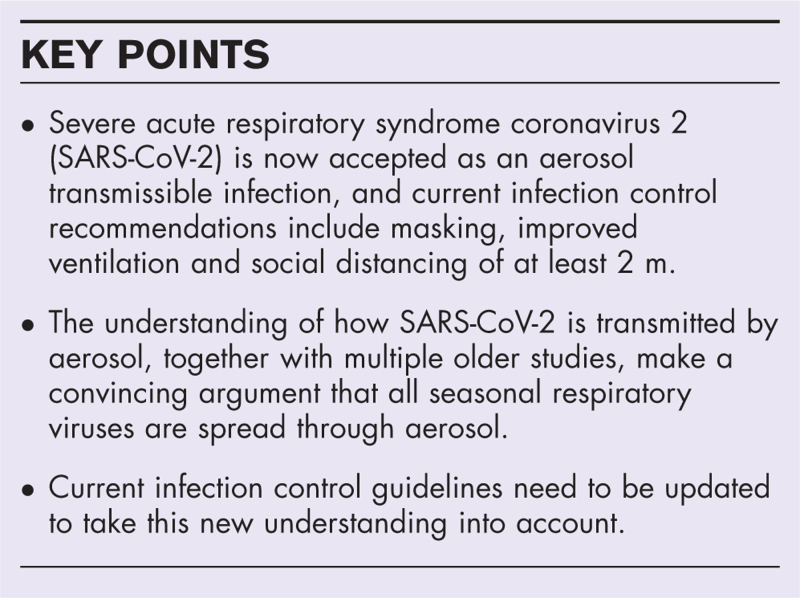
The coronavirus disease 2019 pandemic has had a wide-ranging and profound impact on how we think about the transmission of respiratory viruses This review outlines the basis on which we should consider all respiratory viruses as aerosol-transmissible infections, in order to improve our control of these pathogens in both healthcare and community settings.
We present recent studies to support the aerosol transmission of severe acute respiratory syndrome coronavirus 2, and some older studies to demonstrate the aerosol transmissibility of other, more familiar seasonal respiratory viruses.
Current knowledge on how these respiratory viruses are transmitted, and the way we control their spread, is changing. We need to embrace these changes to improve the care of patients in hospitals and care homes including others who are vulnerable to severe disease in community settings.
2019 年冠状病毒病大流行对我们如何看待呼吸道病毒的传播产生了广泛而深远的影响。本综述概述了我们应将所有呼吸道病毒视为气溶胶传播感染的依据,以便在医疗保健和社区环境中更好地控制这些病原体。
我们提出了一些新的研究来支持严重急性呼吸综合征冠状病毒 2 的气溶胶传播,并展示了一些更早的研究来证明其他更常见的季节性呼吸道病毒的气溶胶传播能力。
关于这些呼吸道病毒传播方式以及我们控制其传播方式的知识正在发生变化。我们需要接受这些变化,以改善医院和养老院中患者的护理,包括在社区环境中易患重病的其他人。