Faculty of Psychology, SWPS University of Social Sciences and Humanities, Katowice, Poland.
Department of Psychology, Ivan Franko National University of Lviv, Lviv, Ukraine.
Sci Rep. 2023 Mar 3;13(1):3602. doi: 10.1038/s41598-023-28729-3.
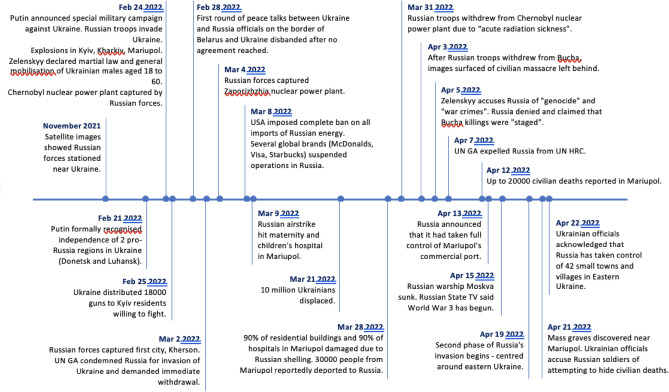
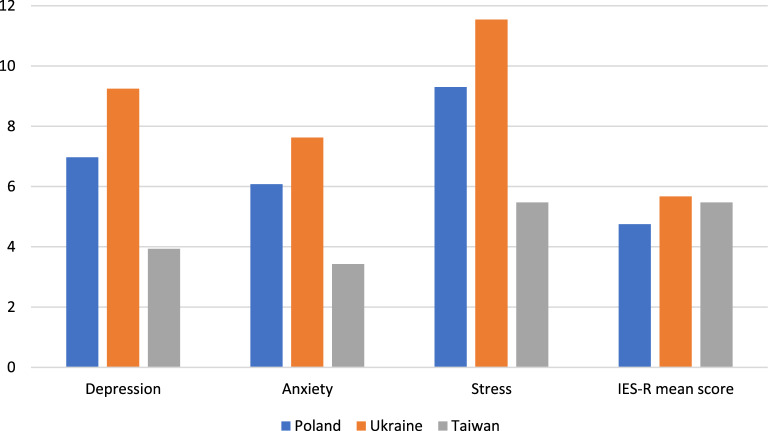
Ukraine has been embroiled in an increasing war since February 2022. In addition to Ukrainians, the Russo-Ukraine war has affected Poles due to the refugee crisis and the Taiwanese, who are facing a potential crisis with China. We examined the mental health status and associated factors in Ukraine, Poland, and Taiwan. The data will be used for future reference as the war is still ongoing. From March 8 to April 26, 2022, we conducted an online survey using snowball sampling techniques in Ukraine, Poland, and Taiwan. Depression, anxiety, and stress were measured using the Depression, Anxiety, and Stress (DASS)-21 item scale; post-traumatic stress symptoms by the Impact of Event Scale-Revised (IES-R) and coping strategies by the Coping Orientation to Problems Experienced Inventory (Brief-COPE). We used multivariate linear regression to identify factors significantly associated with DASS-21 and IES-R scores. There were 1626 participants (Poland: 1053; Ukraine: 385; Taiwan: 188) in this study. Ukrainian participants reported significantly higher DASS-21 (p < 0.001) and IES-R (p < 0.01) scores than Poles and Taiwanese. Although Taiwanese participants were not directly involved in the war, their mean IES-R scores (40.37 ± 16.86) were only slightly lower than Ukrainian participants (41.36 ± 14.94). Taiwanese reported significantly higher avoidance scores (1.60 ± 0.47) than the Polish (0.87 ± 0.53) and Ukrainian (0.91 ± 0.5) participants (p < 0.001). More than half of the Taiwanese (54.3%) and Polish (80.3%) participants were distressed by the war scenes in the media. More than half (52.5%) of the Ukrainian participants would not seek psychological help despite a significantly higher prevalence of psychological distress. Multivariate linear regression analyses found that female gender, Ukrainian and Polish citizenship, household size, self-rating health status, past psychiatric history, and avoidance coping were significantly associated with higher DASS-21 and IES-R scores after adjustment of other variables (p < 0.05). We have identified mental health sequelae in Ukrainian, Poles, and Taiwanese with the ongoing Russo-Ukraine war. Risk factors associated with developing depression, anxiety, stress, and post-traumatic stress symptoms include female gender, self-rating health status, past psychiatric history, and avoidance coping. Early resolution of the conflict, online mental health interventions, delivery of psychotropic medications, and distraction techniques may help to improve the mental health of people who stay inside and outside Ukraine.
自 2022 年 2 月以来,乌克兰一直深陷战争。除了乌克兰人,俄乌战争还影响了波兰人,因为他们面临难民危机,也影响了台湾人,因为他们可能与中国发生危机。我们研究了乌克兰、波兰和中国台湾的心理健康状况及其相关因素。由于战争仍在继续,这些数据将供未来参考。2022 年 3 月 8 日至 4 月 26 日,我们使用滚雪球抽样技术在乌克兰、波兰和中国台湾进行了在线调查。使用抑郁、焦虑和压力量表(DASS-21 项量表)评估抑郁、焦虑和压力;创伤后应激症状使用修订后的事件影响量表(IES-R)评估;应对策略使用经验问题应对取向量表(Brief-COPE)评估。我们使用多元线性回归来确定与 DASS-21 和 IES-R 评分显著相关的因素。本研究共纳入 1626 名参与者(波兰:1053 名;乌克兰:385 名;中国台湾:188 名)。乌克兰参与者报告的 DASS-21(p<0.001)和 IES-R(p<0.01)评分明显高于波兰人和台湾人。尽管台湾人没有直接参与战争,但他们的平均 IES-R 评分(40.37±16.86)仅略低于乌克兰人(41.36±14.94)。台湾人报告的回避评分(1.60±0.47)明显高于波兰人(0.87±0.53)和乌克兰人(0.91±0.5)(p<0.001)。超过一半的台湾人(54.3%)和波兰人(80.3%)对媒体上的战争场景感到苦恼。尽管乌克兰人有较高的心理困扰,但超过一半(52.5%)的乌克兰人不会寻求心理帮助。多元线性回归分析发现,女性、乌克兰和波兰公民身份、家庭规模、自我评估的健康状况、既往精神病史和回避应对与调整其他变量后的 DASS-21 和 IES-R 评分较高显著相关(p<0.05)。我们已经确定了正在进行的俄乌战争对乌克兰、波兰和中国台湾人的心理健康产生的后果。与发展为抑郁、焦虑、压力和创伤后应激症状相关的风险因素包括女性、自我评估的健康状况、既往精神病史和回避应对。冲突的早期解决、在线心理健康干预、精神药物的提供和分散注意力的技巧可能有助于改善乌克兰境内外人民的心理健康。