Department of Mechanical and Aerospace Engineering, Princeton University, Princeton, NJ, 08544, USA.
LadHyX, CNRS, Ecole polytechnique, Institut polytechnique de Paris, 91120, Palaiseau, France.
Nat Commun. 2023 Mar 4;14(1):1242. doi: 10.1038/s41467-023-36860-y.
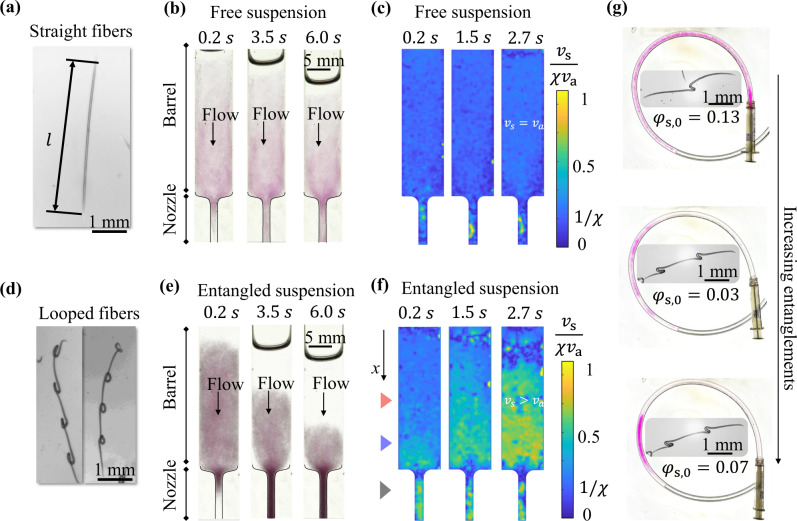
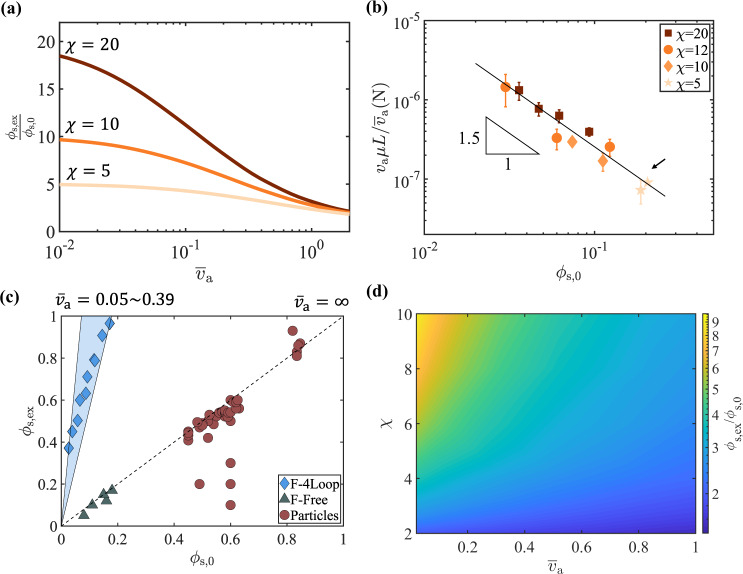
When a suspension of spherical or near-spherical particles passes through a constriction the particle volume fraction either remains the same or decreases. In contrast to these particulate suspensions, here we observe that an entangled fiber suspension increases its volume fraction up to 14-fold after passing through a constriction. We attribute this response to the entanglements among the fibers that allows the network to move faster than the liquid. By changing the fiber geometry, we find that the entanglements originate from interlocking shapes or high fiber flexibility. A quantitative poroelastic model is used to explain the increase in velocity and extrudate volume fraction. These results provide a new strategy to use fiber volume fraction, flexibility, and shape to tune soft material properties, e.g., suspension concentration and porosity, during delivery, as occurs in healthcare, three-dimensional printing, and material repair.
当悬浮的球形或近似球形颗粒通过狭窄通道时,颗粒体积分数要么保持不变,要么减小。与这些颗粒悬浮液不同,我们在这里观察到,缠结纤维悬浮液在通过狭窄通道后,其体积分数增加了 14 倍。我们将这种响应归因于纤维之间的缠结,使得网络能够比液体更快地移动。通过改变纤维的几何形状,我们发现缠结源于互锁形状或高纤维柔韧性。使用定量的多孔弹性模型来解释速度和挤出物体积分数的增加。这些结果为使用纤维体积分数、柔韧性和形状来调整输送过程中的软物质特性(例如悬浮液浓度和孔隙率)提供了一种新策略,这种情况在医疗保健、三维打印和材料修复中都会发生。