Liu Xinyu, Huang Xiaoqiang, Zhao Jindong, Su Yanjin, Shen Lu, Duan Yuhong, Gong Jing, Zhang Zhihai, Piao Shenghua, Zhu Qing, Rong Xianglu, Guo Jiao
Guangdong Metabolic Diseases Research Center of Integrated Chinese and Western Medicine, Guangdong Pharmaceutical University, Guangzhou, 510006, China.
Key Laboratory of Glucolipid Metabolic Disorder, Ministry of Education of China, Guangdong Pharmaceutical University, Guangzhou, 510006, China.
Heliyon. 2023 Feb 13;9(2):e13289. doi: 10.1016/j.heliyon.2023.e13289. eCollection 2023 Feb.
China has become the country with the largest number of people with type 2 diabetes mellitus (T2DM), and Chinese medicine (CM) has unique advantages in preventing and treating T2DM, while accurate pattern differentiation is the guarantee for proper treatment.
The establishment of the CM pattern differentiation model of T2DM is helpful to the pattern diagnosis of the disease. At present, there are few studies on dampness-heat pattern differentiation models of T2DM. Therefore, we establish a machine learning model, hoping to provide an efficient tool for the pattern diagnosis of CM for T2DM in the future.
A total of 1021 effective samples of T2DM patients from ten CM hospitals or clinics were collected by a questionnaire including patients' demographic and dampness-heat-related symptoms and signs. All information and the diagnosis of the dampness-heat pattern of patients were completed by experienced CM physicians at each visit. We applied six machine learning algorithms (Artificial Neural Network [ANN], K-Nearest Neighbor [KNN], Naïve Bayes [NB], Support Vector Machine [SVM], Extreme Gradient Boosting [XGBoost] and Random Forest [RF]) and compared their performance. And then we also utilized Shapley additive explanation (SHAP) method to explain the best performance model.
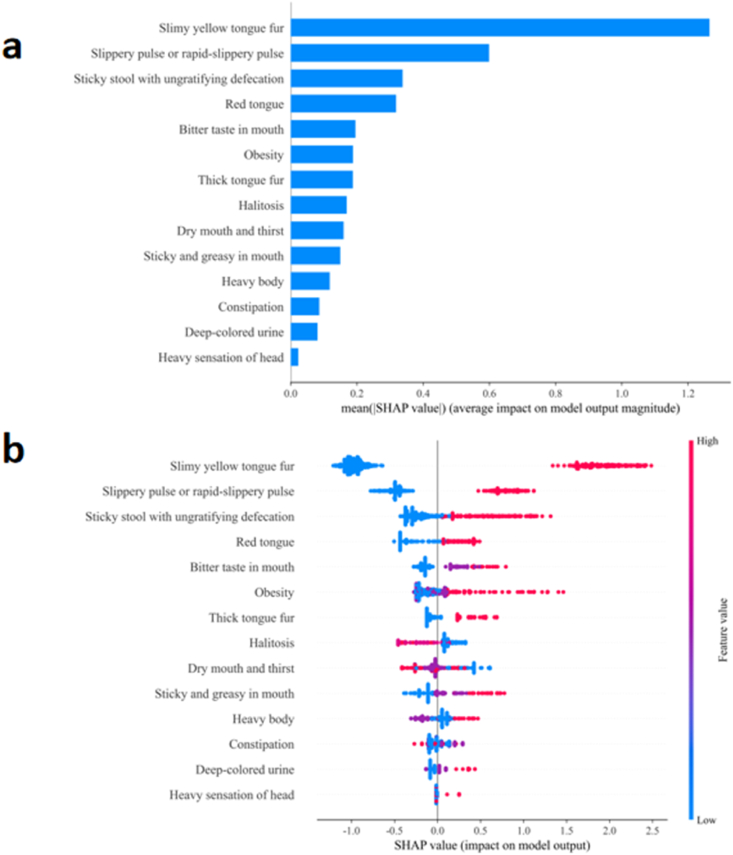
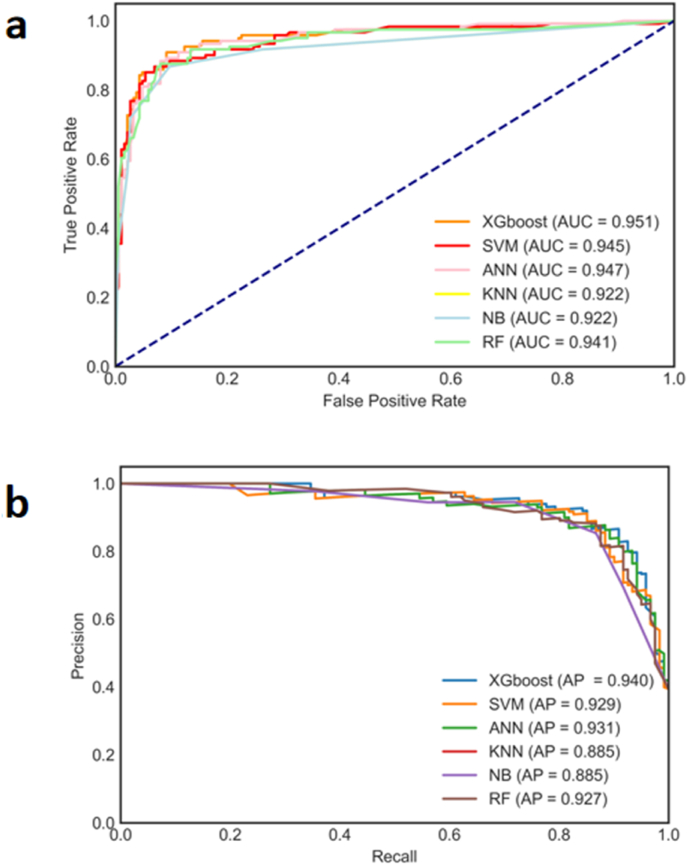
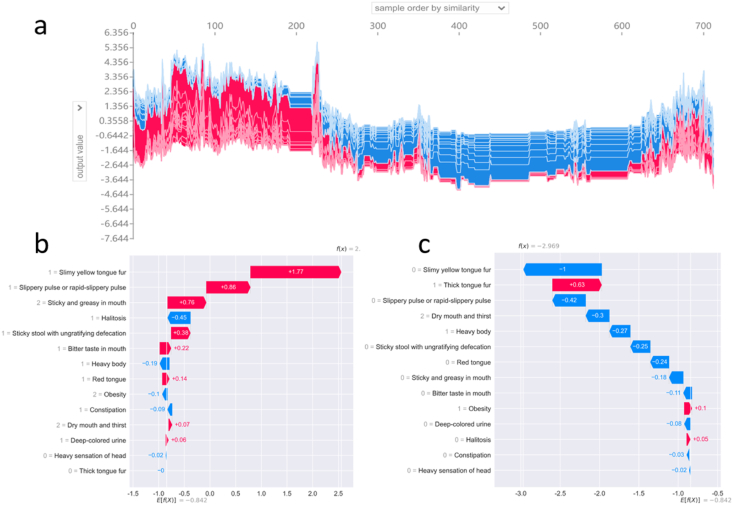
The XGBoost model had the highest AUC (0.951, 95% CI 0.925-0.978) among the six models, with the best sensitivity, accuracy, F1 score, negative predictive value, and excellent specificity, precision, and positive predictive value. The SHAP method based on XGBoost showed that slimy yellow tongue fur was the most important sign in dampness-heat pattern diagnosis. The slippery pulse or rapid-slippery pulse, sticky stool with ungratifying defecation also performed an important role in this diagnostic model. Furthermore, the red tongue acted as an important tongue sign for the dampness-heat pattern.
This study constructed a dampness-heat pattern differentiation model of T2DM based on machine learning. The XGBoost model is a tool with the potential to help CM practitioners make quick diagnosis decisions and contribute to the standardization and international application of CM patterns.
中国已成为2型糖尿病(T2DM)患者人数最多的国家,中医在T2DM的防治方面具有独特优势,而准确的辨证是合理治疗的保证。
建立T2DM的中医辨证模型有助于该病的证型诊断。目前,关于T2DM湿热证辨证模型的研究较少。因此,我们建立一个机器学习模型,希望为未来T2DM的中医证型诊断提供一个有效的工具。
通过一份包含患者人口统计学信息以及与湿热相关的症状和体征的问卷,收集了来自10家中医院或诊所的1021例T2DM患者的有效样本。每次就诊时,由经验丰富的中医师完成所有信息及患者湿热证的诊断。我们应用了六种机器学习算法(人工神经网络[ANN]、K近邻算法[KNN]、朴素贝叶斯算法[NB]、支持向量机[SVM]、极端梯度提升算法[XGBoost]和随机森林算法[RF])并比较它们的性能。然后我们还利用夏普利值附加解释(SHAP)方法来解释性能最佳的模型。
在六个模型中,XGBoost模型的曲线下面积(AUC)最高(0.951,95%可信区间0.925 - 0.978),具有最佳的灵敏度、准确率、F1分数、阴性预测值,以及出色的特异性、精确率和阳性预测值。基于XGBoost的SHAP方法表明,黄腻苔是湿热证诊断中最重要的体征。滑脉或滑数脉、大便黏腻不爽在该诊断模型中也起到重要作用。此外,舌红是湿热证的一个重要舌象。
本研究基于机器学习构建了T2DM的湿热证辨证模型。XGBoost模型是一个有潜力帮助中医师快速做出诊断决策,并有助于中医证型的标准化和国际应用的工具。