California Institute of Technology, Division of Biology and Biological Engineering, 1200 E California Blvd., Pasadena, CA 91125, USA; California Institute of Technology, Tianqiao and Chrissy Chen Brain-Machine Interface Center, 1200 E California Blvd., Pasadena, CA 91125, USA.
California Institute of Technology, Division of Biology and Biological Engineering, 1200 E California Blvd., Pasadena, CA 91125, USA.
Curr Biol. 2022 May 9;32(9):2051-2060.e6. doi: 10.1016/j.cub.2022.03.047. Epub 2022 Apr 6.
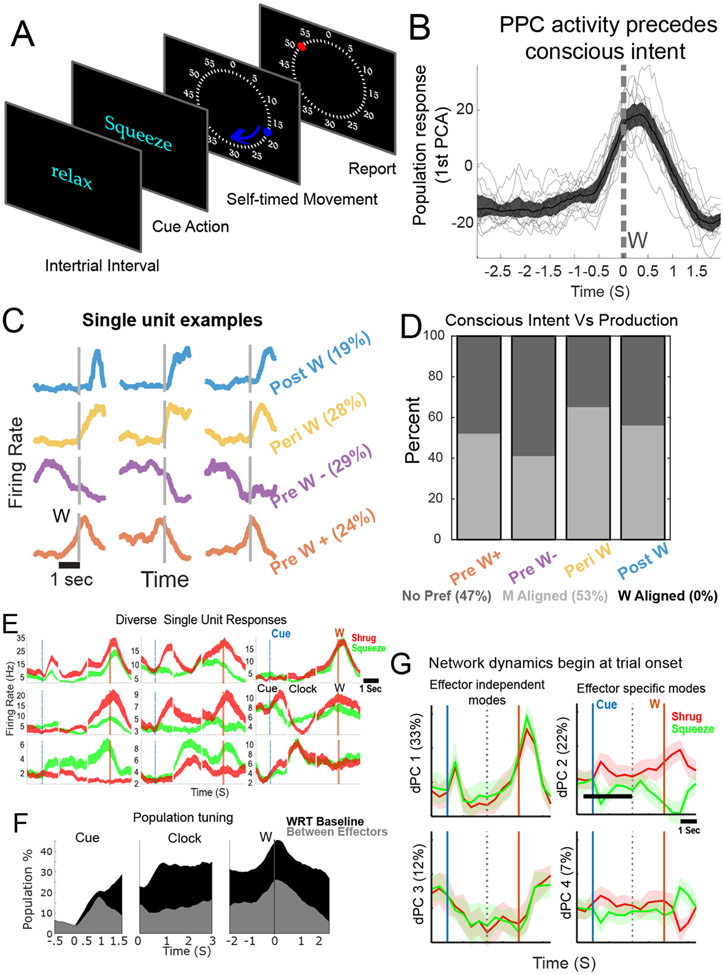
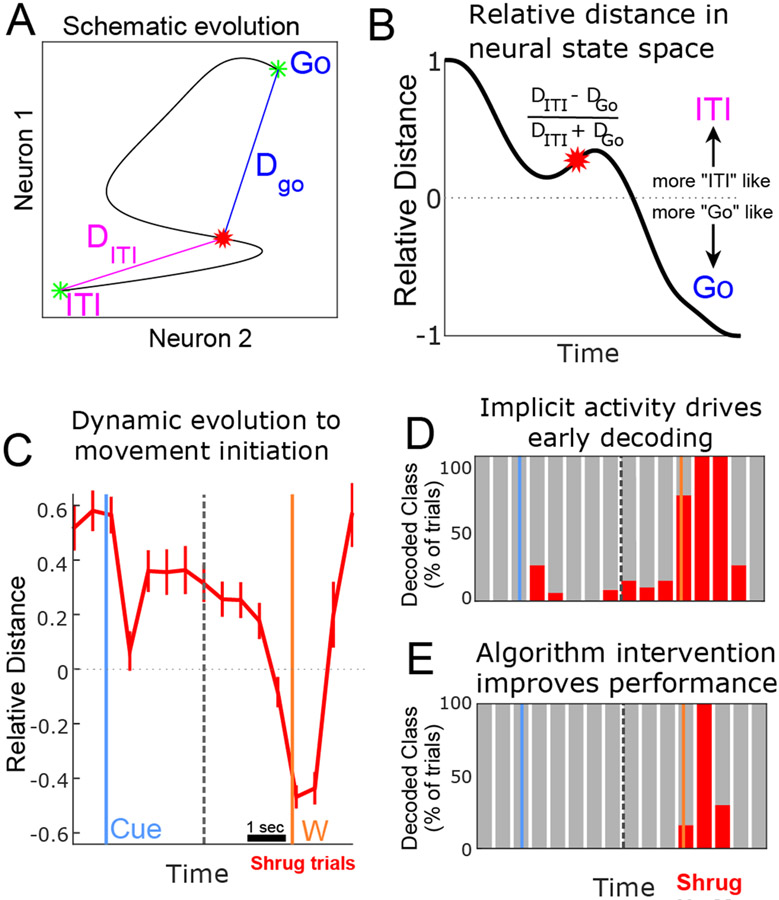
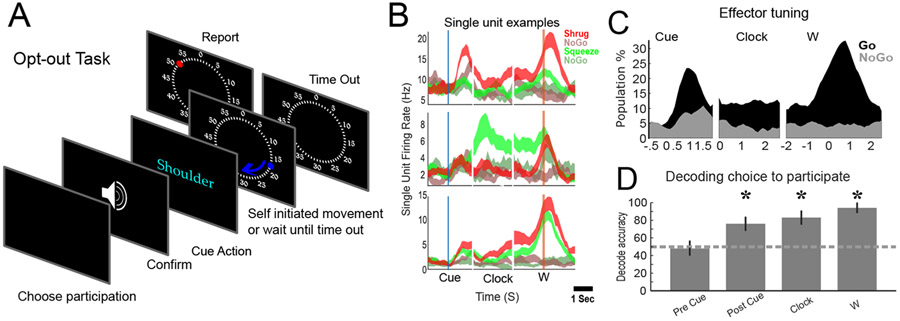
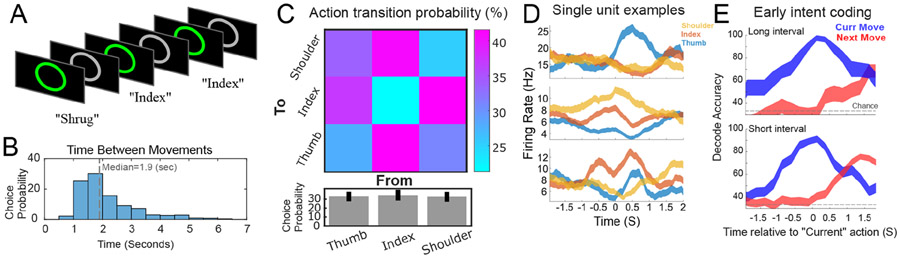
High-level cortical regions encode motor decisions before or even absent awareness, suggesting that neural processes predetermine behavior before conscious choice. Such early neural encoding challenges popular conceptions of human agency. It also raises fundamental questions for brain-machine interfaces (BMIs) that traditionally assume that neural activity reflects the user's conscious intentions. Here, we study the timing of human posterior parietal cortex single-neuron activity recorded from implanted microelectrode arrays relative to the explicit urge to initiate movement. Participants were free to choose when to move, whether to move, and what to move, and they retrospectively reported the time they felt the urge to move. We replicate prior studies by showing that posterior parietal cortex (PPC) neural activity sharply rises hundreds of milliseconds before the reported urge. However, we find that this "preconscious" activity is part of a dynamic neural population response that initiates much earlier, when the participant first chooses to perform the task. Together with details of neural timing, our results suggest that PPC encodes an internal model of the motor planning network that transforms high-level task objectives into appropriate motor behavior. These new data challenge traditional interpretations of early neural activity and offer a more holistic perspective on the interplay between choice, behavior, and their neural underpinnings. Our results have important implications for translating BMIs into more complex real-world environments. We find that early neural dynamics are sufficient to drive BMI movements before the participant intends to initiate movement. Appropriate algorithms ensure that BMI movements align with the subject's awareness of choice.
高级皮层区域在意识出现之前甚至没有意识的情况下就对运动决策进行编码,这表明神经过程在有意识的选择之前就预先决定了行为。这种早期的神经编码挑战了人类能动性的流行观念。它也为脑机接口(BMI)提出了基本问题,传统上认为神经活动反映了用户的有意识意图。在这里,我们研究了从植入的微电极阵列记录的人类顶后皮质单个神经元活动相对于明确启动运动的冲动的时间。参与者可以自由选择何时移动、是否移动以及移动什么,并回顾性地报告他们感到有冲动移动的时间。我们通过显示顶后皮质(PPC)神经活动在报告的冲动前数百毫秒急剧上升来复制先前的研究。然而,我们发现这种“前意识”活动是引发更早开始的动态神经群体反应的一部分,当时参与者第一次选择执行任务。结合神经时间的细节,我们的结果表明,PPC 编码了运动规划网络的内部模型,该模型将高级任务目标转化为适当的运动行为。这些新数据挑战了早期神经活动的传统解释,并为选择、行为及其神经基础之间的相互作用提供了更全面的视角。我们的结果对将 BMI 转化为更复杂的现实环境具有重要意义。我们发现,早期的神经动力学足以在参与者打算开始运动之前驱动 BMI 运动。适当的算法确保 BMI 运动与主体对选择的意识保持一致。