Ruran Hana B, Tourigny Lily, Thorne Peter S, Metwali Nervana
Hopkinton High School, Hopkinton.
University of Iowa, Department of Occupational and Environmental Health, Iowa City.
J Allergy Clin Immunol Glob. 2023 Feb;2(1):79-83. doi: 10.1016/j.jacig.2022.10.002. Epub 2022 Nov 21.
Eight-four percent of people own smartphones and view them 14 billion times daily, making them potential vectors for environmental hazards such as allergens, -D-glucans (BDGs), and endotoxin. Whether these toxins are prevalent and the effectiveness of cleaning solutions targeting these agents on smartphones have not been studied.
We sought to determine (1) whether phones are reservoirs of allergen, endotoxin, and BDGs and (2) if present, whether their levels can be effectively reduced by using specific cleaning methods.
Electrostatic wipes used to wipe the phones of 15 volunteers were tested to determine their allergen, BDG, and endotoxin levels. Cleaning interventions were done on simulated phone models; 70% isopropyl alcohol, 0.184% benzyl and ethyl benzyl ammonium chloride (Clorox nonbleach [The Chlorox Company, Oakland, Calif]), 0.12% chlorhexidine, 0.05% cetylpyridinium, 3% benzyl benzoate, and 3% tannic acid wipes were used and compared with wipes with no solution (the control).
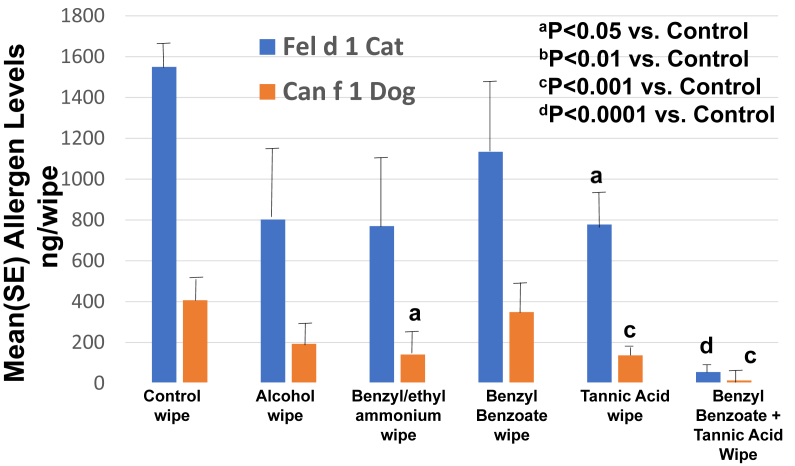
The smartphones showed high and variable levels of BDG and endotoxin. Cat and dog allergens were found mostly on the smartphones of pet owners. The combination of chlorhexidine and cetylpyridinium significantly reduced BDG levels (mean 269 ng/wipe vs 1930 ng/wipe for the control [ < .05]) and endotoxin, (mean 349 vs 1320 endotoxin units/wipe for the control [ < .05]). The combination of benzyl benzoate and tannic acid significantly reduced the levels of cat and dog allergens (dog, mean level of 14 ng/wipe versus 407 ng/wipe for the control [ < .001]; cat, mean level of 55 ng/wipe versus 1550 ng/wipe for the control [ < .001]). The combination mixture solutions had the greatest reductions compared with the control.
There are elevated levels of BDG, allergens, and endotoxin on smartphones. The combination of chlorhexidine and cetylpyridinium was the most effective in reducing BDG and endotoxin levels, and the combination of benzyl benzoate and tannic acid was most effective in reducing cat and dog allergen levels on smartphones.
84%的人拥有智能手机,且每天查看次数达140亿次,这使智能手机成为环境危害(如过敏原、β-葡聚糖(BDG)和内毒素)的潜在传播媒介。这些毒素是否普遍存在以及针对这些物质的清洁溶液对智能手机的清洁效果尚未得到研究。
我们试图确定(1)手机是否为过敏原、内毒素和BDG的储存源,以及(2)如果存在这些物质,使用特定清洁方法能否有效降低其水平。
对用于擦拭15名志愿者手机的静电擦拭布进行测试,以确定其过敏原、BDG和内毒素水平。在模拟手机模型上进行清洁干预;使用70%异丙醇、0.184%苄基和乙基苄基氯化铵(高乐氏非漂白剂[高乐氏公司,加利福尼亚州奥克兰])、0.12%洗必泰、0.05%西吡氯铵、3%苯甲酸苄酯和3%单宁酸擦拭布,并与无溶液擦拭布(对照)进行比较。
智能手机显示出高水平且变化不定的BDG和内毒素。猫和狗过敏原大多在宠物主人的智能手机上被发现。洗必泰和西吡氯铵的组合显著降低了BDG水平(平均每擦拭布269纳克,对照为1930纳克/擦拭布[P<0.05])和内毒素水平(平均每擦拭布349与1320内毒素单位/擦拭布,对照为[P<0.05])。苯甲酸苄酯和单宁酸的组合显著降低了猫和狗过敏原的水平(狗,平均水平为每擦拭布14纳克,对照为407纳克/擦拭布[P<0.001];猫,平均水平为每擦拭布55纳克,对照为1550纳克/擦拭布[P<0.001])。与对照相比,混合溶液组合的降低幅度最大。
智能手机上BDG、过敏原和内毒素水平升高。洗必泰和西吡氯铵的组合在降低BDG和内毒素水平方面最有效,苯甲酸苄酯和单宁酸的组合在降低智能手机上猫和狗过敏原水平方面最有效。