Branger Bernard, Bainier Amaïa, Martin Laureen, Darviot Estelle, Forgeron Aude, Sarthou Laurent, Wagner Anne-Claire, Blanchais Thomas, Brigly Thomas, Troussier Françoise
Department of Pediatrics, Epidemiologist, Nantes, France.
Department of Pediatrics, Centre Hospitalier Universitaire, Angers, France.
Front Pediatr. 2023 Feb 15;10:1053473. doi: 10.3389/fped.2022.1053473. eCollection 2022.
Breastfeeding is a protective factor against respiratory and intestinal infections in developing countries. In developed countries, proof of this protection is more difficult to show. The objective of the study is to compare the proportion of children breastfed during their first year in groups of children with infectious pathologies supposedly prevented by breastfeeding and children free of these infectious pathologies.
Questionnaires about diet, socio-demographic data and the motive for consultation were given to the parents upon arrival in the paediatric emergency departments of 5 hospitals located in Pays de Loire (France) in 2018 and 2019. Children with lower respiratory tract infections, acute gastroenteritis and acute otitis media were included in the case group (A), children admitted for other reasons were included in the same control group (B). Breastfeeding was classified as exclusive or partial.
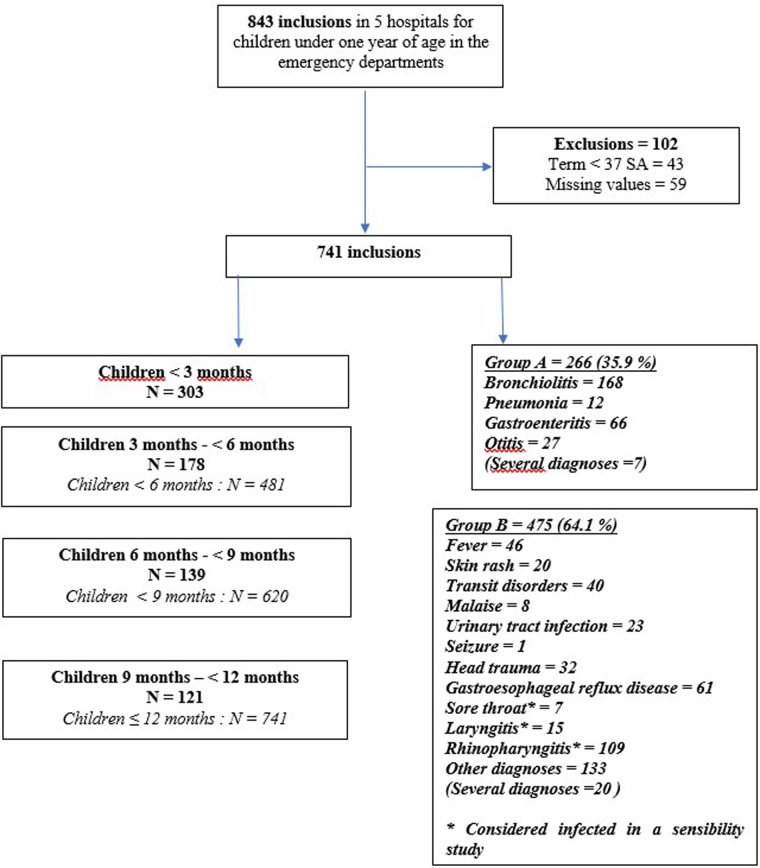
During the study period, 741 infants were included, of which 266 (35.9%) in group A. In this group, children were significantly less likely to have been breastfed at the time of admission than children in group B: for example, for children under 6 months, 23.3% were currently breastfed in group A, vs. 36.6% (weaned BF or formula diet) in group B [OR = 0.53 (0.34-0.82); = 0.004]. Similar results were found at 9 and 12 months. After taking into account the age of the patients, the same results were confirmed with an aOR = 0.60 (0.38-0.94) ( = 0.02) at 6 months, but with when considering six variables six variables, aOR was not significative aOR = 0.65 (0.40-1.05); = 0.08), meaning that factors such as the childcare out of home, socio-professional categories, and the pacifier decrease the protective effect of breastfeeding. Sensitivity analyses (age-matching, analysis by type of infection) showed the same protection effect provided by breastfeeding when it was pursued for at least 6 months and also that the protective effect of breastfeeding is especially true against gastro-enteritis.
Breastfeeding is a protective factor against respiratory, gastrointestinal and ear infections when pursued at least 6 months after birth. Other factors such as collective childcare, pacifiers and low parental professional status can reduce the protective effect of breastfeeding.
在发展中国家,母乳喂养是预防呼吸道和肠道感染的一个保护因素。在发达国家,这种保护作用的证据则较难证明。本研究的目的是比较在那些可能因母乳喂养而预防了感染性疾病的儿童组和未患这些感染性疾病的儿童组中,一岁以内进行母乳喂养的儿童比例。
2018年和2019年,在法国卢瓦尔河地区的5家医院的儿科急诊科,在患儿家长就诊时发放了关于饮食、社会人口统计学数据及就诊原因的问卷。下呼吸道感染、急性肠胃炎和急性中耳炎患儿被纳入病例组(A组),因其他原因入院的患儿被纳入同一对照组(B组)。母乳喂养分为纯母乳喂养或部分母乳喂养。
在研究期间,共纳入741名婴儿,其中A组266名(35.9%)。在该组中,入院时进行母乳喂养的患儿比例显著低于B组患儿:例如,对于6个月以下的儿童,A组中23.3%的患儿目前正在进行母乳喂养,而B组为36.6%(已断奶的母乳喂养或配方奶喂养)[比值比(OR)=0.53(0.34 - 0.82);P = 0.004]。在9个月和12个月时也发现了类似结果。在考虑患儿年龄后,6个月时同样的结果得到证实,校正后的OR(aOR)=0.60(0.38 - 0.94)(P = 0.02),但在考虑六个变量时,aOR无统计学意义(aOR = 0.65(0.40 - 1.05);P = 0.08),这意味着诸如外出托管、社会职业类别和安抚奶嘴等因素会降低母乳喂养的保护作用。敏感性分析(年龄匹配、按感染类型分析)表明,母乳喂养至少6个月时具有同样的保护作用,并且母乳喂养对肠胃炎的保护作用尤为明显。
出生后至少进行6个月的母乳喂养是预防呼吸道、胃肠道和耳部感染的一个保护因素。其他因素,如集体托管、安抚奶嘴和父母较低的职业地位,可能会降低母乳喂养的保护作用。